Vascular Surgeons at UTHealth Houston Publish Groundbreaking Research on TCAR and FB-EVAR
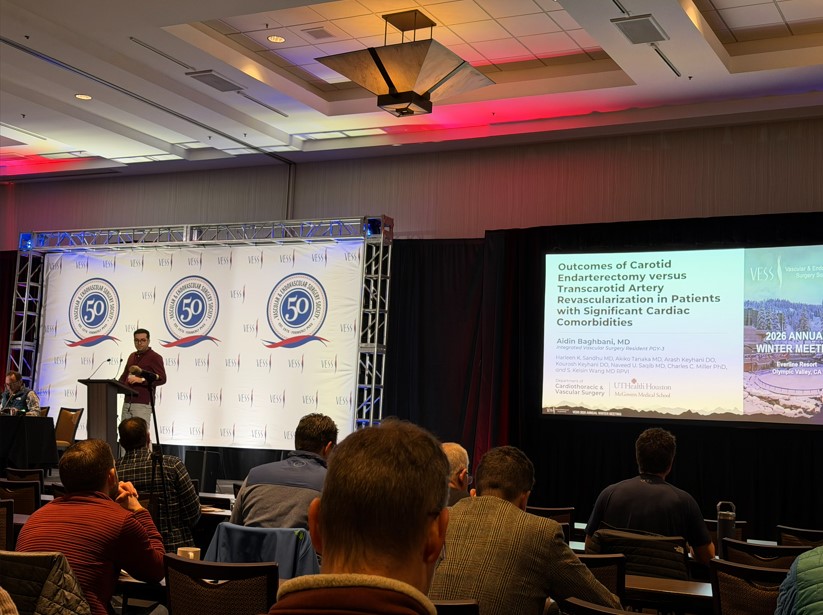
Vascular surgeons at McGovern Medical School at UTHealth Houston are among the first to show that carotid endarterectomy remains possible in cases of restenosis after transcarotid artery revascularization (TCAR). Their case study, published in the Journal of Vascular Surgery: Cases, Innovations and Techniques, highlights successful stent removal in a 67-year-old man with a history of atrial fibrillation, coronary artery disease, Type 2 diabetes, hyperlipidemia, hypertension, and peripheral vascular disease.1
“Although TCAR is less invasive and highly effective for patients with carotid artery stenosis, a small number may develop recurrent blockage or experience a progression of disease,” says Aidin Baghbani, MD, the first author of the study and a third-year vascular surgery resident in the Department of Cardiothoracic and Vascular Surgery at McGovern Medical School. “Few reports describe the removal of a stent placed in the carotid artery, with most focusing on removal after transfemoral carotid stenting,” Baghbani says. “In this case study, we’ve shown that a stent placed during TCAR can be successfully removed using standard surgical techniques more than a year after placement. Our article builds on growing data showing that TCAR is effective, and it also addresses the treatment available in the event of restenosis.”
A minimally invasive hybrid procedure that requires a small incision at the base of the neck and surgical exposure of the carotid artery, TCAR uses a specialized arterial sheath, a venous sheath, and a blood flow controller with a built-in filter. During the procedure, surgeons block the carotid artery near the arterial sheath to create a reversal of blood flow away from the brain to lessen the risk of embolic stroke. The blood is returned via the venous sheath.
“Some patients prefer TCAR because they are high risk or want a smaller incision and quicker recovery,” Baghbani says. “Our results reassure physicians and patients that TCAR doesn’t burn bridges and that surgical repair through carotid endarterectomy remains possible if needed.”
Naveed Saqib, MD, professor in the Department of Cardiothoracic and Vascular Surgery, an author of the article, and one of Baghbani’s mentors, is among the leaders in the changing landscape of carotid interventions in the United States favoring TCAR. He performs more than 40 TCAR procedures annually.
Baghbani presented the research at the 53rd annual Society of Clinical Vascular Surgery symposium held March 28 – April 1 in Chula Vista, California. He also is the first author of a recently published article in the February issue of the Journal of Endovascular Therapy focused on fenestrated-branched endovascular aneurysm repair (FB-EVAR).2
“Some patients worry that a family history of aortic aneurysm may worsen their surgical outcomes in endovascular aortic repair,” Baghbani says. “Few studies examine how inherited risk affects outcomes. Our study showed that patients with a family history of aortic aneurysm or dissection did as well after FB-EVAR as those without a familial link to the condition.”
FB-EVAR involves the use of a stent graft with openings that allow blood to flow through branches of the aorta, feeding vital arteries while surgeons repair the aneurysm.
“This study builds on our earlier work in open aortic surgery and expands it into advanced endovascular techniques,” Baghbani adds. “Our findings challenge the assumption that family history alone should rule out complex endovascular repair and support broader use of FB-EVAR in carefully selected patients.”
1Baghbani A, Podgorsek B, Storch JB, Martin GH, Saquib NU, Miles DG. Carotid endarterectomy remains a feasible bailout for progressive disease after transcarotid artery revascularization: A case report. J Vasc Surg Cases Innov Tech. 2025 Dec 6;12(2):102079. doi: 10.1016/j.jvscit.2025.102079. eCollection 2026 Apr.
2Baghbani A, Savadi S, Sulzer TAL, Tenorio ER, Mesnard T, Vacirca A, Mendes BC, Saqib NU, Maximus S, Huang Y, and Oderich GS. Familial History of Aortic Disease Does Not Affect Outcomes of Fenestrated-Branched Endovascular Aortic Repair in Patients with Complex Aortic Aneurysms. J Endovasc Ther. 2026 Feb 9:15266028261417156. doi: 10.1177/15266028261417156. Online ahead of print.