Saving Frederick Acka: Repair of a Type A aortic dissection with complications
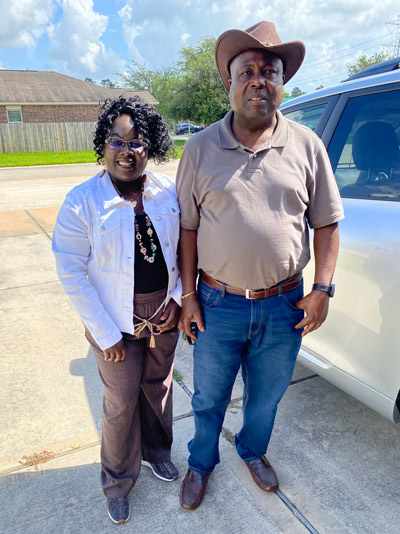
On a Saturday morning in November 2025, Frederick Acka, his wife Clarisse, and their 17-year-old daughter Milka were heading out to do some early Christmas shopping when Frederick, 62, experienced sudden severe pain in his back. “He had complained of back pain before, but on that day, he was close to fainting,” Clarisse said. “I asked him to please lay down, hoping it was simple back pain that would pass, but it didn’t. He was in such terrible pain that I knew something very bad was wrong.”
Clarisse drove her husband to Memorial Hermann Northeast Hospital in Humble, Texas, a six-minute trip from their home. “When we got to the emergency room, they put him in a wheelchair and took him immediately to check his vitals and do some imaging,” she said. “When they got the results, they told us it was an extreme emergency—an aortic dissection—and called for a helicopter to take him downtown.”
Frederick was transferred by Memorial Hermann Life Flight® to Memorial Hermann–Texas Medical Center for evaluation by the aortic team. Rana Afifi, MD, an associate professor of cardiothoracic and vascular surgery at McGovern Medical School at UTHealth Houston who specializes in complex aortic disease and is affiliated with Memorial Hermann, was called to the case. “He came to us with a Type B dissection, a tear in the descending portion of the aorta that moves blood away from the heart to the abdomen,” Dr. Afifi said. “Type B dissections without complications usually can be treated medically using beta-blockers or calcium channel blockers to control blood pressure and heart rate, which reduces stress on the aorta.”
When Frederick’s pain, left leg numbness, and weak pulse failed to improve with medical management, Dr. Afifi took him to the OR for intervention. She began with intravascular ultrasound, which provides real-time, high-resolution images of the arterial walls for accurate assessment of the aorta. “The ultrasound showed us that the dissection had extended proximally into the arch and ascending aorta, changing the diagnosis to a Type A dissection, a more critical condition with a higher risk of life-threatening complications,” Dr. Afifi said. “Type A dissections have a high risk of mortality, especially in the first 48 hours, when the mortality rate increases 1% to 2% per hour, and they require emergent surgical intervention.”
Frederick was prepared for complex aortic surgery. Anthony Estrera, MD, professor and chair of the Department of Cardiothoracic and Vascular Surgery at McGovern Medical School and affiliated with Memorial Hermann, performed an ascending total aortic arch replacement using a frozen elephant trunk hybrid graft, a surgical technique that reconstructs the arch and proximal descending aorta in a single-stage operation, which took six hours. “Dr. Afifi was concerned about the compromised blood flow to Mr. Acka’s left leg,” said Dr. Estrera, who also holds the Hazim J. Safi, MD, Distinguished Chair in Cardiothoracic and Vascular Surgery at the medical school. “But many times when we repair the ascending aorta, blood flow to the legs improves. If it doesn’t, the surgery we performed would give her a good landing zone to work on the distal thoracic and abdominal aorta.”
The team moved Frederick to the ICU, where Dr. Afifi reassessed blood flow to his left leg. When she found that the flow was still reduced, she returned him to the OR for a second surgery that would improve the flow. She and her team performed a left carotid to subclavian artery bypass in the neck to ensure blood flow to his spine and lower the risk of paraplegia, cleared clots from his left arm and leg, and placed a specialized stent graft that extends into the abdominal aorta to reestablish blood flow to his legs. “The stent graft did the job,” she said.
In total, Frederick spent more than 12 hours in the OR. “During both surgeries, the doctors told me in detail what was happening and explained all the medical terms,” said Clarisse, who was by his side during his two-month ICU stay. While there, he was on a ventilator, underwent dialysis for kidney failure, and was monitored for ministrokes. “We thank God that his condition kept getting better over time,” she said.
On Jan. 3, 2026, Frederick was discharged to a long-term care center in Conroe, Texas, where he underwent rehabilitation therapy for the next month. In February, he spent another month in rehab at TIRR Memorial Hermann–The Woodlands. He was discharged to home on March 16, nearly four months after the aortic dissection.
In a follow-up visit at a UTHealth Houston Heart & Vascular Aortic Program Clinic, Frederick complained of shortness of breath while walking. “When I saw him in clinic, I was happy to see how well he was doing,” Dr. Afifi said. “Studies we did after the surgeries showed that his heart function was fine, but sometimes inflammation occurs after these long and involved procedures.”
She ordered an echocardiogram that showed a large collection of fluid surrounding the heart. He was admitted to the hospital for a procedure called pericardiocentesis, in which fluid is drained using a needle. He recovered well, and both surgeons will follow him annually at the Aortic Clinic.
“Frederick is doing fine and regaining his strength,” Clarisse said. “I was scared to death, but he survived it by God’s grace. I learned that a lot of people with dissections die on the way to the hospital. I never imagined that anything like that would happen to Frederick. It was so sudden. Every night when I saw the call from the hospital, my heart jumped. But we were in good hands. We couldn’t have asked for a better team of physicians and under the circumstances, we had the best experience possible.”
Though aortic dissection is rare—occurring in about 3 to 5 out of 100,000 people—Estrera said his team sees many cases because physicians refer to them from around the region.
“Mr. Acka’s case highlights how crucial it is to have an experienced multidisciplinary team that combines diverse expertise,” Estrera said. “A Type A dissection requires quick action and is particularly dangerous because symptoms of heart attack can be similar, including severe chest pain, shortness of breath, and pain that radiates to the back or neck.”
Acka continues physical therapy through home care. “He still has a long way to go, but we hold faith in our hearts and pray. Dr. Afifi, Dr. Estrera, and their entire group worked fast and did a really good job,” Clarisse said. “I’m so grateful every time we see them. I always say ‘thank you, thank you’ for saving my husband’s life.”