Outpatient Robotic-Assisted Anterior Hip Replacement
Outpatient Robotic-Assisted Anterior Hip Replacement: What Patients Should Know
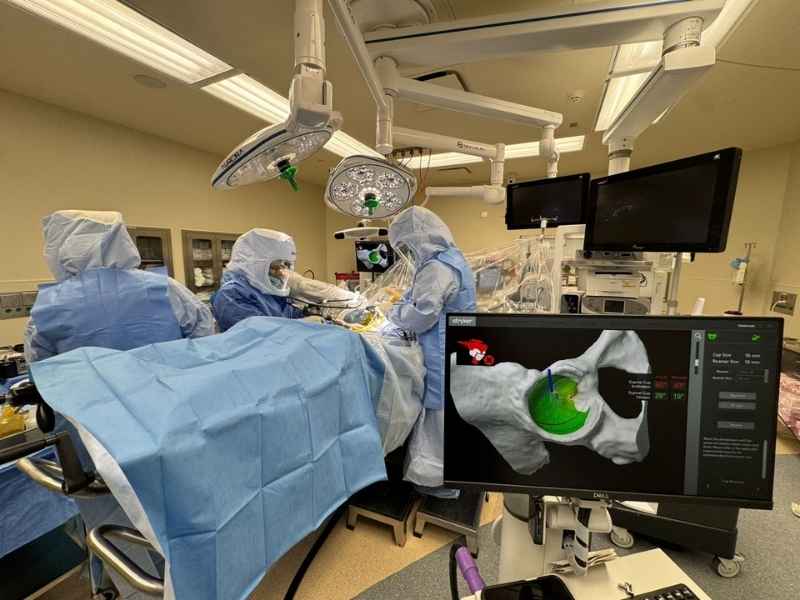
Outpatient robotic-assisted anterior hip replacement surgery.
Hip pain can gradually limit the simplest daily activities — walking, putting on shoes, climbing stairs, or even sleeping comfortably. For many patients with advanced hip arthritis, hip replacement offers a reliable solution to restore mobility and improve quality of life.
Advances in minimally invasive techniques and robotic technology now allow many patients to undergo outpatient robotic-assisted anterior hip replacement, returning home the same day with a faster early recovery.
This article answers common patient questions about candidacy, surgical approach, recovery, and long-term outcomes.
When Is Hip Replacement Necessary?
“Hip replacement becomes necessary when hip pain and stiffness from arthritis, cartilage loss, or injury significantly interfere with daily life and no longer respond to non-surgical treatments,” says David Maldonado, MD, fellowship-trained total joint replacement orthopedic surgeon and assistant professor at UTHealth Houston (external link) and UT Physicians (external link).

David Maldonado, MD, joint replacement orthopedic surgeon.
Conservative treatments typically include:
- Physical therapy
- Anti-inflammatory medications
- Activity modification
- Corticosteroid injections
Patients often report:
- Persistent groin pain
- Difficulty walking or standing for long periods
- Trouble putting on socks and shoes
- Pain that disrupts sleep
- Progressive loss of mobility
When pain becomes persistent and quality of life declines despite appropriate non-operative care, hip replacement can provide reliable pain relief and functional restoration.
Who Is a Candidate for Outpatient Robotic-Assisted Anterior Hip Replacement?
Most healthy, motivated patients with hip arthritis are candidates for outpatient robotic-assisted anterior hip replacement. Dr. Maldonado uses a minimally invasive anterior approach with a “bikini” incision, allowing many patients to go home the same day.
Candidacy depends more on overall health and support systems than age alone.
Important considerations include:
- General medical health
- Bone quality
- Body composition
- Home support after surgery
- Patient engagement in recovery
Each procedure is customized using advanced preoperative planning and robotic technology to match the patient’s unique anatomy.
What Is the Anterior “Bikini” Approach?
The anterior approach enters the hip joint from the front of the body through a natural interval between muscles. Unlike traditional methods, muscles are not detached from the bone.
The “bikini” incision is placed within a natural skin crease, which may provide a more cosmetic scar while maintaining muscle integrity.
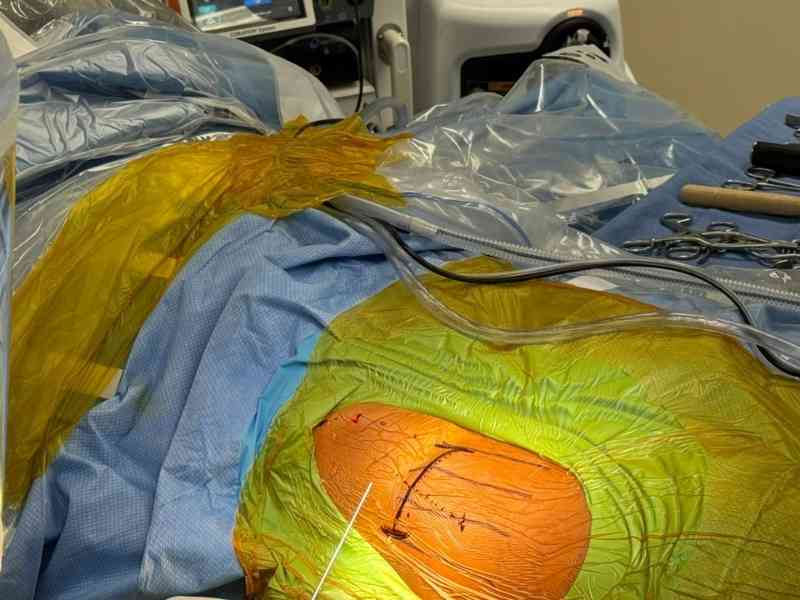
Minimally invasive anterior approach with a “bikini” incision
Potential advantages of the anterior approach include:
- Less muscle disruption
- Faster early recovery
- Improved early stability
- Lower risk of dislocation
- No postoperative movement restrictions
By preserving muscle function, patients often experience greater confidence during early mobilization.
How Does Robotic Assistance Improve Surgical Precision?
Robotic-assisted hip replacement uses advanced imaging and real-time intraoperative guidance to optimize implant positioning.
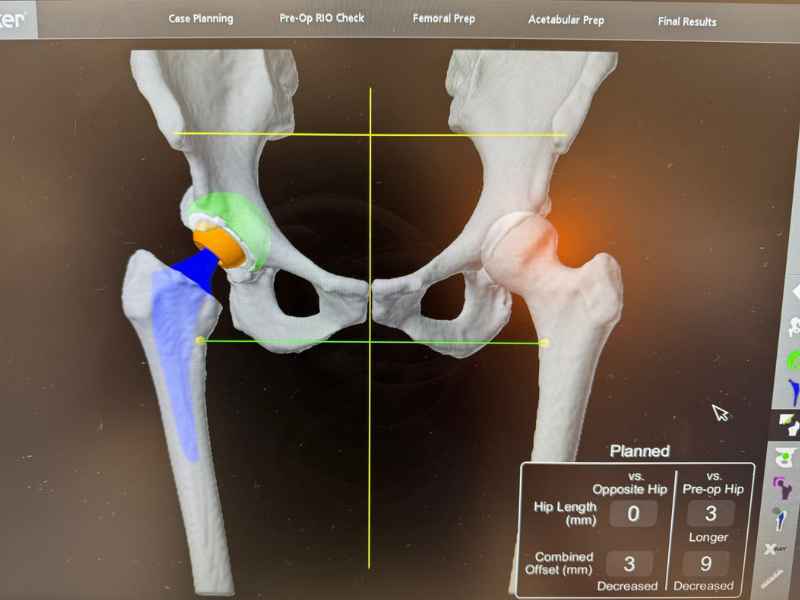
Outpatient robotic-assisted anterior hip replacement advanced imaging.
This technology allows for:
- Precise balancing of leg lengths
- Accurate implant alignment
- Restoration of natural hip biomechanics
- Personalized component positioning based on patient anatomy
Accurate implant positioning is one of the most critical factors in long-term implant durability and stability. Robotic assistance enhances surgical precision, aiming to improve long-term outcomes and reduce complications.
What Can Patients Expect During Recovery?
One of the defining features of outpatient robotic-assisted anterior hip replacement is early mobilization.
Most patients:
- Walk the same day as surgery
- Return home the same day
- Use a walker temporarily
- Transition to a cane within days to weeks
- Resume normal daily activities within few weeks
Pain relief is often noticeable early, particularly arthritic pain. Full recovery continues over several months as strength, endurance, and balance improve.
Physical therapy focuses on:
- Restoring gait mechanics
- Strengthening hip musculature
- Improving flexibility
- Safely returning to recreational activities
How Long Does a Hip Replacement Last?
Modern hip replacements are highly durable. Most newer implants last 20 to 30 years or longer, especially when components are accurately positioned.
Advances in implant materials and robotic-assisted precision contribute to improved longevity. Long-term durability depends on several factors, including patient activity level, bone quality, and implant alignment.
What Happens If a Hip Replacement Wears Out?
Although most hip replacements last for decades, implants can eventually wear out, loosen, or become unstable. When this occurs, a revision hip replacement may be necessary. In revision surgery, part or all of the original components are replaced.
Common reasons for revision include:
- Implant loosening
- Wear over time
- Infection
- Instability or dislocation
- Fracture around the implant
Because long-term outcomes depend heavily on initial implant positioning, careful preoperative planning and robotic-assisted placement during the primary surgery may reduce the likelihood of future revision.
For patients interested in learning more, see our companion article on Revision Hip Replacement: When and Why It’s Needed.
The Takeaway
Outpatient robotic-assisted anterior hip replacement combines:
- Minimally invasive muscle-sparing technique
- Advanced robotic precision
- Same-day discharge
- Durable long-term outcomes
For appropriately selected patients, it offers a modern, patient-centered approach to treating hip arthritis, focused on restoring mobility, reducing pain, and supporting long-term joint health.
If you are experiencing persistent hip pain and would like to learn whether outpatient robotic-assisted anterior hip replacement is right for you, we encourage you to contact Dr. Maldonado’s offices in Bellaire or Memorial Villages to schedule a consultation. A comprehensive evaluation can help determine the most appropriate treatment based on your symptoms, overall health, and personal goals.
To learn more about available surgical options, advanced technology, and our full spectrum of services and providers, visit our Total Joint Replacement page for additional information and patient resources.