AAMC: “Is it Mistreatment?”
AAMC: “Is it Mistreatment? Practices for Productive Teacher-Learner Interactions”
Mistreatment is complicated
- It is personal and involves¹
- It is not limited to negative feedback or
- It can occur unintentionally during
AVOID these unproductive attitudes and strategies
- Offensive/misinterpreted behaviors: Touching, vulgarity, or personal errands
- Overgeneralizations: Concluding that differences in perception mean someone will inevitably be offended, so why attend to words so closely
- Personalization’s: Conveying the sentiment that mistreatment prepared you for life
- Frustrations: Sharing regrets that learners are simply oversensitive to any criticism
- Complaints: Using generational differences or political correctness as a justification for mistreatment
- Ignoring learners/avoiding feedback: Sidestepping difficult feedback conversations, which is unhelpful and often viewed as dismissive3
- Relying too heavily on humor: Joking as a means to build camaraderie, but which may be misinterpreted, may be at another’s or a group’s expense, and may be offensive
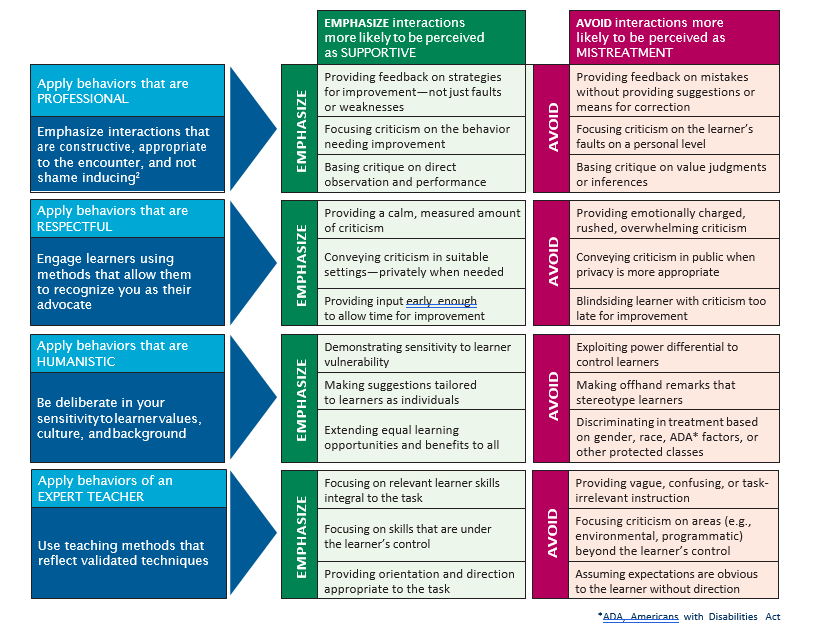
References:
- Gan R, Snell L. When the learning environment is suboptimal: Exploring medical students’ perceptions of “mistreatment.” Acad Med. 2014;89:608–617.
- Bynum WE 4th, Artino AR Jr, Uijtdehaage S, Webb AMB, Varpio L. Sentinel emotional events: The nature, triggers, and effects of shame experiences in medical residents. Acad Med. 2019;94:85–93.
- Buery-Joyner SD, Ryan MS, Santen SA, Borda A, Webb T, Cheifetz Beyond mistreatment: Learner neglect in the clinical teaching environment. Med Teach. 2019;41:949–955.
Author contact: [email protected]
To view full article please click here (external link).