Bringing research closer to patients: Karmouty-Quintana Lab joins Pulmonary Division
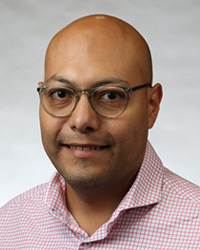
Harry Karmouty-Quintana, PhD, professor and director of the Pulmonary Center of Excellence, moved his laboratory to the Division of Pulmonary, Critical Care, and Sleep Medicine.
For more than 15 years, Harry Karmouty-Quintana, PhD, has dedicated his research career at UTHealth Houston to understanding why lung diseases cause blood vessels and lung tissue to become damaged, scarred, and stiff over time. Now, a recent move is bringing that work closer to the patients it aims to help.
Within the last two months, Karmouty-Quintana, professor and director of the Pulmonary Center of Excellence, relocated his laboratory from the Department of Biochemistry and Molecular Biology to the Division of Pulmonary, Critical Care, and Sleep Medicine.
The move reflects a longstanding goal of connecting laboratory discoveries with patient care.
“Since we were already working so closely with the pulmonary team, it made sense to join the division where we could engage in even more translational research,” Karmouty-Quintana said.
Pulmonary diseases remain a leading cause of disability and death worldwide, yet many conditions still have limited treatment options. Karmouty-Quintana’s laboratory focuses on pulmonary hypertension, idiopathic pulmonary fibrosis, scleroderma-associated lung disease, and lung damage that develops following viral infections.
“For patients with severe fibrosis, lung transplantation can become the only option, and that’s far from an ideal outcome,” he said. “There is still so much we don’t understand about why these diseases develop and progress.”
At the heart of the laboratory’s work is the Lung Tissue Biorepository, which stores lung tissue from discarded donor lungs unsuitable for transplantation as well as explanted lungs from patients receiving transplants for end-stage pulmonary diseases.
“The biobank serves as a platform for discovery science,” Karmouty-Quintana said. “We’re able to identify molecular pathways involved in disease and determine whether they can be targeted therapeutically.”
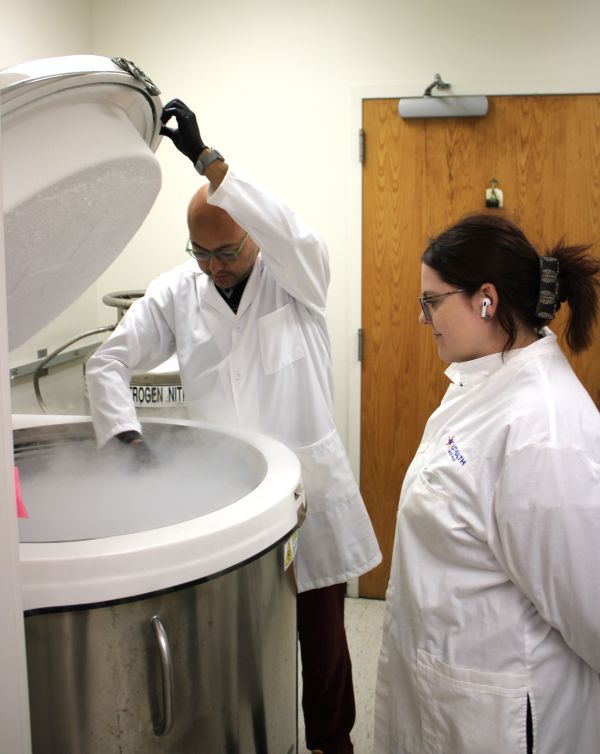
Karmouty-Quintana and Hannah P. Thompson, MD, PhD student, look for tissue samples in the lab’s liquid nitrogen storage.
The laboratory’s new first-floor space houses the biobank as well as facilities for RNA and cellular analysis, protein studies, immunohistochemistry, and pulmonary function testing.
The team works closely with the Memorial Hermann-Texas Medical Center transplant team, which includes Manish Patel, MD and Rahat Hussain, MD, with the UTHealth Houston Center for Advanced Cardiopulmonary Therapies and Transplantation, to obtain tissue samples and investigate the molecular changes taking place within the lungs.
The move places the laboratory alongside clinicians who diagnose and treat patients every day, creating new opportunities for collaboration.
“Previously, we were working mostly with end-stage disease,” said Scott D. Collum, program and laboratory manager. “Now we are hoping to work more closely with physicians who see patients earlier, so we can better understand how these diseases evolve over time.”
The closer connection to clinicians is also expected to accelerate ongoing research projects. Supported by grants from the National Institutes of Health and other agencies, the laboratory is investigating how protein production becomes dysregulated in scleroderma-associated lung fibrosis and studying previously understudied genes that may contribute to pulmonary vascular disease. Researchers are also exploring abnormalities in RNA processing that may help explain why some cardiovascular adaptations progress to heart failure while others do not.
In addition to advancing discovery, the laboratory trains the next generation of physician-scientists and researchers, including students, trainees, and visiting scholars from around the world.
With the laboratory now embedded in the Division of Pulmonary, Critical Care, and Sleep Medicine, Karmouty-Quintana believes the path from scientific discovery to patient impact will become even shorter.