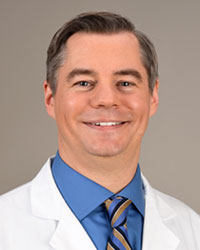
Nils P. Johnson, MD, MS
- Professor, Cardiovascular Medicine
- Weatherhead Distinguished Chair of Heart Disease
- General Cardiology
- Interventional Cardiology
Biography
Dr. Nils Johnson grew up equally in Edmonton, Houston, and Tulsa (his father was in the oil industry), becoming an Eagle Scout and violin member of the all-state orchestra in high school before spending an exchange year in Witzenhausen, Germany. He completed his undergraduate degree in physics and computing at the University of British Columbia in Vancouver; medical school at Columbia University in Manhattan; and internal medicine residency, cardiology fellowship, and interventional cardiology fellowship at Northwestern University in Chicago, where he also earned a Master of Science degree in epidemiology and biostatistics.
Dr. Johnson is a tenured Professor of Medicine, holds the Weatherhead Distinguished Chair of Heart Disease, and was honored by the Catherine S. Tsai, MD Endowment. His research with mentor Dr. K. Lance Gould started in 1999 and focuses on clinical coronary physiology, from non-invasive perfusion imaging to intracoronary hemodynamics. During the 2015-16 academic year, he spent a sabbatical emphasizing invasive coronary physiology with Dr. Nico Pijls at the Catharina Hospital in Eindhoven, the Netherlands. He has lectured in 20 countries across 4 continents and contributed to over 200 publications.
Clinically, Dr. Johnson cares for patients in the cardiac care unit and hospital wards, practices interventional cardiology in the catheterization laboratory, interprets SPECT and PET perfusion images, and sees outpatients in the clinic. His interests span all of cardiology with a special focus on using pressure and flow measurements to clarify the diagnosis and select optimal treatment. He is board-certified by the American Board of Internal Medicine (ABIM) in Cardiovascular Disease and Interventional Cardiology, plus subspecialty credentials in Nuclear Cardiology. Dr. Johnson is a fellow of the American College of Cardiology (FACC), European Society of Cardiology (FESC), and American Society of Nuclear Cardiology (FASNC).
Teaching
- Academy of Master Educators at UTHealth, inducted in June 2024
- Course director for cardiovascular module during first year of medical school
- Cardiology Faculty of the Year Award in 2017/18 and almost annual teaching awards
Research
- Stress aortic valve index (SAVI) for aortic stenosis physiology
- HeartSee software for absolute blood flow quantification using cardiac PET
- Coronary flow capacity (CFC) concept now part of ESC guidelines on lesion assessment
Administrative
- Associate Director, Weatherhead PET Imaging Center
- Director of nuclear cardiology at MHH-TMC
- Medical director of the chest pain center at MHH-TMC
Education
- Medical Degree
- Columbia University College of Physicians and Surgeons
- Residency
- Northwestern University McGaw Medical Center, Chicago, IL
- Fellowship
- Northwestern University McGaw Medical Center, Chicago, IL
- Master Degree
- Epidemiology and Biostatistics, Northwestern University, Chicago, IL
Areas of Interest
Research Interests
Dr. Johnson seeks to improve patient care by applying clinical physiology, both non-invasive perfusion imaging and invasive pressure, and flow measurements
Publications
Board Certifications
- American Board of Internal Medicine – Cardiovascular Disease
- American Board of Internal Medicine – Interventional Cardiology