
Fenestration of an Enlarging Cavum Septum Pellucidum: Hunter Wins a Long Uphill Battle
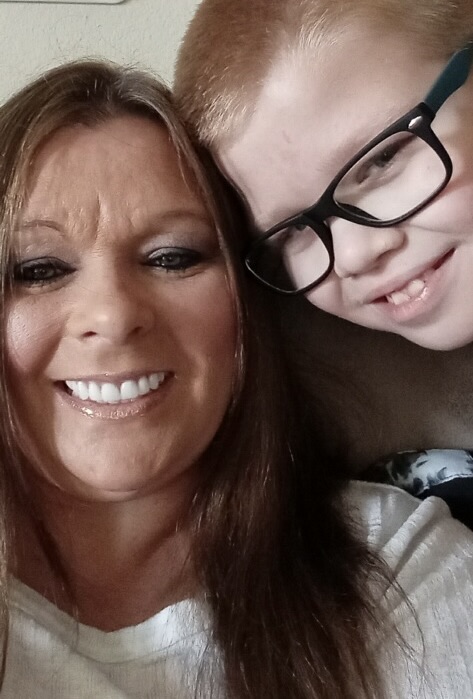 The symptoms first appeared when Hunter Brown, now 12, was 5 years old. “His speech didn’t seem right to me at that age, and his pupils were fully dilating to where you couldn’t even see the color of his eyes,” says Glenda Brown, his mother.
Hunter’s pediatrician referred him to a pediatric neurology practice in nearby Fort Worth, where an MRI led to the discovery of two cysts: a cavum septum pellucidum and a pineal cyst. “The cavum was getting bigger, but after a while they said they didn’t need to follow it any longer. I didn’t agree, so I took him to a neurologist in Dallas,” Brown says. “The cyst was growing by millimeters, and the doctors there agreed to watch it.”
Hunter began complaining of pressure in his head and was unable to focus on his schoolwork. “One day, he was doing some math and said, ‘Mama, that three looks upside down.’ I thought he was just tired and told him to get off the schoolwork,” Brown says. “Two weeks later, he told me other objects in the house were upside down. Later, he had an 11-hour episode where he saw everything upside down, which really frightened us. He would wake up with light streaming into the house and scream that he couldn’t see. Other times he would be talking to my husband and just forget what he was saying.”
As the cyst grew, he developed behavioral issues. “A couple of times he dug his fingernails into my hand and told me I was ruining his day,” she recalls. “When he did it, his pupils were fully dilated, and his right eyelid was drooping.”
Brown took her son back and forth to his doctors for 6 ½ years looking for answers and treatment. During that time, she also consulted ophthalmologists and neurosurgeons.
“I went back in tears to his pediatrician, who asked how I felt about going to Houston,” she says. “I said I’m willing to do whatever I need to do for him.”
The pediatrician referred them to fellowship-trained pediatric neurosurgeon Jeffrey Treiber, MD, an assistant professor in the Department of Pediatric Neurosurgery at McGovern Medical School at UTHealth Houston, who first saw them in a video visit. Treiber and his team members agreed with Brown that the cavum septum pellucidum could be the cause of Hunter’s neurological symptoms.
“Cavum septum pellucidums are nearly always asymptomatic and rarely enlarge, but after reviewing Hunter’s MRI results over more than six years, we believed there was a real possibility that the enlarging cavum was contributing to his worsening symptoms,” he says. “None of his symptoms — head pressure, speech problems, behavior issues, intermittent pupillary dilation, and eyelid drooping — could be definitively explained by the cyst, but Mrs. Brown had exhausted all diagnostic options, and we felt there was a connection. The surgery has a fairly low complication rate, and I believed I could operate with minimal risk.”
“Although I’d been looking so long for a solution, the thought of Hunter undergoing brain surgery really scared me,” says Brown, who sought a second opinion. “Another agreed with Dr. Treiber’s treatment plan and thought he was in good hands. I talked with Hunter and with my husband, and we all felt the potential benefits outweighed the risks.”
Treiber took Hunter to the OR in November 2025 and performed an endoscopic fenestration of the cavum septum pellucidum, which had grown to 6 centimeters by 3.5 centimeters, about the size of an egg. “Mrs. Hunter clearly loves her son and has been advocating for him for years with the hope of giving him as normal a life as possible,” he says. “I explained that the surgery might not resolve all his symptoms, but we felt positive enough to try.”
Hunter came out of anesthesia with tears in his eyes. “When I asked him if he was okay, he said, ‘Mama, I don’t have any more head pressure,” Brown recalls.
“His speech is better, and the eyelid drooping and the upside-down vision are gone,” she says. “The abnormal behavior is gone, and his focus is better. We’re still working on his speech, and that will improve. I shed a lot of tears, but I never gave up hope. If we hadn’t found Dr. Treiber, I honestly don’t know what I would have done. He is the kindest, most compassionate doctor we have.
“I’m still concerned about the pineal cyst, but Dr. Treiber will continue as his neurosurgeon and follow it,” she adds. “It was heartbreaking for so many years, watching Hunter struggle. I can’t express how grateful I am.”