

Diagnosis and Treatment of Cushing’s Disease Caused by a Pituitary Adenoma
Xavier Alejandro Pech, 49, suddenly began suffering severe bone and joint pain and dizziness. Prior to the onset of these symptoms, he endured others that came and went over a period of three years: difficulty swallowing, allergies, fatigue, muscle stiffness, muscle weakness, and weight gain that fluctuated between 270 and 308 pounds.
“It was very frustrating and painful, and I felt hopeless,” Pech says. “If the weather was cold, it was unbearable, and I spent most of my days in bed. I had to be transported in a wheelchair and was unable to perform the most basic activities of daily life. I was taking so many medications for pain and my other symptoms that I was afraid my liver would be damaged.”
Pech had seen a rheumatologist and a cardiologist without finding relief. Then his family physician referred him to Lavanya Sendos, MD, associate professor of internal medicine in the Division of Endocrinology, Diabetes, and Metabolism at McGovern Medical School at UTHealth Houston. Sendos saw him at UT Physicians Multispecialty – Bellaire Station.
“He was known to have an adrenal adenoma and came to me because imaging had shown an increase in the size of the nodule,” Sendos says. “His muscle weakness and weight gain pointed to high cortisol levels and are conditions concerning for Cushing’s disease. He also had an abnormal 2-milligram dexamethasone suppression test, a strong indicator for Cushing’s. I ordered an adrenocorticotropic blood test, and when I reviewed his lab studies, I found that the numbers pointed to the pituitary gland, rather than the adrenals.”
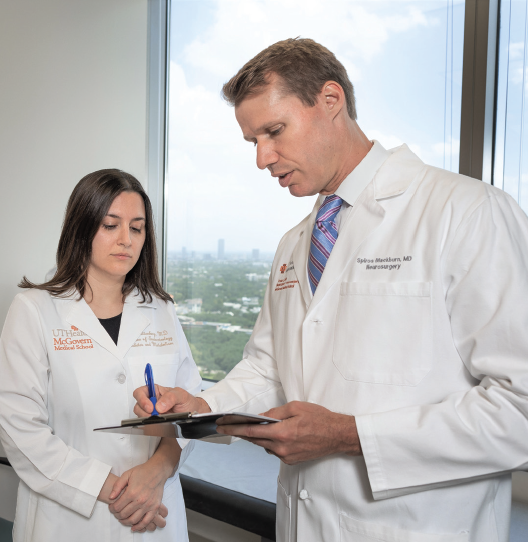
Sendos referred Pech to Spiros Blackburn, MD, professor and director of the Pituitary Tumor Clinic in the Vivian L. Smith Department of Neurosurgery at McGovern Medical School, for evaluation for a pituitary tumor that might be the cause of his Cushing’s disease. Blackburn ordered a pituitary protocol MRI that showed what appeared to be a small pituitary adenoma. “The tumor was difficult to see on MRI, which concerned me that it would be hard to locate and remove during surgery,” he says.
Sendos presented Pech’s case at the medical school’s pituitary conference, led monthly by Katie Guttenberg, MD, associate professor of internal medicine in the Division of Endocrinology, Diabetes, and Metabolism, with specialists attending from neurosurgery, endocrinology, neuroradiology, and neuropathology. Both Sendos and Guttenberg work closely with Blackburn on pituitary cases. “We review surgical cases from the previous month and discuss upcoming cases with clinical questions,” she says. “In Mr. Pech’s case, we recommended IPSS.”
Inferior petrosal sinus sampling is an infrequently used method of confirming the presence of a hormonally active pituitary adenoma when imaging alone has been insufficient. The technique can confirm that excess adrenocorticotropic hormone is being produced by the pituitary and can also help determine the exact location of the tumor.
Blackburn performed the IPSS endovascularly under anesthesia, inserting catheters through the femoral arteries into both petrosal sinuses. “Then we measure the levels of ACTH on both sides,” he says. “If the level is higher on the right, the tumor is probably on the right. We confirmed that the tumor was on the right side of the sella turcica, which was consistent with our MRI results. So, in this case, the IPSS was a good confirmatory test.”
Pech says he was hopeful that he would find relief. “Finally, someone had found the cause of my pain and the decline in my health,” he says.
Blackburn took Pech to the OR in August 2022 and resected a 5-millimeter tumor through a small incision on the pituitary gland using an endoscopic transsphenoidal approach performed through the nose with William C. Yao, MD, associate professor of otorhinolaryngology at McGovern Medical School. The two surgeons have worked together since 2015.
“The vast majority of patients leave the hospital two days after surgery and do quite well,” Guttenberg says. “For patients with Cushing’s disease, follow-up treatment is a little more complicated because they tend to have low cortisol after removal of the tumor.”
Sendos, who is seeing Pech in follow-up, prescribed hydrocortisone. “In patients with Cushing’s disease, the adrenal glands are suppressed and tend to recover slowly after tumor removal,” she says. “It generally takes about a year for patients to start producing enough cortisol to stop taking the hydrocortisone, but we’re slowly tapering it down. Recently, his wife noticed that he has been more active and that his sensitivity to cold has improved tremendously. He continues to improve daily.”
Although total recovery is a process, Pech says he’s finally found relief. “Dr. Sendos was wonderful. She was very thorough, and I thank her for taking over management of my medical care and for finding a solution,” he says. “I’m also thankful to Dr. Blackburn for his excellent care and how both of them continue to manage my health and address any concerns I have.”
Blackburn and Guttenberg share a clinical space in Suite 2800 at 6400 Fannin St. in the Texas Medical Center, where they see patients in one visit. “We average about two pituitary surgeries per week,” Guttenberg says. “I see the majority of pituitary patients for preoperative evaluation, Dr. Blackburn performs the surgery, the inpatient endocrine service sees all patients while they’re hospitalized to screen for hormone problems after surgery, and then we follow up with them after discharge to check their hormone levels.”
UTHealth Houston Neurosciences is designated a Multidisciplinary Team of Distinction by the North American Skull Base Society. To refer a patient for evaluation, call (713) 486-8000.