Clinical Magnetoencephalography (MEG) Fellowship
Available positions for 2026 and beyond
The Clinical MEG Fellowship is offered through both the Department of Pediatrics and the Department of Neurology at McGovern Medical School at UTHealth Houston.
Available in FAQ format if helpful.
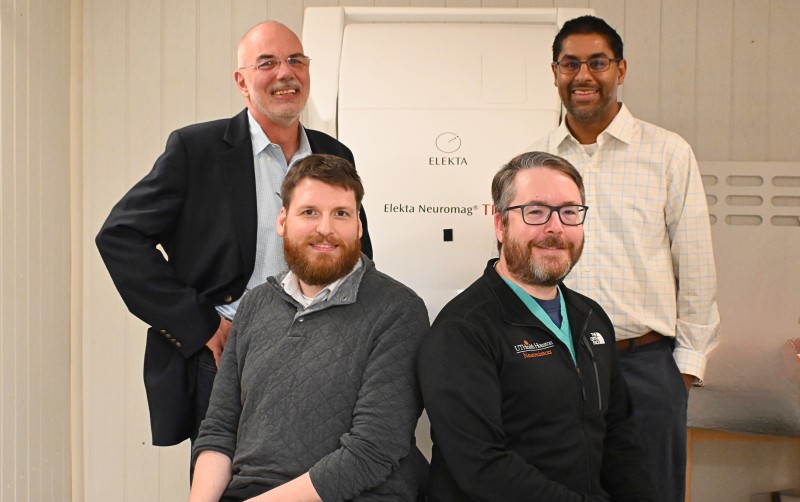
L-R: MEG Fellowship Program Director Michael Funke, MD, PhD; MEG Fellow Aaron Pope, MD; Assistant Professor Michael Watkins, MD; and Associate Professor of Neurology Jay Gavvala, MD, MSCI
Program Overview
Clinical MEG is a subspecialty area of neurology defined by special competence in the interpretation of MEG and simultaneously performed EEG as part of the presurgical work-up for epilepsy.
Since being established in 2014, this program remains the only ACGME recognized training program for MEG (J-1 visas sponsored) which now includes optional scholarly concentrations in neuromodulation and intracranial EEG that can be added to the standard MEG curriculum for interested applicants.
This is a 12-month fellowship open to neurologists and child neurologists (trained in the US, Canada, or internationally with ECFMG certification) with prior EEG knowledge. A prior fellowship in epilepsy or clinical neurophysiology is desirable but not required. Off-cycle applicants are welcome.
The fellowship’s goal is to train clinical Magnetoencephalographers to support the noninvasive evaluation and surgical management of drug-resistant epilepsy in epilepsy centers as well as operable lesions within neurosurgical programs.
Curriculum and Experience
Core MEG training
- Learn end‑to‑end MEG workflow: study design, acquisition, artifact handling, source localization, and clinical reporting
- Broad exposure to pediatric and adult studies
- Localization of interictal discharges and seizure onsets, functional mapping (sensory/motor/visual/auditory/language)
- Integration of functional MEG data with MRI/DTI, PET/SPECT, and intracranial recordings utilizing 3-dimensional imaging techniques
- Active participation in epilepsy case management and SEEG/subdural implantation conferences
- Lead weekly MEG review conferences, MEG teaching and journal club sessions
- Opportunities for mentored scholarly or research projects
- Privilege to attend the annual ACMEGS Course and Meeting (funded)
Optional neuromodulation scholarly concentration
- Neuromodulation clinic longitudinal training experience
- Evaluate neuromodulation data and lead neuromodulation patient review/discussions
- Complete a curated reading list of landmark neuromodulation trials and key publications
- Complete a neuromodulation research project
- Opportunity to participate in one of the annual neuromodulation workshops
Optional intracranial EEG scholarly concentration
- Opportunities to interpret intracranial EEG studies and participate in cortical mapping
- Plan SEEG trajectories for cases discussed in patient management conference
- Complete a curated reading list of key publications on the topic of intracranial EEG
- Complete an intracranial EEG research project
- Opportunity to attend one of the annual SEEG courses
Key Features and Training Highlights
- State-of-the-art MEG system and real-time movement compensation, enabling advanced MEG data acquisition and analysis
- Dedicated exposure to pediatric and adult epilepsy surgery programs, including high-volume intracranial EEG, stereo-EEG (SEEG), and MR-guided laser interstitial thermal therapy (LITT)
- Multidisciplinary team environment including neurology, neurosurgery, neuropsychology, radiology, and neuro-engineering — ideal for translational MEG-neuroimaging research
- Hands-on skill development: MEG preprocessing, artifact rejection, beamforming/source modeling (MNE, minimum-norm), MRI–MEG coregistration, sensor- and source-space analysis workflows
- Mentorship by fellowship-trained attendings, weekly MEG review meeting, weekly case conferences, and supervised interpretation of MEG and intracranial EEG in clinical settings
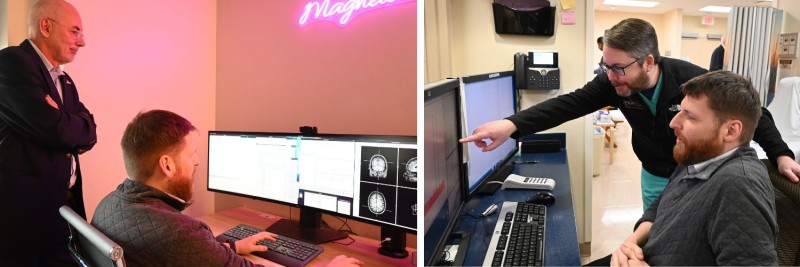
The highly customizable MEG Fellowship Program offers instruction from accessible, approachable faculty who are truly invested in their fellow’s success.
Clinical and Research Competencies
By the end of the fellowship, trainees will be proficient in:
- Clinical MEG acquisition and interpretation for epilepsy localization and functional brain mapping
- Pediatric MEG protocols and developmental neuroimaging
- Time-frequency and spectral analysis of MEG data
- MEG source localization and beamforming
- Workflow design for MEG studies
- Intracranial EEG (ECoG/subdural grids) and stereo-EEG (SEEG) in a surgical epilepsy context
- Collaborative neurophysiology research projects in cognitive neuroscience, connectivity, and outcome prediction
Schedule, Duration, and Structure
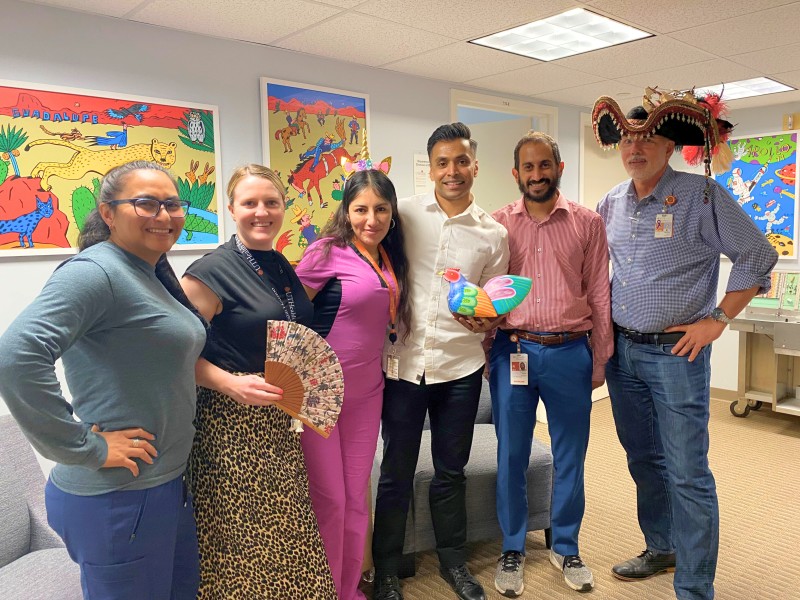
The ceremonial “passing of the chicken” has become a program tradition, marking the completion of one fellowship and the start of a new journey. (Silly hats and fans optional but recommended.)
- One-year fellowship, starting July 1
- Standard working days are Monday to Friday, weekends as required based on clinical volume
- Position does not require call, clinic, or hospital service
- Combines clinical rotations in MEG and epilepsy surgery, didactic teaching, and hands-on data analysis workshops
- Weekly multidisciplinary conferences and research/education seminars
Application Process
Applicants must have completed a neurology or child neurology residency accredited in the United States or Canada. Although prior epilepsy fellowship training is highly preferred, strong candidates with a keen interest in MEG/neuroimaging will be considered.
To apply:
- Email personal statement and CV to Fellowship Director Michael Funke, MD, PhD.
- Have two references mail letters of recommendation directly.
- On-site interview for shortlisted candidates
Back to Pediatric Neurology Fellowships
Program Director
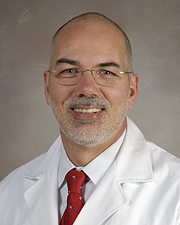 Michael Funke, MD, PhD
Medical Director of Magnetic Source Imaging