Champions of Clinical Learning Environment: Hasan and Bhandari
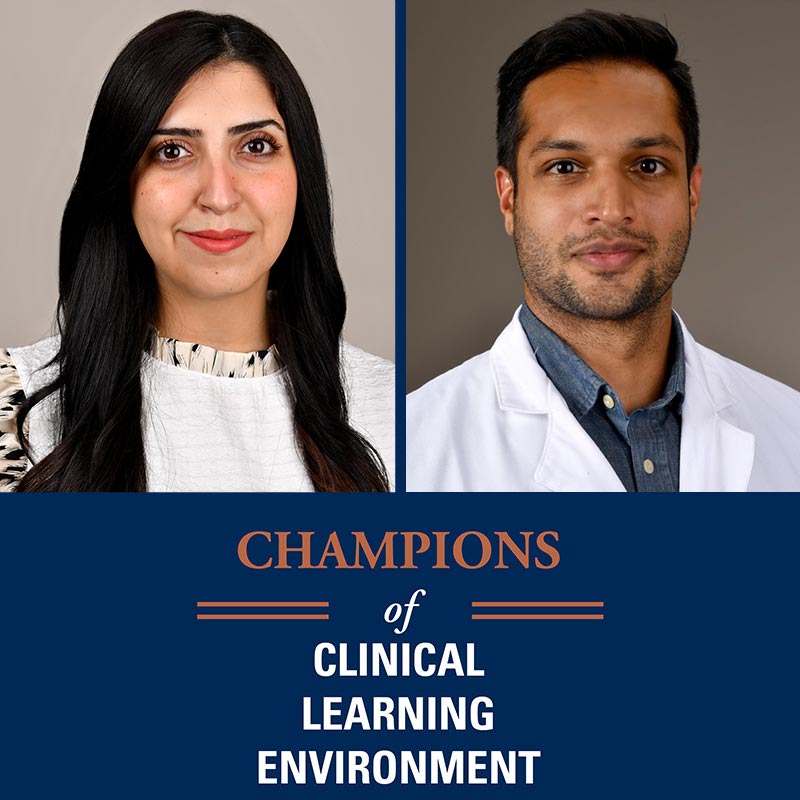
The Office of Professionalism at McGovern Medical School at UTHealth Houston congratulates Ansam Hasan, MD, and Karthik Bhandari, MD, on being honored as Champions of the Clinical Learning Environment.
Champions are identified through the Learning Environment Surveys, which are sent to students and provide an opportunity to recognize faculty members whose everyday actions have meaningfully shaped their clinical education.
This series spotlights Champions of the Clinical Learning Environment. Each issue highlights educators who have made a lasting impression on third-year medical students during clerkship rotations by fostering clinical learning environments rooted in professionalism, compassion, and academic rigor.
Ansam Hasan, MD
Assistant professor in the Department of Pediatrics
How would you describe your teaching philosophy?
My teaching philosophy centers on building structured, evidence-based, and supportive learning environments where learners can develop confidence and mastery. I believe in combining clear expectations with individualized feedback and data-driven remediation plans to help every learner reach their potential.
What do you enjoy most about working with medical students during their training?
One of my most effective practices has been integrating board-style clinical reasoning into daily teaching. By framing patient care discussions through the lens of board exam principles, residents and learners learn to connect foundational knowledge with bedside decision-making, improving both clinical care and exam performance.
What is a memorable moment or teaching success story from working with third-year medical students?
Teaching has refined my own clinical thinking and deepened my commitment to continuous learning. Designing and leading the Pediatric Board Review Course has shown me the power of structure and mentorship in transforming confidence into competence, not just for trainees, but also for faculty educators.
Karthik Bhandari, MD
Assistant professor in the Department of Internal Medicine
How would you describe your teaching philosophy?
My teaching philosophy is centered on process over fact. After a personal cognitive shift, I realized that true durability in medical practice comes not from memorizing endpoints, but from mastering the pathway to the answer. As an educator, my primary goal is to act as a guide, employing guided inquiry to help learners construct their own internal framework for clinical reasoning. If they can internalize this process, they will develop the adaptability needed to navigate any unfamiliar clinical territory.
What do you enjoy most about working with medical students during their training?
I often employ a practice I call “decision flipping” to build clinical autonomy and active decision-making in my learners. Instead of having them present the case and then look to me for the final treatment plan, I flip the script: I preemptively provide them with the context, alongside the risks and benefits of a particular management choice, and then instruct them that we will proceed with the decision they make (usually giving them 24 hours to research and reflect), regardless of whether it is the correct choice.
This empowers them to take full ownership and feel responsible for their choice, moving them from passive note-takers to active clinical leaders. The results are consistently excellent; learners become highly invested in the process, and the vast majority of the time, they arrive at the same management plan I would have chosen.
What is a memorable moment or teaching success story from working with third-year medical students?
What I enjoy most is witnessing their professional identity formation as they navigate critical transition spaces—those high-stakes points where roles and responsibilities change dramatically. These are the pivotal moments when a learner moves from passive book knowledge to active clinical reasoning, when a medical student becomes a resident physician, and when a trainee evolves into a confident practitioner. These paradigm shifts are often extremely challenging, but it is incredibly rewarding to guide and witness the significant, accelerated growth that accompanies them.