
A Second Chance for a 6-Year-Old With a Brainstem Cavernoma
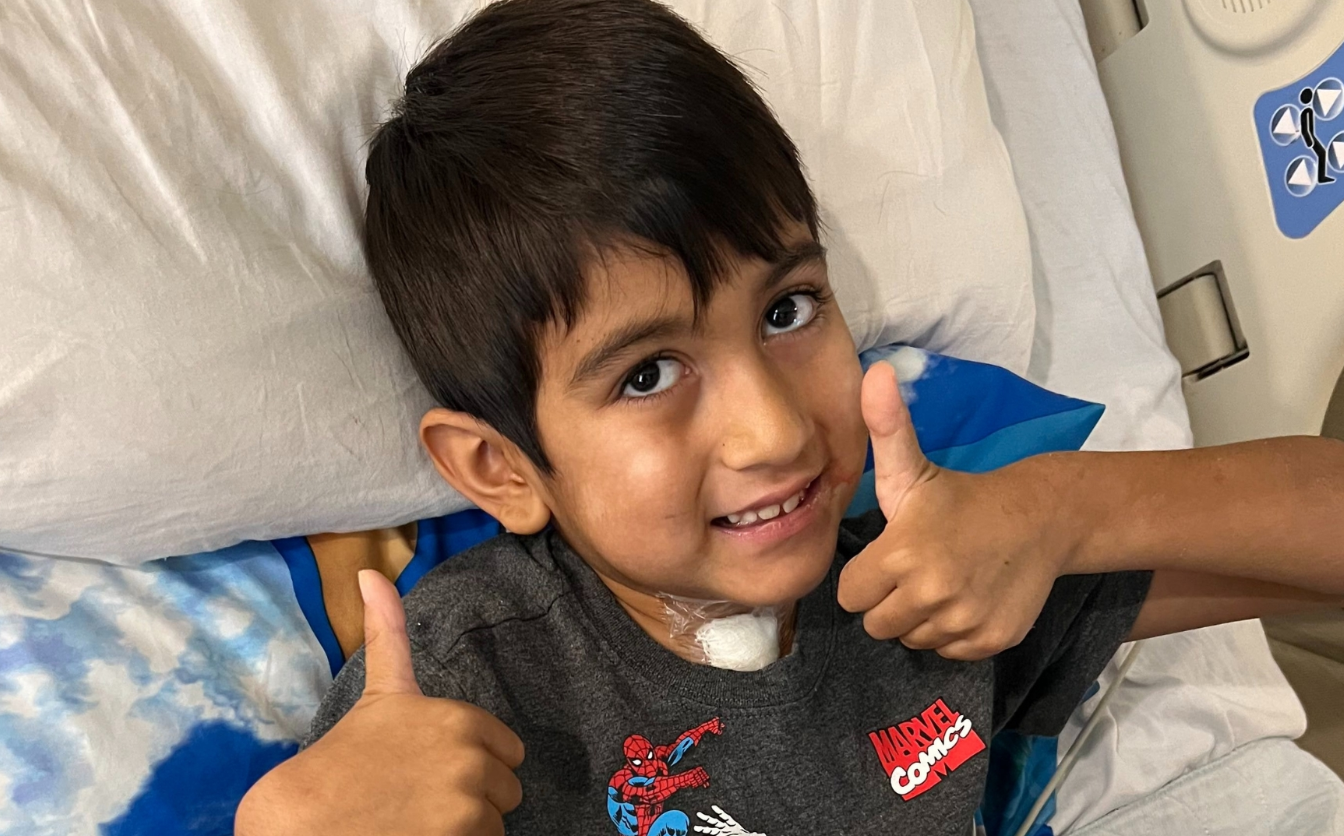
Witten Shane Daniel of Lubbock, Texas, fell seriously ill with the flu in April. When his eyes started twitching and he felt dizzy, his mother, Casey Daniel, thought a prolonged fever might be the cause. But when Witten’s symptoms worsened instead of improving, she and her son embarked on a months-long journey that would lead them to the other side of the state.
“At the time, I had no idea how serious the situation was,” Daniel says. “It’s hard to imagine now that I could have lost my little boy.”
A single mom, Daniel rushed Witten to a Lubbock emergency center where he underwent tests. The medical team suspected a tumor, but further tests revealed a tangled mass of abnormal blood vessels in Witten’s medulla — a cavernoma.
“Within half a day, he lost his ability to speak, move, and breathe on his own,” Daniel says. “The cavernoma was hemorrhaging. His situation went from bad to worse in a heartbeat.”
After additional testing, doctors told Daniel there was nothing they could do for her son other than treat the bleed and manage his symptoms. They believed surgery was too risky and recommended sending Witten home on a ventilator and PEG tube.
Daniel took matters into her own hands. Late at night in the hospital, she searched online and found an article about operable cavernomas in adults written by Jacques J. Morcos, MD, professor and chair of the Vivian L. Smith Department of Neurosurgery and a John P. and Kathrine G. McGovern Distinguished Chair at McGovern Medical School at UTHealth Houston. She sent Morcos an email, with Witten’s scans attached and an impassioned plea for help.
“Within 12 hours, I received a call from Dr. Morcos, telling me that Witten’s cavernoma was indeed operable. He told me to get to Houston as soon as possible because he was certain it would re-bleed, which could cost him his life.”
On June 1, 2025, Witten was flown from Lubbock to Houston. Just four days later, he underwent a four-hour surgery in which Morcos, who has special expertise in brainstem cavernomas, and Manish N. Shah, MD, successfully removed the lesion. Shah is professor of pediatric neurosurgery at McGovern Medical School, as well as a John P. and Kathrine G. McGovern Distinguished Chair and the THINK Neurology Chair in Pediatric Tumor Research and Innovation.
“Cavernomas typically are present at birth, but they often remain unnoticed and cause no problems for years,” Shah says. “In children, bleeding like Witten experienced is very uncommon. The impact really depends on where the cavernoma is located. When one develops in the brainstem, it can be especially concerning and more likely to cause symptoms.”
Operating on a brainstem cavernoma requires a high level of skill and experience. “The goal for the neurosurgeon is to navigate a mine field to reach the target,” Morcos says. “It’s also like being a master burglar who can slip in and out without a trace. I approached very meticulously from the midline of the medulla from behind by entering what is called the floor of the fourth ventricle. This is a very tricky area in which every millimeter counts. I was able to develop a safe path between the critical neural tracts and nuclei of the brainstem and remove both the blood clot and the cavernoma completely. The surgery went very well.”
Within hours of the surgery, Witten awakened and immediately began speaking. He could breathe on his own, and with the help of the hospital’s physical therapy team, he was walking five days later.
Morcos says that Witten’s health care team will need to monitor him closely for a recurrence of the lesion. However, his prognosis remains excellent.
“From the moment we were picked up in Lubbock to the moment we left, every member of the health care team was there for Witten. Every question I had was answered, no matter how small. The sole focus of everyone was Witten’s recovery,” Daniel says. “So many highly trained professionals wouldn’t touch my son’s case. I’m so grateful that Dr. Morcos and Dr. Shah did.”
Witten started school as a second grader and has since celebrated his seventh birthday. The cavernoma caused him to miss the end of first grade, but he had earned enough credits to move forward. His most significant victory came when he returned to playing baseball, the goal he had set for himself when working with the physical therapists after his surgery.
His follow-up appointments are now handled via telehealth from Lubbock, but if he needs to come to Houston for treatment, Daniel says they will come without hesitation. She shares Witten’s story in the hope that it will help other families facing impossible situations.
“Our experience really underscores the importance of having a centralized database where people can research rare medical conditions and identify the specialists who treat them,” she says.
Morcos and Shah performed the surgery but they consider Daniel the real hero. “She wouldn’t give up and explored every possible option to save her son,” Morcos says. “When you’re told something is inoperable, always seek a second opinion from a tertiary or quaternary center. They may have a solution for you.”
For Daniel, the experience was both terrifying and transformative. “When I see Witten doing the activities he loves, I’m reminded of how close we came to losing him,” she says. “I’ll always be grateful to the medical team that gave him a second chance.”