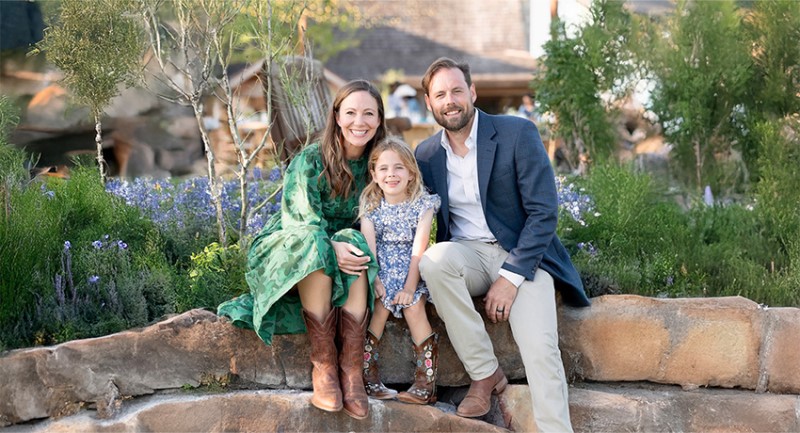
“We didn’t know she’d be able to play athletics — or that she would be here,” said Melissa Pless, Ellie’s mom. “The fact that we get to do normal things, and she gets to be a normal kid, is the greatest blessing.”
During a routine, 20-week ultrasound screening in 2019, doctors discovered kidney abnormalities. They didn’t know what it was at the time, but the preliminary diagnosis and outlook appeared grim.
The mood began to turn when Melissa’s maternal-fetal medicine specialist presented the case at a multidisciplinary conference. Two urologists approached her and suggested the condition might be something different — and potentially treatable. Blaine and Melissa Pless clung to that sliver of hope through twice-weekly ultrasounds. Each appointment was a test of whether their baby still had amniotic fluid and her kidneys were still functioning.
A diagnosis and lifeline
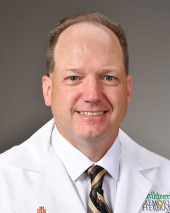
Eric A. Jones, MD
Ellie was born at 38 weeks with bilateral ureteroceles, a rare congenital abnormality seen in roughly one child per 2,000 to 5,000 births. Her case was particularly challenging because she had ureteroceles on both sides. The tubes connecting her kidneys to her bladder didn’t develop properly, making her vulnerable to severe, life-threatening infections.
Eric A. Jones, MD (external link), a pediatric urologist at UT Physicians Pediatric Surgery — Texas Medical Center, became central to their journey. He met Ellie and her parents just a day after her birth.
“The prenatal ultrasound evaluations are limited to some extent, so you often don’t have the full picture at that time,” said Jones, an associate professor of pediatric surgery in urology at McGovern Medical School at UTHealth Houston. “Early on, it was unclear how well the kidneys would function at all.”
The initial news after birth brought cautious relief as both of Ellie’s kidneys were working. But her parents knew this was only the beginning. They met with a nephrologist and prepared themselves for what seemed inevitable: a kidney transplant at age two. They resigned themselves to that idea, figured it was their life ahead, and were thankful she was alive. Fortunately, this path wasn’t their reality after all.
Two surgeries, countless setbacks
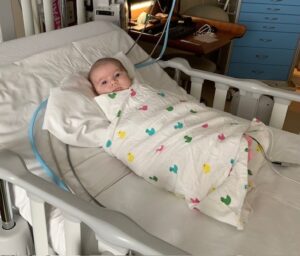
Ellie before her ureterocele procedure to reduce the immediate risk of severe infections. (Photo provided by family)
Ellie required two surgeries, so Jones developed a surgical plan in two stages. At about three months old, he performed a bilateral ureterocele incision to reduce the immediate risk of severe infections. Opening up the ureteroceles enabled them to drain freely.
“This doesn’t correct the problem in totality, but it buys some time so Ellie can grow and be able to better handle the next, larger operation,” Jones said.
But the path wasn’t smooth. Just after Ellie’s first birthday, she contracted Klebsiella, a multidrug-resistant bacteria. It was persistent, hiding in the crevices of her misformed bladder, then reappearing more aggressively. Despite prior surgery by Jones, she developed recurrent urinary tract infections requiring hospitalizations and intravenous antibiotics.
The pattern became terrifyingly routine: Ellie’s temperature would spike from normal to 105° overnight. They’d rush to the hospital. Doctors would start antibiotics and wait for cultures to identify which drugs might work. Every attempt to schedule the definitive surgery to reconstruct her bladder was thwarted by another infection.
From July through November 2020, they lived between home and hospital — seven or eight ER visits, two-week hospital stays, constantly monitoring for the next fever spike. Doctors were running out of antibiotics to kill the bacteria.
“I remember one night before surgery, when we had to end up rescheduling,” Melissa said. “It was like, ‘Oh my gosh, we’re so close, and this bacteria is trying to kill her.’ I have goosebumps thinking about that.”
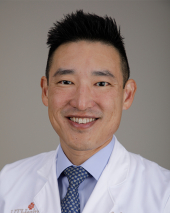
Michael L. Chang, MD
An unconventional approach
Michael L. Chang, MD (external link), a pediatric infectious disease specialist at UT Physicians Pediatric Specialists — Texas Medical Center (external link), proved crucial during this stage. The antibiotics that could protect Ellie were also driving the antibiotic resistance. The team needed a way to decrease Ellie’s exposure to antibiotics while minimizing the risk of future infections. Balancing these risks meant considering an unconventional approach.
Chang said Ellie’s situation presented three challenges:
- The infections might eventually resolve as she healed and grew, but no one could predict when.
- Repeated use of broad-spectrum antibiotics risked fueling more resistance.
- Each new infection carried the possibility of long-term kidney damage or even life-threatening illness.
“After thoughtful discussions with Ellie’s parents and Dr. Jones, we agreed to try a treatment and preventive strategy rarely used in children and supported by very limited evidence,” said Chang, an associate professor of pediatric infectious diseases at McGovern Medical School. “I spent time with Ellie’s parents explaining how the treatment worked, being transparent about what was known and unknown, and helping them carefully weigh potential risks and benefits.”
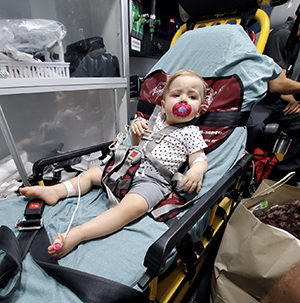
Ellie was transferred between hospitals during one of her severe urinary tract infections. (Photo provided by family)
Ultimately, they brought Ellie to the hospital, where she could be ready for surgery once the infection cleared. Chang switched Ellie to an older antibiotic called fosfomycin.
Ellie was ready for the major reconstructive surgery, nearly a year after the first. Jones removed the ureteroceles, reconstructed her bladder, and spliced her four ureters into two functional tubes. Jones said Ellie came through the lengthy surgery well. Once she healed, her kidneys decompressed and returned to normal. Potty training, which they’d expected to be a major challenge, went remarkably well. Ellie learned in about two days.
The team that wouldn’t give up
Throughout the long, arduous journey, Jones remained the family’s constant source of support. He gave them his cell phone number and responded at all hours.
“Dr. Jones was texting us in the middle of the night, even when he was on vacation,” Melissa said. “He was in it, but went above and beyond in his same, calming demeanor that just never changed.”
Chang said what made the greatest difference was trust.
“Dr. Jones trusted me to explore every available option, I trusted his surgical expertise, and together we earned the trust of Ellie’s family,” Chang said. “By staying present, answering questions, and reassuring them that I was continually thinking of Ellie’s well-being, we built a partnership that sustained them through difficult moments.”
Partnering together
Their advice to other families facing similar diagnoses is to stay educated, ask questions, and find your advocates. They found other people going through a similar journey in online groups, which was powerful.
But mostly, they want other families to “find a Dr. Jones.” At their last appointment, Melissa told Jones they’d adopted him and that he was now part of the family. Jones, characteristically modest, credits the team effort and the family themselves.
“Obviously, a lot of it is Ellie’s family,” Jones said. “They’re very reliable, very devoted to Ellie, and were always positive and hopeful, which I think makes a big difference.”
From his perspective, what makes him most proud isn’t just the technical success, but also the relationship he developed with Ellie’s parents.
“I think just hanging in there with them and reassuring them that things were going to turn out positively,” he said. “I always had a good level of communication with them.”
A normal life, against all odds

Ellie is thriving and plays softball with the Timbergrove Sports Association, where her parents coach the team. (Photo provided by family)
Today, at age 6, Ellie is thriving in kindergarten and playing softball and golf.
“Ellie is smart, she’s healthy, and sometimes I have to pinch myself like, ‘Did all that happen?’” Melissa said. “We know the problem is not gone, and we always will have to watch her kidneys, but she’s not waiting on a kidney transplant list.”
Ellie knows about her scar, which is barely visible, but doesn’t remember the hospitals, the PICC lines, and the fear. She asks about Jones fondly. Melissa sends him updates and photos. “She loves Dr. Jones,” she said.
The experience changed the family forever. Blaine could hardly put into words the gratitude and appreciation for Dr. Jones. His consistent support wasn’t his job assignment, he said.
“He saved our daughter’s life,” Blaine said. “There’s just nothing you can give to equate that transaction. We got our child.”