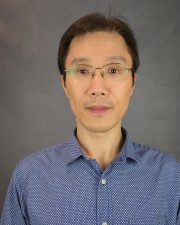
Seokhun Kim, PhD
- Assistant Professor, The Institute for Clinical Research and Learning Health Care
Biography
Seokhun Kim, PhD, is an assistant professor in the Institute for Clinical Research and Learning Health Care at McGovern Medical School at UTHealth Houston. Trained as an engineer, experimental psychologist, and biostatistician, he is a data scientist whose work focuses on applying advanced statistical and machine learning methods to improve prediction and identify treatment heterogeneity in health-related outcomes across clinical and population-based settings.
Dr. Kim earned his BS in electrical and computer engineering from Seoul National University and his PhD in experimental psychology from the University of Connecticut. He subsequently completed graduate training in biostatistics and data science at the School of Public Health at UTHealth Houston and a postdoctoral fellowship in behavioral data science at The University of Texas MD Anderson Cancer Center, where he now also holds an adjunct appointment in the Department of Behavioral Science.
Methodologically, Dr. Kim’s work centers on causal inference within the potential outcomes framework, drawing on a broad spectrum of approaches from frequentist to Bayesian methods. He also develops and applies predictive and causal machine learning techniques to high-dimensional clinical, genetic, and behavioral data. In addition, he has extensive experience with multilevel modeling, structural equation modeling, survival analysis, and quantile regression.
Dr. Kim has applied these tools to a wide range of topics, including cancer survivorship, smoking cessation, pain, stroke outcomes, and health behaviors among adolescents and adults. He serves as a co-investigator and lead biostatistician on multiple funded projects, including studies of social isolation and loneliness among prostate cancer survivors, lifestyle interventions for truck drivers in Texas, and multilevel barriers and facilitators of oral health care access among Black men. Across these efforts, his overarching goal is to use rigorous analytic methods and high-dimensional data to identify treatment heterogeneity and support more precise, equitable, and effective interventions for diverse populations.
Education
- Bachelor of Science (BS)
- Seoul National University, Seoul, Korea
- Doctor of Philosophy (PhD)
- University of Connecticut, Storrs, CT
Areas of Interest
Research Interests
Causal inference
Bayesian modeling
Machine learning