CiCHD researchers develop groundbreaking human-based model for Fontan-associated liver disease
Researchers at the Center for Innovation in Congenital Heart Disease (CiCHD) at UTHealth Houston have developed a first-of-its-kind, human-based model designed to advance understanding and treatment of Fontan-associated liver disease (FALD), a serious and increasingly recognized complication affecting survivors of single-ventricle congenital heart disease.
The study A Dynamic 3D Human Liver Sinusoid Model for Mechanistic Interrogation of Fontan-Associated Liver Disease (external link)—recently accepted for publication in Advanced Science—introduces a fully human, perfusable FALD-on-a-chip platform that recreates the complex biological and mechanical conditions underlying disease progression. The technology captures key hemodynamic changes, fibrotic responses, and cellular interactions that characterize FALD, providing researchers with a powerful new tool to investigate disease mechanisms and evaluate potential therapies.
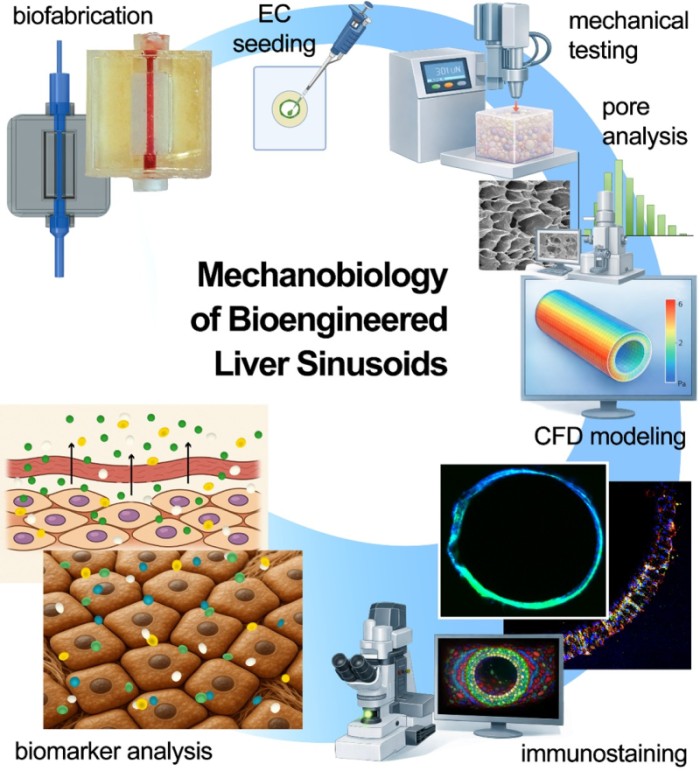
Schematic overview of the development and mechanobiological characterization of a perfusable 3D bioengineered human liver sinusoid model for studying Fontan-associated liver disease
FALD remains one of the most challenging long-term complications faced by patients who have undergone the Fontan procedure. The disease often progresses silently over many years, making early diagnosis difficult and limiting opportunities for timely intervention. Despite growing awareness of the condition, clinicians have lacked reliable human-relevant models capable of replicating the disease’s complexity.
CiCHD Co-Director Vahid Serpooshan, PhD, led the research team to address this critical gap. “Our goal is to develop human-relevant platforms that allow us to better understand complex diseases and accelerate the discovery of effective therapies,” said Serpooshan. “By recreating the key biological and mechanical drivers of Fontan-associated liver disease in a controlled environment, this platform provides a unique opportunity to uncover disease mechanisms and test therapeutic strategies in ways that were previously not possible.”
A key contributor to the project was postdoctoral researcher Sarah Rezapour, MD, who led the study and played a central role in the design, development, and validation of the novel platform. Her work enabled the team to establish a model that closely mirrors the pathological conditions experienced by Fontan patients, opening new avenues for translational research. The FALD-on-a-chip system represents part of a broader research vision at CiCHD focused on developing advanced human-tissue models for congenital heart disease and its associated complications. By integrating bioengineering, stem cell technologies, and disease-specific physiology, the center aims to create platforms that can bridge the gap between laboratory research and clinical care. Researchers believe the technology could significantly enhance efforts to identify biomarkers of disease progression, understand patient-specific responses, and accelerate the development of targeted therapies for FALD and other multi-organ disorders linked to congenital heart disease.
As the number of Fontan survivors continues to grow worldwide, innovations such as the FALD-on-a-chip platform may help transform the way clinicians diagnose, monitor, and ultimately treat one of the most serious long-term consequences of single-ventricle heart disease. The study’s acceptance in Advanced Science marks an important milestone for the CiCHD team and highlights UTHealth Houston’s growing role in advancing bioengineering-driven solutions for complex cardiovascular and liver diseases.