Chronic Pain Management vs. E/M Codes

Image Credit: Pexels
CMS introduced monthly Pain Management codes in 2023. So, why are some practices still using Evaluation and Management codes exclusively? There may be a few reasons for that. One, E/M codes are more familiar. Two, they may reimburse better. But perhaps there’s something else not being considered. Where appropriate, monthly chronic pain management codes may be reported in addition to a medically necessary E/M visit, as well as other chronic management services.
Let’s take a look at a few examples.
Chronic Pain Management Only
Example 1: Initial CPM Month (G3002 only)
- Established Medicare patient with chronic lumbar radiculopathy
- In‑person visit to initiate CPM (not separately reportable)
- Over the month:
- Pain scale documented
- Care plan created (PT, NSAIDs, activity goals)
- Medication review and counseling
- Behavioral health referral discussed
- Care coordination with PT
- After initial visit, subsequent CPM may be performed via telemedicine
Total CPM time for month: 35 minutes Billing: G3002 × 1
Rationale:
- Met ≥30 minutes
- Monthly care management furnished
- No additional 15‑minute increment completed
Example 2: Higher‑Intensity CPM Month (G3002 + G3003)
- Chronic osteoarthritis with depression and opioid taper
- Over the calendar month:
- Care plan updates
- Opioid risk discussion
- Coordination with behavioral health
- Family education
- Follow‑up calls and documentation
Total CPM time: 65 minutes
Billing: G3002 × 1, G3003 × 2 (30 additional minutes)
Rationale
- First 30 minutes = G3002
- Each full additional 15 minutes = G3003
CPM + Separate E/M (Evaluation and Management)
Example 3: CPM + E/M (same month)
- Patient has scheduled visit for worsening neuropathic pain
- Visit addresses:
- New symptoms
- Medication adjustment
- Diagnostic decision‑making (E/M)
Separately in the same month
- Care plan updates
- Behavioral health coordination
- Pain education
- Follow‑up calls
Billing: 99214 (visit‑based E/M)-25, G3002 (+ G3003 if time met)
Documentation Tip
- E/M note = problem-oriented assessment & MDM
- CPM documentation = monthly care‑management activities + time log
Decision Tree: CPM, E/M, or Both
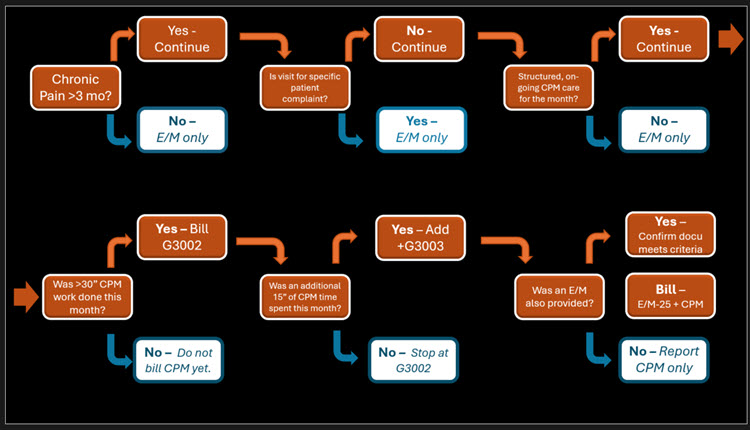
Example 4: E/M Only
- Patient presents for knee pain flare
- Provider evaluates symptoms, orders imaging, adjusts meds
- No ongoing care coordination beyond visit
Billing: 99213
-
- Or other appropriate E/M level based on Time or MDM
Rationale:
You would report E/M only when:
- The service is a problem-oriented visit (e.g., knee pain)
- No structured monthly pain management is occurring
- Time spent is entirely related to visit‑based evaluation
- No cumulative monthly CPM time ≥30 minutes
Other Care Management
CMS allows separately distinguishable Care Management to be delivered and reported the same calendar month as CPM, such as CCM (Chronic care Management), TCM (Transitional Care Management, BHI (Behavioral Health Integration), RPM (Remote Patient Monitoring), and RTM (Remote Therapeutic Monitoring).
Key Takeaways
- CPM codes are still underused—even though they capture work E/M codes simply don’t.
- You can bill CPM and E/M together when the services are genuinely distinct.
- Time is the deciding factor for CPM.
- CPM includes far more than face‑to‑face visits.
- Use E/M alone when the work is limited to a single, problem‑focused encounter.
- CPM can be reported in the same month as other care‑management programs.
Editor’s Note: AI tools were used to assist with drafting. All content and conclusions are the author’s own and based on professional expertise.
Resources
MSHBC – CCM Series Part VI: Chronic Pain Management Services
AmericanPainSociety.org (external link)