Injection Series: Part V-Sacroiliac (SI) Joints

Pexels: Tima Miroshnichencko
The OIG had previously audited facet joint procedures and found high error rates. Because SI (sacroiliac) joint injections are another common spinal pain management service, OIG wanted to know if physicians were following the Medicare rules when performing and billing SI joint injections?”
They found three main areas of concern in how these services were reported to Medicare.
- significant documentation,
- medical necessity, and
- coding errors
“Physicians incorrectly billed 46,711 sessions as therapeutic injections when they should have been billed as diagnostic injections.”
For the purposes of this article, we are going to specifically focus on the findings in the report regarding therapeutic vs. diagnostic sacroiliac injection procedure documentation, coding, and reporting.
Defining:
- When a diagnosis of SI-mediated pain has truly been established, and
- When the service transitions from diagnostic testing to therapeutic treatment.
Let’s review therapeutic vs. diagnostic requirements.
Therapeutic SI Injections
Diagnostic SI Joint Injection
Purpose
To determine whether the sacroiliac joint is actually the source of the patient’s pain.
What is injected?
Typically:
- Local anesthetic only (or primarily anesthetic)
- Minimal or no steroid
Clinical Question
“Is the SI joint causing the patient’s pain?”
How It Works
The physician injects anesthetic into the SI joint and evaluates the patient’s pain relief. If the patient experiences substantial temporary pain relief (often ≥75% depending on payer requirements), the SI joint is considered a likely pain generator.
Patient Example
- Chronic low back pain
- Buttock pain
- Positive SI joint provocative tests
- MRI does not clearly explain symptoms
Procedure:
- Fluoroscopically guided SI joint anesthetic injection
Result:
- Pain decreases from 8/10 to 1/10 for several hours
Conclusion:
- SI joint likely causing the pain
- Diagnostic injection considered positive
Diagnostic SI Injections
Purpose
A therapeutic SI joint injection is intended to treat pain, not diagnose it.
What is injected?
Typically:
- Corticosteroid
- Local anesthetic
Clinical Question Being Answered:
“Can we reduce inflammation and provide longer-term pain relief?”
How It Works
The steroid provides anti-inflammatory benefit that may last weeks or months.
Patient Example
- Patient had a positive diagnostic SI joint injection previously
- SI joint pain has returned
Procedure:
- SI joint injection with corticosteroid
Result:
- Pain reduced 60-80% for 2-3 months
Conclusion:
- Therapeutic treatment successful
Side-by-Side Comparison
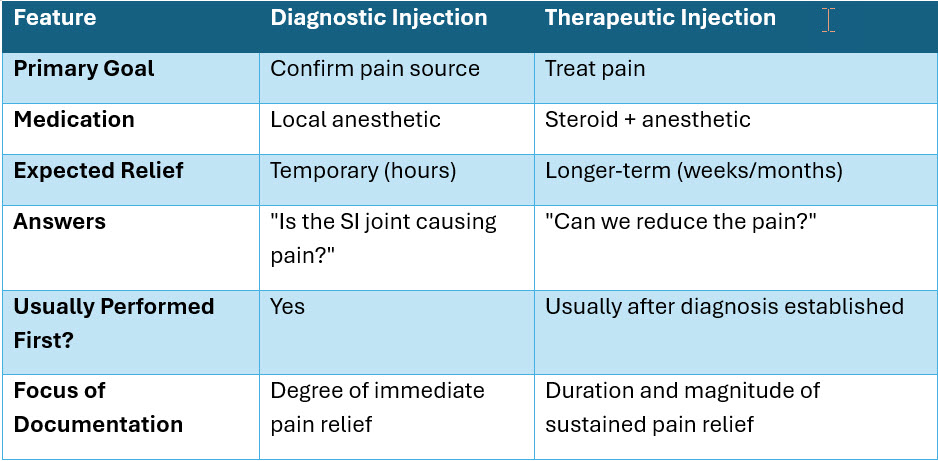
Why Auditors Care
From a compliance perspective, the distinction matters because:
Diagnostic Injection Documentation Should Show
- Medical necessity
- Symptoms suggesting SI pathology
- Physical examination findings
- Baseline pain score
- Degree of post-procedure pain relief
- Percentage improvement
Therapeutic Injection Documentation Should Show
- Prior response to injection
- Functional impairment
- Duration of previous pain relief
- Recurrence of symptoms
- Medical necessity for repeat treatment
Summary
The distinction between a diagnostic and therapeutic sacroiliac joint injection may seem subtle, but from a Medicare compliance perspective, it matters. Providers should be able to explain not only what procedure was performed, but also why it was performed and how the patient’s response supports continued treatment. The OIG’s findings highlight the importance of documentation that tells the complete clinical story and accurately supports the service billed.
Resources:
Office of Inspector General (OIG)