Series Part I: Chronic Care Management Services

Photo Credit: Pexels
Chronic Care Management Services are intended to encompass the behind-the-scenes work (non-face-to-face) performed by healthcare professionals and their staff related to disease management of chronic conditions. Work includes oversight and education activities geared towards equipping patients with information needed to improve their overall quality of life.
Examples of Chronic Care Conditions:
- Alzheimer’s disease and related dementia
- Arthritis (osteoarthritis and rheumatoid)
- Asthma
- Atrial fibrillation
- Autism spectrum disorders
- Cancer
- Cardiovascular disease
- Chronic Obstructive Pulmonary Disease
- Depression
- Diabetes
- Hypertension
- Infectious diseases (e.g., HIV/AIDS)
- Sickle-Cell
- Substance Use Disorders
Chronic Care Service Requirements:
- Two or more (multiple) chronic conditions expected to last at least 12 months or until death
- Chronic conditions place the patient at significant risk of death, acute exacerbations and/or decompensation, or functional decline
- Comprehensive care plan established, implemented, revised, or monitored
- Reported per calendar month
- Services provided by clinical staff with physician or OQHP direction, or
- Provided personally by physician or (OQHP) Other Qualified Healthcare Professional
Personalized Comprehensive Chronic Care Plan may include:
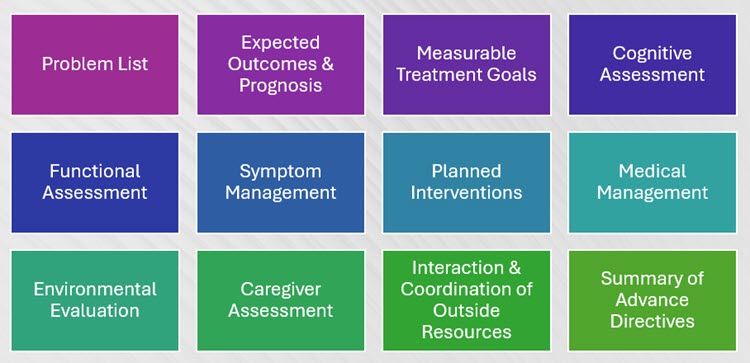
*Not an all-inclusive list
CPT Coding
(CCM) Chronic Care Management Services
- 99490: Minimum of 20 minutes of clinical staff time per month (approx. $64)
- +99439: Each additional 20 minutes of clinical staff time (approx. $48)
- 99491: At least 30 minutes of care by a physician or other qualified healthcare professional per month (approx. $86.70)
- +99437: Each additional 30 minutes of care by a physician or other qualified healthcare professional (approx. $61.08)
Some time-based services have the benefit of the “past midpoint” rule. Not so for CCM services. Chronic care management services must meet the minimum time thresholds in order to be reported. If less than the stated time is met, do not report the service.
However, per CPT coding tip (CPT pg. 51), if the treating physician or OQHP personally performs ANY of the care management services and those activities are not used to meet the criteria for a separately reportable code (99424, 99491), then their time may be counted towards the required clinical staff time to meet elements of 99426, 99487, 99490, as applicable.
Patients must give consent to receive CCM services. Consent can be given verbally or in written form and documented in the medical record.
This documentation in the medical record must include:
- The patient’s consent to participate in CCM,
- That she/he can stop receiving CCM services at any time, and
- That only one health care professional or hospital can provide CCM in a calendar month.
Information about applicable cost sharing should be included as well.
For more in-depth information, we have included a plethora of resource links below. Stay tuned for the next article in this series.
Series Part II: Complex Chronic Care Management
Resources:
- Chronic Care Management Services Fact Sheet (external link)
- Chronic Conditions Data Warehouse (external link)
- Chronic Care Management Frequently Asked Questions (external link)
- Chronic care management and patient communication (external link)
- Target Probe and Educate (TPE) Chronic Care Management (external link)
- MLN909188 – Chronic Care Management (cms.gov) (external link)
- Medicare.gov – CCM Article (external link)
- Novitas TPE Results – CCM (external link)