Ambulatory Specialty Model (ASM)

Pexels: Kindel Media
Mandatory Provider Participant Criteria
Participation is not triggered simply because a physician treats heart failure or low back pain patients.
To be required to participate, physicians must:
(1) bill Medicare under the Physician Fee Schedule,
(2) belong to a specialty included in ASM,
(3) practice in a selected geographic area, and
(4) meet CMS volume requirements.
For low back pain, specialties that commonly manage this condition in outpatient settings include anesthesiology (including interventional pain), pain management, neurosurgery, orthopedic surgery, and physical medicine & rehabilitation.
What does this mean for physicians who work with APPs?
APPs may support the management of heart failure and LBP patients, but they are not individually subject to the model’s participation requirements. The physician remains responsible for meeting the model’s requirements.
What ASM Is Trying to Accomplish
- Reduce avoidable specialty spending
- Improve adherence to evidence-based care
- Reward specialists who manage episodes efficiently
- Reduce unnecessary testing, procedures, imaging, ED visits, and hospitalizations
- Create accountability for total episode costs
Think of ASM as a specialty-specific cousin of accountable care and bundled payment initiatives. Physicians mandated to participate will continue billing Medicare normally. CMS then applies quality scoring, episodic cost calculations, shared savings, and potential downside risk adjustments.
How Long will this Program Model Run?
The CMS Ambulatory Specialty Model (ASM) will begin on January 1, 2027, in selected geographic areas and will run through five performance years ending December 31, 2031.
Participating physicians will be evaluated on quality, outcomes, and cost of care for designated chronic conditions, with performance-based payments beginning in 2029 and continuing through the model’s conclusion on December 31, 2033. 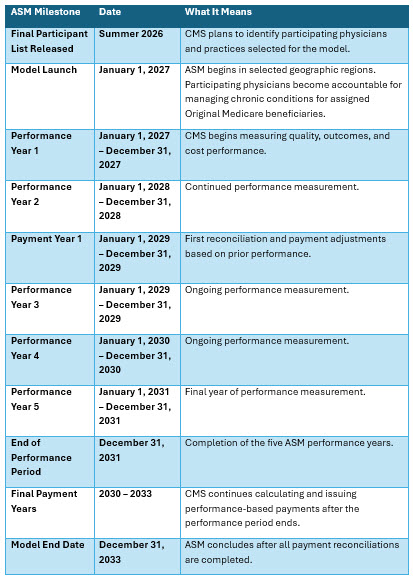
Compliance Risks
For compliance departments, the highest-risk findings will likely be:
| Risk Area | Compliance Concern |
| Heart Failure | Failure to document severity and GDMT optimization |
| Heart Failure | Lack of documented care coordination |
| Heart Failure | Recurrent admissions without evidence of outpatient management efforts |
| LBP | MRI ordered without documented clinical indication |
| LBP | Procedures lacking failed conservative treatment history |
| LBP | Generic diagnoses such as “back pain” |
| Both | Copy-forward notes that do not demonstrate active management |
| Both | Documentation that fails the “medical necessity” test despite technically meeting E/M requirements |
Documentation Tips
- Describe disease severity.
- Demonstrate clinical decision-making, not just diagnoses.
- Detail why evidence-based therapies were or were not used.
- Document care coordination activities.
- For LBP, always establish the pathway from conservative treatment to advanced intervention.
Final Thoughts
From a compliance perspective, ASM is less about new CPT coding rules and more about ensuring that documentation demonstrates appropriate specialty management, evidence-based treatment decisions, and stewardship of Medicare resources. Providers who already document medical necessity well and clearly explain their clinical reasoning are generally the ones most likely to perform successfully under the model.
While specialty societies have begun developing educational resources for Heart Failure participants, fewer ASM-specific readiness tools are currently available for Low Back Pain providers.
Nevertheless, the same foundational principles apply: accurate diagnosis coding, documentation of conservative management, appropriate use of imaging and procedures, interdisciplinary care coordination, and adherence to evidence-based treatment guidelines.
Coming Soon – ASM Documentation: Heart Failure and Low Back Pain
Resources
Ambulatory Specialty Model – Participants (external link) and FAQs (external link)
ASM (Ambulatory Specialty Model (external link))
ASM Webinar Registration Link: ASM Participant September 2026 Office Hour (external link)