
New Treatments Extend the Chronic Stroke Recovery Timeframe
Chronic ischemic stroke survivors with a persistent resolve to recover and resume regular life have access to two new clinically proven treatments available for up to 10 years following their initial post-stroke care. The implantable Vivistim® Paired VNS™ System (external link) boosts the brain’s neural activity, building lasting connections that continue to work even when the therapy is not in use. The wearable IpsiHand® (external link), a noninvasive brain-computer interface, enables at-home therapy. Both devices are FDA approved, have been shown in clinical trials to boost neuroplasticity, and are available through the Stroke Program at UTHealth Houston.
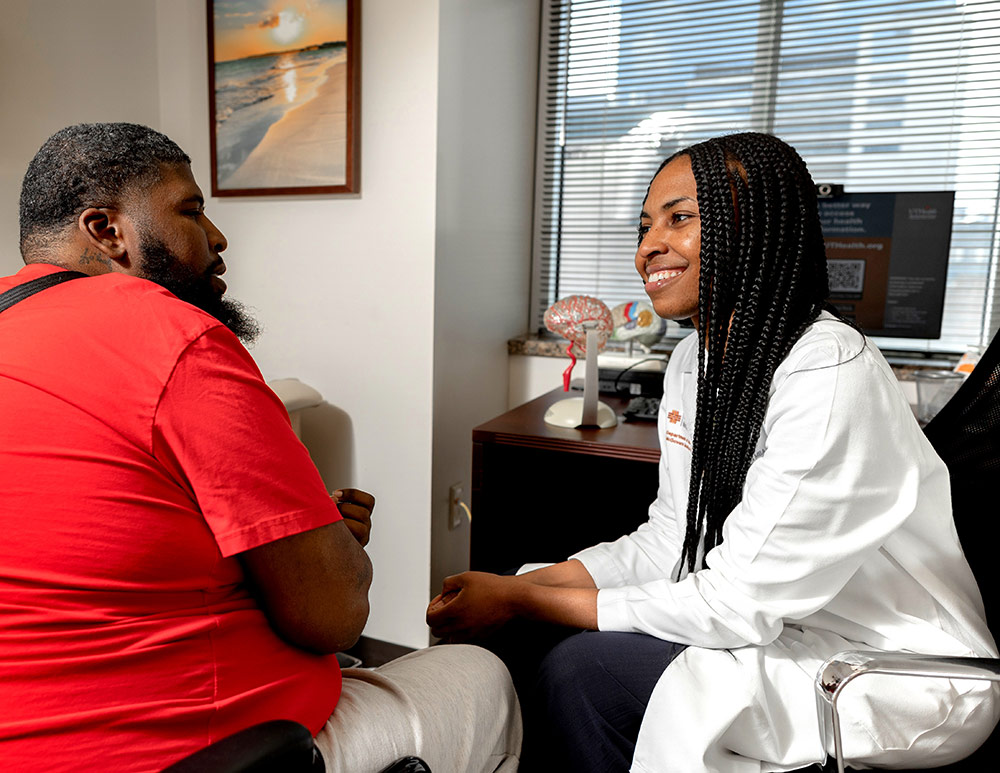
Led by Anjail Sharrief, MD, MPH, professor of neurology and director of the Stroke Transitions Education and Prevention (STEP) Program at McGovern Medical School at UTHealth Houston, the clinic is a vital resource for stroke survivors, offering a post-hospital stroke lifeline that promotes prevention, supports recovery, and helps patients thrive after stroke.
“Stroke recovery varies widely depending on the stroke’s severity, location, and the patient’s overall health,” Sharrief says. “While some people make significant progress, others face long-term disability and a recovery that can continue for months or even years. In the STEP Program, we’re evolving to meet the needs of our patients by creating a structured pathway for chronic stroke survivors to help them recover and avoid a second stroke. We hope the entire medical community will inform their patients about these new options.”
Vivistim® Paired VNS™ System
 The Vivistim® System received FDA approval in August 2021, following successful clinical trials. It stimulates the vagus nerve during rehabilitation therapy, with the aim of reducing motor deficits and enhancing the ability to move arms and hands.
An implantable pulse generator is placed under the skin, and software and a wireless transmitter are used by clinicians to manage treatment settings. The system requires surgical implantation followed by a high-intensity rehabilitation protocol of 18 sessions, three times a week for 90 minutes, coupled with a self-directed, home-based therapy program.
Mary Bryant, now 76, suffered a stroke in February 2023, followed by a second stroke in September 2024. “She’s had a much harder time bouncing back from the most recent one,” says her husband, Eddie Bryant, who was with her during both incidents. “We were eating when she had the second one. As soon as she told me she couldn’t grip her fork, I said, ‘Mary, get your shoes on. I’m driving you to the hospital,’” Bryant says.
She was outside the window for administration of tenecteplase, an effective treatment for acute ischemic stroke when administered up to 4.5 hours after the time the patient was last known to be well, and she was admitted to TIRR Memorial Hermann-Greater Heights for 30 days of inpatient rehabilitation. “Mary had pretty much momentum going by the time she was released, but then it took us about six weeks to get into an outpatient therapy program. After she finished the 12 weeks of outpatient therapy covered by Medicare, we were able to continue therapy with a professional at home twice a week for another month. Although the therapist recommended that we continue, she was approved for only one more session.”
Later in recovery, the Bryants saw Margaret Oni, MD, a physical medicine and rehabilitation specialist in Katy, who suggested that they try Vivistim. Mary Bryant’s device was implanted in March 2026 by Nitin Tandon, MD, professor and Nancy, Clive and Pierce Runnels Distinguished Chair in Neuroscience of the Vivian L. Smith Center for Neurologic Research. She’s currently undergoing the Vivistim prescribed outpatient therapy protocol at TIRR Memorial Hermann Outpatient Rehabilitation at Memorial City.
“We work on her therapy almost seven days a week,” Bryant says. “We have sheets with exercises, plus I take notes at her therapy sessions, so we know what to do at home. In just two weeks, we can see improvement. Therapists we’ve seen say that everyone they’ve worked with who has Vivistim has had a remarkable improvement. We’re hoping it’s the same for Mary. It’s like everything else: you get out of it what you put into it.
“Even though the studies showing improvement were done on the upper extremities and no studies have been done on the lower extremities, Vivistim patients are also seeing improvement in their walking and gait as an added benefit,” he says.
The IpsiHand® System
Findings from the first randomized controlled trial evaluating IpsiHand (external link) in chronic stroke survivors were presented at the International Stroke Conference 2026, held in New Orleans in February. They showed that patients using the IpsiHand System achieved significantly greater improvements in upper-extremity motor function than those participating in a home exercise program alone.
Patients who were at least six months post-stroke with persistent upper-extremity paresis or hemiplegia, with no upper or lower limits on baseline Upper Extremity Fugl-Meyer (UEFM) scores, were directed to complete their assigned therapy five times per week over a 12-week period. As the users concentrated on moving the affected hand and arm, an EEG headset sensed signals from the undamaged parts of the brain. With repeated therapy in the clinical trial, 70% of users improved functional movements of the arm and hand.1 Study enrollment was stopped early for efficacy following a planned interim analysis.
“The IpsiHand brain-computer interface system uses brain activity when patients are thinking about movement to reorganize brain connections to control the upper arm and hand,” Sharrief says. “Motor cortex damage caused by a stroke makes it difficult for the brain to connect with hand and arm muscles. IpsiHand allows patients to open and close their hands by imagining movement. This brain-computer interface system may be especially valuable to patients with limited access to ongoing post-stroke rehabilitation.”
Coming Back From Chronic Stroke
“As a clinic, we created pathways for VNS evaluation and referral in May 2025 and IpsiHand this past February. In addition to supporting access for eligible patients, we work closely with them to identify their personal risk factors,” Sharrief says. “We help them move toward a healthy lifestyle by eating right, staying active, managing stress, connecting socially, and maintaining a healthy weight. We provide education, risk-factor screening and management, and assessment and treatment of post-stroke complications. We also connect patients and caregivers to our partner clinics, community programs, and community resources that address post-stroke needs over the long haul.”
Sharrief sees patients at UTHealth Houston Neurosciences Neurology – Texas Medical Center and UTHealth Houston Neurosciences – Southwest. Team members also see patients who have not yet had a stroke but are at high risk because of silent strokes or cerebrovascular disease seen on MRI, vascular cognitive impairment, or uncontrolled risk factors. Clinics are available at UTHealth Houston Neurosciences locations in Memorial City, Southwest Houston, and the Texas Medical Center.
To refer a patient, call (832) 325-7080 or fax (713) 512-2239.
- Rustamov N, Souders L, Sheehan L, Carter A, Leuthardt EC. IpsiHand brain-computer interface therapy induces broad upper extremity motor rehabilitation in chronic stroke. Neurorehabil Neural Repair. 2025;39(1):74-86. doi:10.1177/15459683241287731