Barry Ballou Can Finally Breathe
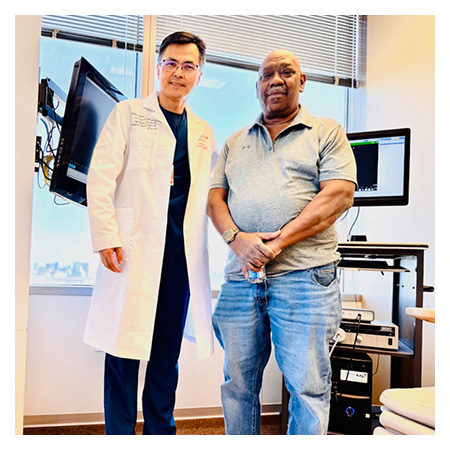 Retired architectural engineer Barry Ballou has endured nearly a an inability to breathe through his nose. Diagnosed with obstructive sleep apnea, Ballou, who is 64, had used a CPAP machine for 18 years. In early 2024, he developed an fluid in his right middle ear space. “I couldn’t breathe well, and then I couldn’t hear,” he says. “I was miserable.”
A community ENT referred him to Xiaoyang Hua, MD, PhD, a physician researcher and associate professor in the Department of Otorhinolaryngology at McGovern Medical School at UTHealth Houston. “Barry came to me with several issues,” Dr. Hua says. “In addition to the inability to breathe through his nose, he had difficulty sleeping, couldn’t use his CPAP, and had fluid in his ears. All this was connected. A blocked nose can affect the Eustachian tubes, which ventilate the middle ear. We performed a myringotomy with tube placement that dramatically improved his ability to hear.”
Ballou returned to Dr. Hua in early 2025, after long-term use of nasal sprays failed to improve his inability to breathe. “Barry actually had a deviated septum and chronic rhinitis – two conditions that made it very difficult for him to breathe through his nose,” Dr. Hua says. “These nasal problems likely contributed to his obstructive sleep apnea and his difficulty using CPAP.”
Dr. Hua performed an inferior turbinate submucosal resection and septoplasty. “The surgery was life changing for me – a total success,” Ballou says. “Just a week later, I could breathe through my nose, something I haven’t been able to do in decades. My snoring is much better, I sleep more soundly, and thanks to the ear tubes, I can hear clearly again.”
“While nasal surgery is unlikely a cure for obstructive sleep apnea, it can reduce snoring, improve nasal breathing, and make it easier for patients to use CPAP if needed,” Dr. Hua says. “It also reduces sleep disruptions called respiratory-related arousals, which wake people with OSA throughout the night. In Barry’s case, treating his nasal obstruction significantly improved his sleep quality and overall quality of life.”
“My experience with Dr. Hua was excellent,” he says. “He listened to me, and he cared. I’ve seen a lot of doctors over the years. If your doctor doesn’t listen to you, find one who will.”