A Happier Year for Bryonna After Turbinate Reduction Surgery
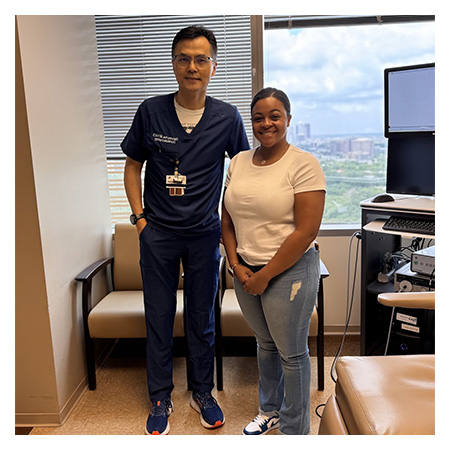 Born and raised in the California Bay Area, Bryonna Sullivan has always had allergies. In July 2024, she relocated to Houston, one of America’s most challenging cities for people with allergies due to its elevated tree and grass pollen counts. Things got worse.
“I didn’t notice a problem until the weather got colder,” says Sullivan, 31. “My allergies are usually better in winter, and suddenly I was having trouble breathing. Then a friend told me I was gasping for air during a nap, which scared me because I’m a single mom and need to stay alert. I decided to see a doctor.”
Her primary care physician referred her to the Department of Otorhinolaryngology at McGovern Medical School at UTHealth Houston, where she saw Xiaoyang Hua, MD, PhD, a practicing otolaryngologist and National Institutes of Health-funded surgeon-scientist. He diagnosed Sullivan with turbinate hypertrophy – chronic swelling of the nasal turbinates, bony structures in the nose that help warm and filter air. The inflammation caused persistent nasal obstruction, mouth breathing, and snoring, all of which can interfere with sleep.
Sullivan’s disease was severe, and her turbinates were highly inflamed. In January 2025, after medical management failed to relieve her symptoms, Dr. Hua began talking with her about bilateral turbinate reduction surgery.
“I was struggling to breathe at night, but I had never had surgery and thinking about it made me a nervous wreck,” she says. “But he reassured me that everything would be fine and provided me with statistics on outcomes of the surgery.”
Dr. Hua described it as a “very routine outpatient surgery” and told her to expect some discomfort for the first week, until he could remove the nasal sponge packing and splints that support healing.
“It’s important to bring all your surgical skill to bear when treating a patient, but it’s equally important to put yourself in their shoes and meet them where they are,” Dr. Hua says. “I always explain the pros and cons of any procedure and never promise what I can’t deliver. I told her to expect some discomfort for about a week following surgery.”
“After the procedure, I felt like a completely different person,” Sullivan says. “I was very happy with the result. Before the surgery, I woke up quite a bit at night. Afterwards, I could breathe and sleep much better. He did tell me this will not erase my allergies. I still have my little allergies here and there, but I’m no longer struggling to breathe.”