Scholarly and Academic Pathways
The pediatric rotation is the favorite of countless medical students. When surveyed, students report this rotation increased their confidence early on in their third year, reinforced or sparked interest in pediatrics, and shaped their professional identity. Many cite it as foundational for future rotations.
Pediatric Clerkship
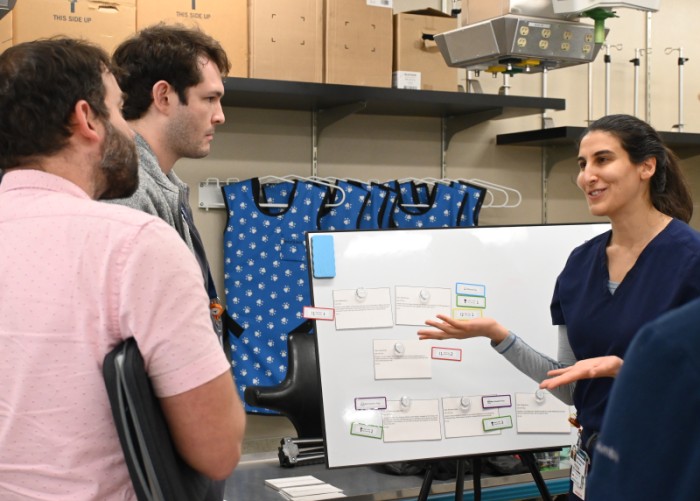
Trainees at all levels work directly with experienced faculty to talk through difficult diagnoses and ideal treatment plans.
The Department of Pediatrics is organized to provide medical education opportunities in clinical pediatrics at undergraduate, graduate, and postgraduate levels of training.
Led by Professor Amalia Guardiola, MD, and Associate Professor Veronica Gonzalez, MD, FAAP, this eight-week clerkship is required in the third year for medical students. It is divided into a 4-week outpatient experience and a 4-week inpatient experience, including a week in the newborn nursery. Clinical experience provides students with a hands-on approach to caring for children through history-taking, physical examinations, interpretation of laboratory data in pediatric conditions, and management of common pediatric disorders, such as bronchiolitis, otitis media, and upper respiratory infections, with an emphasis on discussion and shared decision-making with parents and caregivers. The students also learn about well-child visits, immunizations, and the development of children.
A particularly acclaimed feature of the clerkship is the passport lecture: a set of didactics provided most afternoons during the inpatient portion. It is a dedicated one-hour teaching session led by either faculty or a third-year resident to go over clinical cases or have a Jeopardy “competition” on a pediatric medical topic. Medical students also enjoy the morning report, which is a department-wide meeting each Friday where clinicians from different divisions go over a medical case of a patient admitted with a diagnostic enigma. Together, they work through the diagnosis and how to treat it.
Advocacy and Child Health Scholarly Concentration
Led by Assistant Professor Wan-Hsuan “Sherly” Chen, DO, and Associate Professor Zoabe Hafeez, MD, the Advocacy and Child Health Scholarly Concentration empowers medical students to discover their potential as pediatric advocates. This program fosters growth through mentor-guided experiences. By exploring the diverse facets of the advocacy world, our graduates emerge as skilled, adaptive, and passionate champions for children’s unique health needs.
Health Disparity and Advocacy Longitudinal Theme
Led by Assistant Professor Ashley Gibson, MD, MS, FAAP, and Assistant Professor Wan-Hsuan “Sherly” Chen, DO, the Health Disparities and Advocacy Longitudinal Theme is a longitudinal curriculum designed to prepare medical students to deliver compassionate, patient-centered care for all patients. Through integrated sessions across the pre-clinical and clinical years, students learn to recognize barriers that can affect health outcomes and access to care. The theme strengthens communication, problem-solving, and care coordination skills to support patients and families in real-world settings. The theme also highlights strategies for connecting patients to appropriate resources to promote high-quality care.