Electroconvulsive Therapy (ECT)
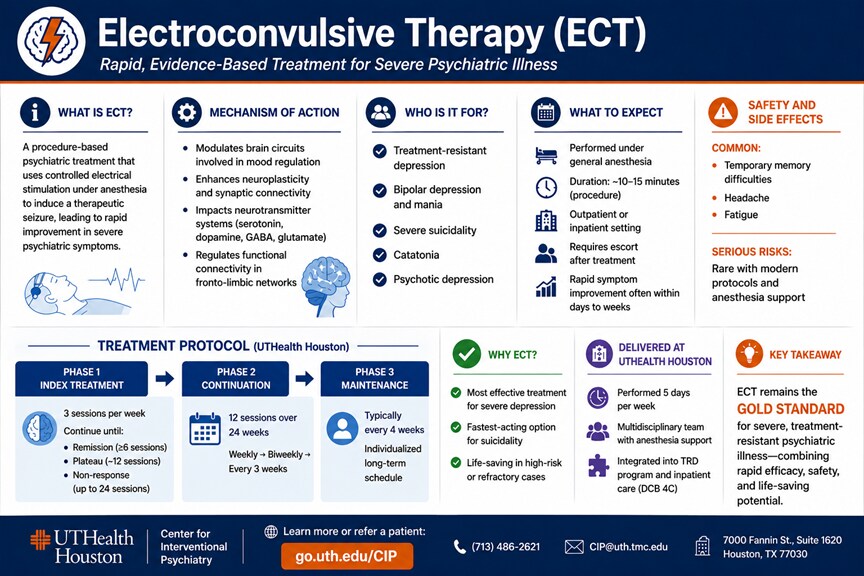 Electroconvulsive Therapy (ECT) is a highly effective, evidence-based treatment for severe and treatment-resistant psychiatric illness. It is particularly indicated for conditions requiring rapid and reliable symptom relief, including severe depression, bipolar disorder, psychosis, catatonia, and acute suicidality. Modern ECT is a safe, carefully controlled medical procedure performed under anesthesia by a specialized clinical team.
At the UTHealth Houston Center for Interventional Psychiatry, ECT is delivered within a comprehensive, multidisciplinary program and integrated across outpatient, partial hospitalization, and inpatient levels of care, including the inpatient unit on DCB 4C at the John S. Dunn Behavioral Sciences Center.
When ECT Is Considered
ECT may be recommended for patients who:
- Have severe or treatment-resistant depression
- Experience bipolar depression or mania unresponsive to standard treatments
- Present with catatonia, including malignant or life-threatening forms
- Have psychotic depression or severe psychosis
- Require rapid symptom improvement due to suicidality, poor oral intake, or marked functional decline
- Have not tolerated or benefited from medications or other interventional treatments
All patients undergo a comprehensive psychiatric and medical evaluation to assess appropriateness, risks, and expected benefits.
Treatment Process
ECT is performed in a controlled medical setting under general anesthesia, with continuous monitoring by psychiatry, anesthesia, and nursing teams. The procedure involves:
- Brief electrical stimulation of the brain to induce a controlled therapeutic seizure
- Muscle relaxation to prevent physical movement
- Continuous physiologic monitoring throughout treatment and recovery
Treatments are typically administered two to three times per week during the acute phase, with the total number of sessions individualized based on diagnosis, severity, and response.
UTHealth Houston ECT Treatment Protocol
The UTHealth Houston Electroconvulsive Therapy (ECT) Treatment Protocol (updated September 1, 2025) outlines a structured, evidence-based approach divided into three phases to ensure both acute response and long-term stability.
Phase 1 – Index Treatment (Acute Phase)
The goal of the index phase is clinical response or remission. Treatment typically involves:
- Three sessions per week for several weeks
- Continuation until:
- Remission (minimum 6 sessions), or
- Plateau in response (minimum 12 sessions), or
- Lack of response (up to 24 sessions)
The average number of treatments during this phase is approximately 12 sessions.
Once initial improvement is achieved, treatment frequency is tapered to two sessions per week for one to two weeks.
Phase 2 – Continuation Treatment (Relapse Prevention)
The continuation phase is designed to prevent relapse following acute response and consists of 12 sessions over 24 weeks:
- Weekly for 4 weeks (4 sessions)
- Every 2 weeks for 8 weeks (4 sessions)
- Every 3 weeks for 12 weeks (4 sessions)
Phase 3 – Maintenance Treatment (Recurrence Prevention)
The maintenance phase focuses on preventing recurrence and typically includes:
- Treatment every 4 weeks for 16 weeks (4 sessions)
Some patients may require shorter or progressively longer intervals (e.g., every 6–12 weeks). When extending beyond four-week intervals, spacing is gradually increased by adding one week to each of the four consecutive sessions, balancing sustained benefit with reduced treatment burden.
Safety and Side Effects
ECT has one of the strongest evidence bases in psychiatry and a well-established safety profile. Potential side effects may include:
- Transient confusion following treatment
- Short-term memory difficulties, typically improving over time
- Headache or muscle soreness
Risks, benefits, and alternatives are reviewed carefully with patients and, when appropriate, with family members before treatment initiation.
Integration With Ongoing Care
ECT is fully integrated with:
- Ongoing medication management
- Psychotherapy, when clinically appropriate
- Coordinated transitions across inpatient, PHP, IOP, and outpatient services
- Long-term planning for relapse and recurrence prevention
Through this structured, protocol-driven, and closely monitored approach, the Center aims to provide timely, effective, and potentially life-saving treatment for individuals with the most severe and treatment-resistant psychiatric conditions.