Space Medicine Summit brings global experts to UTHealth Houston
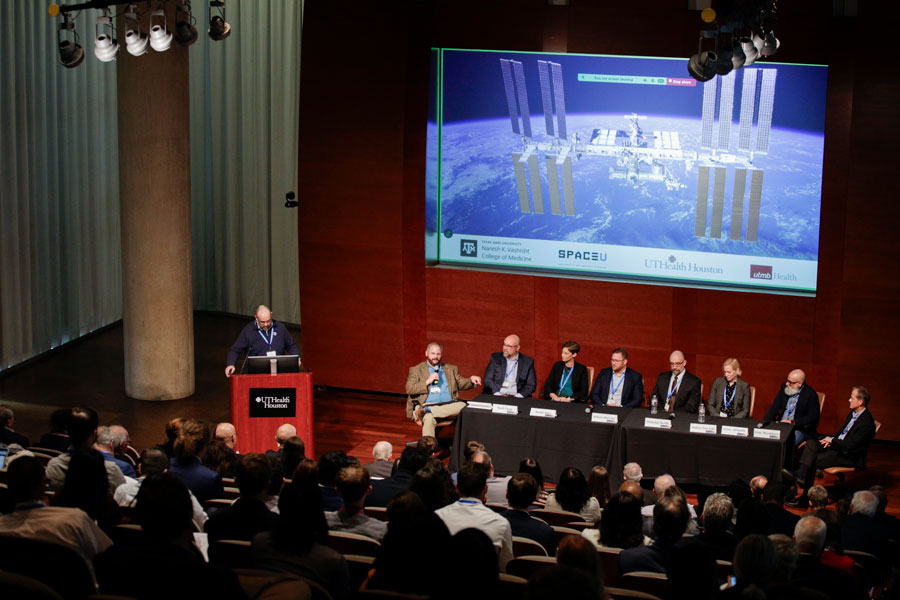
Bringing together astronauts, NASA physicians, commercial spaceflight leaders, and international partners from more than a dozen nations, UTHealth Houston hosted the 2025 International Space Medicine Summit Nov. 19-21, marking the first time the globally recognized meeting convened under the university’s leadership and signaling a pivotal moment for the institution’s expanding Space Medicine Program.
The three-day, invitation-only summit drew representatives from NASA Headquarters, the European and Japanese space agencies, the U.S. Air Force and Space Command, and commercial partners such as SpaceX, Blue Origin, Axiom Space, Sierra Space, and Intuitive Machines.
Attendees also included physicians, researchers, and medical directors from France, Germany, Portugal, Hungary, Saudi Arabia, and Russia — many of whom traveled to Houston specifically for the event.
“This was a meeting of space medicine doctors, researchers, administrators, engineers, and commercial partners at the very highest levels,” said Michael Bungo, MD, professor of cardiovascular medicine in the Department of Internal Medicine at McGovern Medical School at UTHealth Houston.
This year’s summit was especially meaningful for UTHealth Houston. For more than 17 years, it was hosted by Rice University and led by George W.S. Abbey, the former director of NASA’s Johnson Space Center and one of the most influential figures in the history of human spaceflight. Following Abbey’s passing in 2024, Rice stepped away from hosting the event, opening the door for a new steward.
UTHealth Houston, in partnership with the University of Central Florida, Texas A&M University, and The University of Texas Medical Branch, stepped forward. The University of Texas System was also instrumental in providing support. David Lakey, MD, the vice chancellor for Health Affairs and chief medical officer of UT System, provided remarks at Thursday evening’s activities.
One of the most memorable moments of the first morning was a special welcome video beamed directly from the International Space Station. NASA astronaut Mike Fincke, currently serving on Expedition 73, greeted the audience from orbit.
“I’ve had the privilege of spending almost 500 days in space across four space missions, and I can tell you firsthand space medicine is not just important, it’s essential,” Fincke said. “From managing microgravity’s effects on our bodies to preparing for deep space exploration, your work is the foundation of everything we do up here. Your summit is a celebration of the global collaboration that is the foundation of human exploration, especially here on the International Space Station. From all of us here in space, thank you for your dedication, your innovation, and your passion. We’re cheering you on from orbit, and we’re looking forward to seeing where your collaborations take us next.”
A new chapter for UTHealth Houston in the space medicine landscape
Hosting the summit for the first time allowed UTHealth Houston to highlight the depth and breadth of its Space Medicine Program (external link), a growing network of researchers and clinicians working across the university’s schools of medicine, public health, nursing, dentistry, and biomedical informatics. Over the past year, the program has expanded rapidly, building collaborations with NASA, commercial partners, and global agencies while launching new projects in microgravity research, AI-driven clinical support, and remote health care delivery.
For Kris Lehnhardt, MD, director of the Space Medicine Program, the summit was also an opportunity to demonstrate how UTHealth Houston is shaping the future direction of the field.
“If you’ve been to ISMS before, I hope you’re going to notice a few key changes this year,” Lehnhardt told attendees. “The first one is that we have a much more robust commercial spaceflight presence here at this event, and that was done intentionally. The second is that we have a larger emphasis and focus on the interdisciplinary nature of space medicine and human health and performance in general.”
Lehnhardt emphasized these changes were not cosmetic. They reflect the direction in which UTHealth Houston is pushing the field.
Aligning a global summit with institutional momentum
For UTHealth Houston leadership, the summit represents a valuable opportunity to demonstrate the university’s growing capabilities in space medicine and to strengthen connections with national and international partners shaping the future of human spaceflight.
“What makes UTHealth Houston uniquely positioned to lead in space medicine is the remarkable depth and diversity of expertise across all of our schools. When our clinicians, public health scientists, biomedical informaticians, nurses, dentists, and space medicine leaders come together, we create solutions that no single discipline could achieve alone,” said Bentley Bobrow, MD, UTHealth Houston’s inaugural vice president for healthcare innovation. “Space medicine is no longer a niche field; it is a catalyst for the next generation of medical innovation, and leading institutions around the country are moving quickly. Our students see this clearly — they are energized by the possibilities of space medicine and AI and what it will mean for their training and careers.”
Bobrow noted that UTHealth Houston’s space medicine efforts already span clinical education, human factors research, radiation health, aerospace epidemiology, autonomous care systems, and collaborations with SpaceX and other commercial spaceflight partners.
Funding support for the summit was partially provided through UTHealth Houston’s innovation initiatives, underscoring the event’s alignment with the university’s long-term strategic direction.
A summit built around global cooperation
Programming for the International Space Medicine Summit reflected the wide range of challenges and opportunities facing human spaceflight over the next decade. Among the 2025 highlights:
- A strategic discussion with NASA leadership and international partners on mission priorities, commercial partnerships, and training needs for the next generation of spaceflight teams.
- Celebration of the 25th anniversary of ISS Increment 1, featuring astronauts and flight surgeons who helped establish the earliest medical operations aboard the station.
- Deep dives into radiation risks, lunar exploration, emergency medical capabilities, behavioral health, and autonomous medical support systems for deep-space missions.
- Conversations on new spacefaring nations, with representatives from Saudi Arabia, India, the United Arab Emirates, and Hungary discussing how emerging programs are training astronauts and building medical readiness.
- Panels on commercial spaceflight, including standards for nontraditional astronauts and the evolving research landscape aboard private missions.
- A focus on STEM education and workforce development, led by academic and industry partners shaping the next generation of engineers, physicians, and scientists.
The summit also featured a tribute to George Abbey, a reminder of the summit’s history and of Houston’s longstanding role at the center of human spaceflight.
Looking ahead
By hosting this year’s summit, UTHealth Houston took a significant step toward strengthening the visibility and momentum of its space medicine efforts, both on campus and across the global aerospace community.
“This summit positions us to lead,” Lehnhardt said.
As the commercial space industry accelerates, new spacefaring nations emerge, and lunar and Mars missions become more tangible, UTHealth Houston aims to remain at the forefront of the medical systems, technologies, and training models that will support the next era of exploration.