Advancing behavioral health for the next generation
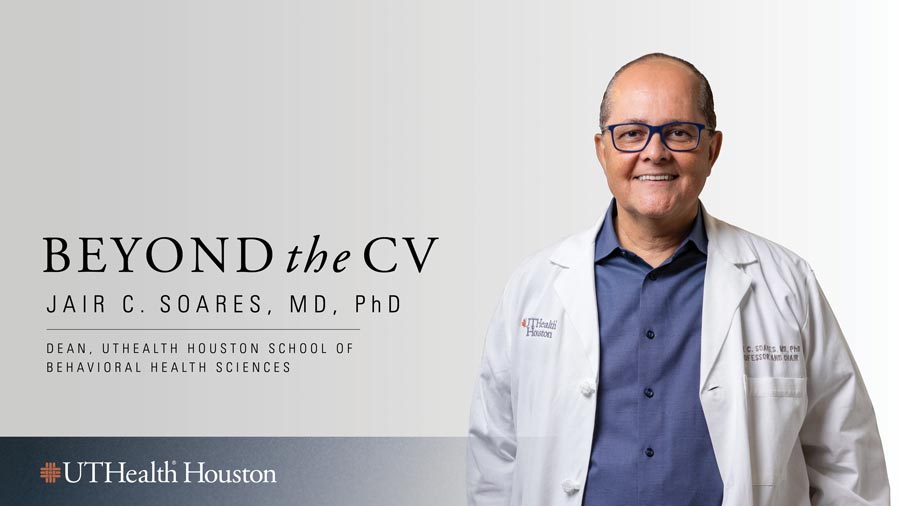
In every health care university, there are leaders whose journeys, passions, and commitments shape the experiences of students and the future.
The Beyond the CV series looks past the bios of the deans leading UTHealth Houston’s schools to explore their personal motivations, defining moments, and guiding philosophies.
This month, Jair C. Soares, MD, PhD, reflects on his journey and the future of behavioral health at UTHealth Houston. Soares serves as vice president for Behavioral Sciences and is the Pat R. Rutherford, Jr. Chair in Psychiatry at McGovern Medical School at UTHealth Houston, as well as founding dean of UTHealth Houston School of Behavioral Health Sciences and executive director of the John S. Dunn Behavioral Sciences Center.
Why did you pursue a career in behavioral health?
Since around age 13, when I was in middle school, I knew I wanted to be a doctor. My father was a dentist, and my parents were very supportive of that decision. At first, I thought I wanted to be a surgeon, but once I got to medical school and spent time following surgeons, I realized that wasn’t for me. Everything changed when I did a rotation with the psychiatry department at the University of São Paulo in Brazil, where I attended medical school. I found it fascinating.
Psychiatry became an easy choice for me. It was more interesting than anything else I studied in medical school. By my second year, my focus had shifted to behavior, psychopharmacology, psychology, and psychiatry. I became involved in research projects, and the rest is history.
I’ve always been drawn to human behavior, understanding what drives people and what we can do to help them feel better and do better. It’s a fascinating field. And with the explosion in brain sciences, we now have greater hope of understanding how the brain works and how disruptions in the brain lead to different kinds of behavioral challenges.
You’ve accomplished so much in your career. How do you keep evolving professionally and stay motivated?
I love what I do and the people I work with. A lot of it comes down to curiosity. I’m a high-energy person, so I can’t sit still for very long. Thinking about everything we still have to accomplish for our patients keeps me motivated and makes the work fun and interesting. The challenges in behavioral health are many and incredibly complex. There are no easy solutions, and that’s what keeps me going. I truly value and embrace the challenges we face every day as we work to find better ways to help our patients.
Tell us about a proud moment in your career where you greatly impacted a student and why it means so much to you.
I’ve been fortunate to work with many great people over a long period of time, but my proudest mentorship story is with my very first postdoc trainee. This was at the University of Pittsburgh, just after I had become an assistant professor. A colleague of mine in Italy, a professor at the University of Milan, had a curious and very bright psychiatric resident who wanted to spend a year working with me in Pittsburgh. At the time, I had just started my first research lab. It was small, just me, one research assistant, and Paolo Brambilla, who ultimately stayed for three years.
When I later moved to Texas, first to The University of Texas San Antonio, Paolo came with me. Eventually, he returned to Italy, where he became a lifelong collaborator and friend and is now chair of psychiatry at the University of Milan. We later had the opportunity to serve together as co-editors-in-chief of a leading publication in our field, the Journal of Affective Disorders.
What are you most looking forward to in your tenure as dean?
Since there are so many unmet needs in behavioral health, workforce development is at the top of our priorities. We need more professionals to care for patients who are suffering, and we also need to build multidisciplinary teams of scientists who can help us address these disorders more effectively. This is an opportunity to assemble a team with real depth, one that can tackle behavioral health challenges in innovative ways and help us better understand how to prevent conditions before they become lifelong, chronic illnesses that cause significant suffering.
We also want to develop more effective treatments and deepen our understanding of disease causation, including the biological mechanisms involved and how those mechanisms interact with environmental factors in complex ways we don’t yet fully understand. As our understanding improves, better and newer treatments will follow. I truly believe behavioral health is approaching a period of exponential growth. We’re not there yet, but what we already have works — if we can deliver it more systematically to more people.
UTHealth Houston School of Behavioral Health Sciences should be a place where many of these discoveries occur over the next decade. Research has been part of our fabric from the beginning, and we intend to strengthen it even further. At the same time, we are building a broad range of graduate and postgraduate programs across the behavioral health disciplines. This creates a tremendous opportunity to connect those offerings with our established graduate medical education programs through the medical school and psychiatry department, including multiple master’s and doctoral programs spanning the full spectrum of behavioral health.
What do you think makes UTHealth Houston and your school unique compared to others?
I believe the real opportunity lies in coordination and synergy, bringing everything together at the largest academic psychiatric hospital in the country, a place that has already built a substantial footprint in behavioral health across clinical services, education, and leading-edge research.
We are the largest academic psychiatric hospital in the nation, with 538 beds operating as a single, integrated entity under one leadership team. By comparison, the second-largest facility has just over 300 beds. We serve a broad catchment area and care for some of the most severely ill patients, who are increasingly coming from across Texas and other parts of the country. This gives our trainees the opportunity to see the most challenging cases in psychiatry and receive outstanding training in how to manage them, all within an environment that is, and should continue to be, strongly research-focused.
By creating a large pool of innovative talent, we’re able to work in a truly multidisciplinary way, building close, synergistic collaborations with our medical school, nursing school, School of Public Health, and McWilliams School of Biomedical Informatics. It’s the breadth and depth of what we can build here that makes this effort unique compared with what has been done elsewhere.
I’m incredibly proud of the team we’ve assembled at UTHealth Houston in behavioral sciences and psychiatry. We’ve had a wonderful run, and one of the proudest accomplishments of my life has been being part of the team that helped craft and execute the vision that led to the creation of the John S. Dunn Behavioral Sciences Center at UTHealth Houston, a facility that was much needed.
What qualities do you want graduates to leave with as they pursue next steps in their career?
Compassion is essential. You really shouldn’t enter this field unless you care deeply about people and want to make their lives better.
At the same time, it’s important to have a strong grasp of the technical skills needed to treat patients effectively. That includes understanding new and emerging disciplines, as advances in neuroscience and behavioral sciences continue to reshape psychiatry. There’s also a part that’s harder to teach — curiosity about human nature, about what drives people, and a desire to work in teams to develop solutions that reduce the suffering associated with serious mental illness.
I really want to see our graduates become compassionate, curious, committed, and hardworking professionals who always keep our patients’ best interests at heart.
What excites you most about the future of behavioral health and behavioral health education, and how is your school preparing for that future?
The demand for behavioral health services is large, and we are nowhere near meeting it. That’s why this is such an important moment to be part of the effort to scale up. Our state, and the nation as a whole, desperately needs these professionals, which makes this a great time to enter the field. Mental illnesses are widespread, with about a 25% chance of being diagnosed with one over a lifetime. They are everywhere you look.
At the same time, society has made real progress in reducing stigma, which means more people are coming forward and seeking the care they need. That progress has also increased demand for services. Keeping pace with that demand by training enough professionals to meet this pressing need in our state is our highest priority over the next several years. All of this makes now an especially exciting time to be in psychiatry and behavioral sciences, with tremendous opportunities for those who choose this path.
I believe psychiatry and behavioral health today are where oncology was three or four decades ago, at the beginning of a period of rapid growth and discovery. There is real momentum behind us, and I expect unprecedented advances that will take our field to the next level. I’m incredibly excited about the team we’ve assembled and the strong support we’ve received from leadership, state officials, and community philanthropists. This truly is the right place to build the future of psychiatry and behavioral sciences.
Tell us one thing about yourself that most people don’t know.
My wife and I have six cats, so I’m kind of a cat person. When the first one came along, I wasn’t completely on board, but the moment I saw it, I loved it right away. One cat led to a few more adoptions, and now we’re up to six. No matter what room you walk into, you’re going to find a cat. I don’t think we’re allowed to adopt any more, at least for now.
I’m also very curious about people and cultures. One of my greatest pleasures in life is traveling — visiting places I’ve never been and returning to places I’ve enjoyed before. I’ve always been drawn to different cultures and experiences, and I plan to keep traveling and exploring as long as I’m healthy and able to enjoy it.