Students get real-life experience at mass casualty simulation
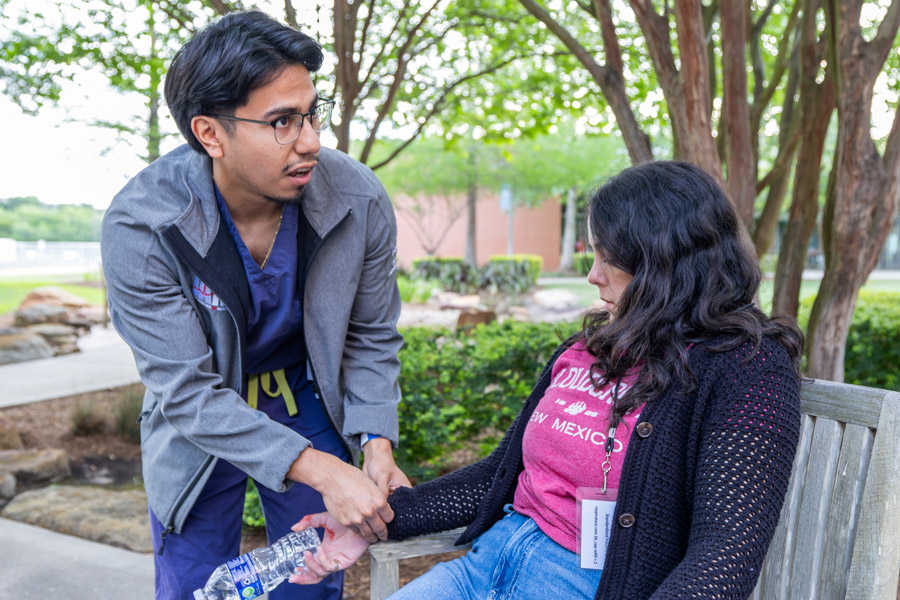
Students from McGovern Medical School at UTHealth Houston, alongside others from Cizik School of Nursing at UTHealth Houston and UTHealth Houston School of Dentistry, as well as social work students from Texas Southern University, stepped into controlled chaos as part of a mass casualty simulation on April 7.
Designed to mirror the urgency and complexity of real-world emergencies, students began the day with a short briefing session before immediately stepping into a simulated mass casualty event in the courtyard of the Cooley University Life Center at UTHealth Houston.
The students immediately sprang into action, spreading out into groups to help patients and determine who needed the quickest care. Whether assessing each patient, providing immediate care, or comforting those who were not in imminent danger, each student played a role in providing care at the scene.
“In a mass casualty, team structure and process are paramount to creating order from chaos,” said Rachel Jantea, MD, MS, associate professor of geriatric and palliative medicine. “In this mass casualty simulation, students learn how to work effectively in teams by assigning roles, engaging in clear communication, and applying evidence-based strategies for collaboration in the field. As they engage in this activity as interprofessional teams, they are also learning about the unique expertise and skills of each health profession in the process, often an eye-opening experience for them.”
Throughout the event, students faced real-world scenarios beyond immediate patient care. Whether it was the good Samaritan who helped neutralize a threat, or a hysterical patient screaming at those around them, the situation was designed to feel as real as possible.
“This was a great way to apply what I’ve learned in medical school, especially quick patient assessment from my emergency medicine rotations,” said Eric Mohan, fourth-year medical student. “You can’t really teach this in the classroom. You only get it by practicing in a simulation like this.”
Following the simulation, students discussed what they did well and what they could improve.
After the debrief, students returned for another simulation, this time in a hospital setting. What started as a normal day in the emergency room quickly turned chaotic when patients from the first session’s mass casualty event begin to arrive at the hospital.
The students had to figure out which of the original patients could be discharged to make room for those coming in. From there, they assessed the patients, determined their medical needs, and placed orders for tests, medications, and consultations.
“As a physician, you’re going to see everything under the light, and mass casualty is probably something that I will encounter in my future,” Mohan said. “A simulation session like this, where I can create this idea in my head of what I think is going to happen, and then being adaptable to actually seeing what’s in front of me is a great resource.”
Following the hospital simulation, students returned to the debriefing room to evaluate their work. After the second session, the students felt they were much more prepared for the chaos of the second scene compared to how they fared in the first.
Throughout the day, students were challenged to apply clinical knowledge, communicate across disciplines, and adapt in real time, which reinforced the critical role of teamwork in delivering effective patient care during crisis situations.
“Our responsibility is to graduate health profession students not only competent in their own field, but also able to engage in effective health care teams that provide high quality patient care,” Jantea said. “As a result of interprofessional simulations like this one, UTHealth Houston students are set up to graduate as health care team leaders.”