Hulsebosch wins John H. Freeman Award
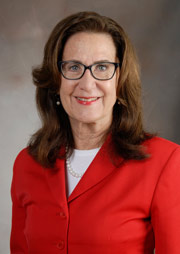
Claire E. Hulsebosch, PhD, professor in the Department of Neurobiology and Anatomy, is the 2026 recipient of the John H. Freeman Award for Faculty Teaching.
Chosen by the senior class, the John H. Freeman Award recognizes McGovern Medical School’s outstanding basic science faculty member. The winner of this award, which was established by university funds and named in Freeman’s honor, must exemplify enthusiasm and drive toward effective teaching, have a personal interest in students’ challenges and educational goals, and set an example that serves as a high standard for students.
Hulsebosch previously won the award in 2018, 2021, and 2023.
“This award is particularly meaningful because it is voted on by the graduating class,” Hulsebosch said. “Needless to say, I was thrilled and extremely honored to have been chosen. For the students to remember a faculty who impacted their medical education during the first two years of medical school is such an extremely high honor and very humbling. It is a privilege to interact with such bright, energetic, and dedicated students.”
Hulsebosch believes those students have served as her best mentors over the span of her career. She said that if an education strategy was successful, the students would let you know. If it was not, they would also let you know in resounding numbers.
“Fortunately, our medical students are very involved in continued improvement of the curriculum and give us constant feedback, which we faculty greatly appreciate and act upon,” she said.
Hulsebosch’s teaching philosophy centers around her own education background, treating each of her students as if they were her during her freshman year at Rice University.
When Hulsebosch graduated as high school valedictorian, she was easily able to learn new concepts and volumes of material. However, when she arrived at Rice, her peers were on the same intellectual caliber as her—some were even considered geniuses.
“I can remember feeling so challenged and still recall the feeling that I was in competition with an entire class of geniuses, and I was not one of them,” she said. “What I strive to do is catch my medical students before self-doubt or imposter syndrome sets in, and assure them that they have the talent and characteristics for success to be a great doctor.”
“I can also tell when students are struggling and pick up on subliminal signals. One of the educational concepts I try to impart to the students is that they aren’t competing against each other, but rather against themselves, to be the best physicians they can be.”
Hulsebosch also uses a multimodal teaching method, including auditory, visual, and kinesthetic learning, as well as drawing complex circuits. She says that a combination of sensory/cortical experiences improves consolidation, retention, and recall of information.
For a deviation from “boring class presentations,” Hulsebosch shakes things up by drawing on her theatrical side.
“I try to bring some theatrics into the presentation to make it more interesting,” she said. “I have been known to bring in stuffed socks, stuffed pantyhose, and moving frisbees to make body segmentation, development, and movement clear for my students.”
Hulsebosch praised the administration and faculty at McGovern Medical School for fostering a flexible learning atmosphere, where curriculum can change to suit the needs inside and outside of the classroom and can respond quickly to innovative and new teaching techniques. This was particularly true when COVID forced faculty to pivot medical modules from in-person delivery to virtual classrooms and laboratories.
“The administration here allows me the freedom and latitude to do things that are innovative and make the medical school learning experience more meaningful for the students,” she said. “The staff and faculty here are extremely supportive of one another. I could have gone to another medical school, but I had already collaborated with McGovern Medical School faculty and knew they were very open and positive about collaboration.”
Hulsebosch, who specializes principally in spinal cord injury, worked for nearly 40 years at The University of Texas Medical Branch before retiring. The retirement, however, was only 30 days long—she joked that she was not a happy retired person.
“I enjoy the interaction with my medical students,” Hulsebosch said. “It is a privilege to teach such bright, dedicated young people.”
With her CV in hand, Hulsebosch approached McGovern Medical School with nearly 40 years of teaching experience in gross anatomy, neuroscience, and development. She was hired immediately and thus returned to teaching in the late 2000s.
She serves on the scientific advisory boards for the Neurological Recovery Network and the North American Clinical Trials Network. She serves as a scientific adviser for National Institutes of Health neuroscience initiatives, and on the study section for the National Institute of Neurological Disorders and Stroke. She also serves on numerous editorial and review boards for scientific journals and has authored more than 350 peer-reviewed abstracts and publications, as well as the book “Spinal Cord Injury Pain.” Among her many honors, Hulsebosch is most proud of receiving the Christopher and Dana Reeve Award for her contributions to spinal cord injury research.
Previous winners of the John H. Freeman Award for Faculty Teaching include: Han Zhang, MD, 2025, 2022, 2019, 2016, 2013, 2010; Ronald “Chris” Mackenzie, PhD, FRSB, 2024, 2017, 2015; Phillip Carpenter, PhD, 2020; Dawnelle Schatte, MD, 2014; Joanne Oakes, MD, 2012; Elizabeth Hartwell, MD, 2007; Margaret O. Uthman, MD, 2011, 2009, 2005, 2001, 1999, 1997; Kent Heck, MD, 2004, 2002; Norman Weisbrodt, PhD, 2003; Barry Van Winkle, PhD, 2000, 1998; Marsha L. Eigenbrodt, MD, MPH, 1996; Ron C. Philo, PhD, 1995; Harley D. Sybers, MD, PhD, 1994, 1992, 1990; Frank W. Booth, MD, 1993; and Karmen L. Schmidt, PhD, 1991.