Champions of Clinical Learning Environment: Cowling and Gupta
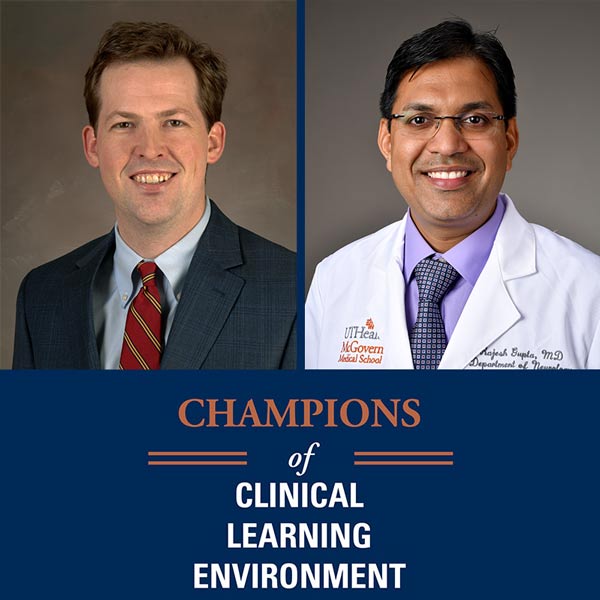
The Office of Professionalism at McGovern Medical School at UTHealth Houston congratulates John Cowling, MD, and Rajesh Gupta, MD, MS, on being honored as Champions of the Clinical Learning Environment.
Champions are identified through the Learning Environment Surveys, which are sent to students and provide an opportunity to recognize faculty whose everyday actions have meaningfully shaped their clinical education.
This series spotlights Champions of the Clinical Learning Environment. Each issue highlights educators who have made a lasting impression on third-year medical students during clerkship rotations by fostering clinical learning environments rooted in professionalism, compassion, and academic rigor.
John Cowling, MD
Assistant professor, Department of Surgery
How would you describe your teaching philosophy?
On my rotation, students not only see the clinical aspect of my practice and how I care for patients, but they also see how I interact with my partners, consultants, and hospital staff. I try to lead by example and inspire them to do what is right for the patient, and I think they get to see how rewarding the practice of surgery can be.
Do you have a particular practice that has proved effective in your clinical teaching?
I spend a lot of time with students reviewing radiology imaging and visual diagrams that can be found online to help them understand technical concepts of an operation immediately before we start a case. That preparation seems to help them better understand what we are trying to accomplish in surgery and where challenges or pitfalls may arise. I encourage questions continuously and do my best to explain as we go along, particularly in the operating room. I remind them to read daily, especially about the pathophysiology we are seeing in the hospital.
What is a memorable moment or teaching success story from working with third-year medical students?
It’s always great to get text messages from former students after Match Day and see that they’ve reached their goals. It’s even better when we’ve been able to inspire someone to pursue surgery as a career.
How do you foster a supportive learning environment for our students on their clerkship rotations?
We make the student a member of the team. I introduce them to every patient we meet, as well as the operating room staff. They play an active role in surgery and assist on rounds. I encourage questions and highlight the thought processes that go into our decision-making. They eat breakfast and lunch with us every day and have opportunities to engage in all kinds of conversations with many of the other doctors in the hospital.
What advice would you give to new faculty or residents who are starting their clinical teaching journey?
Treat students how you would want to be treated and model the clinical care you would want for yourself. They are very eager to learn and to see what life is like in each specialty. Community sites can provide very strong rotations because they offer a high volume of the common clinical problems students see on their exams.
Rajesh Gupta, MD, MS
Associate professor, Department of Neurology
How would you describe your teaching philosophy?
My teaching philosophy is to make neurology approachable by emphasizing pattern recognition, localization, and clinical reasoning. I encourage curiosity and the habit of asking “why,” helping students connect anatomy and pathophysiology to real patient presentations. My goal is for each learner to think critically and develop confidence as a future clinician.
Do you have a particular practice that has proved effective in your clinical teaching?
One of my most effective practices is bedside reasoning through guided questioning. I ask students to describe what they observe, interpret it, and reason through localization. This approach helps them learn to think like neurologists while keeping the patient at the center of the discussion. I also provide immediate, constructive feedback to reinforce learning in real time.
What do you enjoy most about working with medical students during their training?
I enjoy watching students develop confidence and curiosity as they learn to perform detailed neurological exams and localize findings. Their enthusiasm often leads to insightful discussions that keep my own thinking fresh and grounded in curiosity. Teaching reminds me daily of the intellectual and humanistic roots of neurology.
How has teaching shaped your clinical practice?
Teaching has refined my clarity of communication and deepened my empathy. Explaining complex neurological diseases such as autoimmune encephalitis and neurosarcoidosis to students sharpens my own reasoning and ensures I stay up to date with evolving science. It also reminds me to approach every patient encounter as an opportunity to teach, learn, and connect.
How do you foster a supportive learning environment for our students on their clerkship rotations?
I strive to create a safe, respectful space where students feel comfortable sharing ideas and uncertainties. I encourage them to think aloud, develop hypotheses, and learn from mistakes. My approach models curiosity, humility, and teamwork—values central to both neurology and medical education.
What advice would you give to new faculty or residents who are starting their clinical teaching journey?
Start small and focus on one key teaching point per encounter. Use open-ended questions that guide learners to reason through clinical problems. Above all, show enthusiasm. Students learn as much from your attitude and empathy as they do from your words.