Dean’s Dialogue showcases momentum across McGovern Medical School and UTHealth Houston
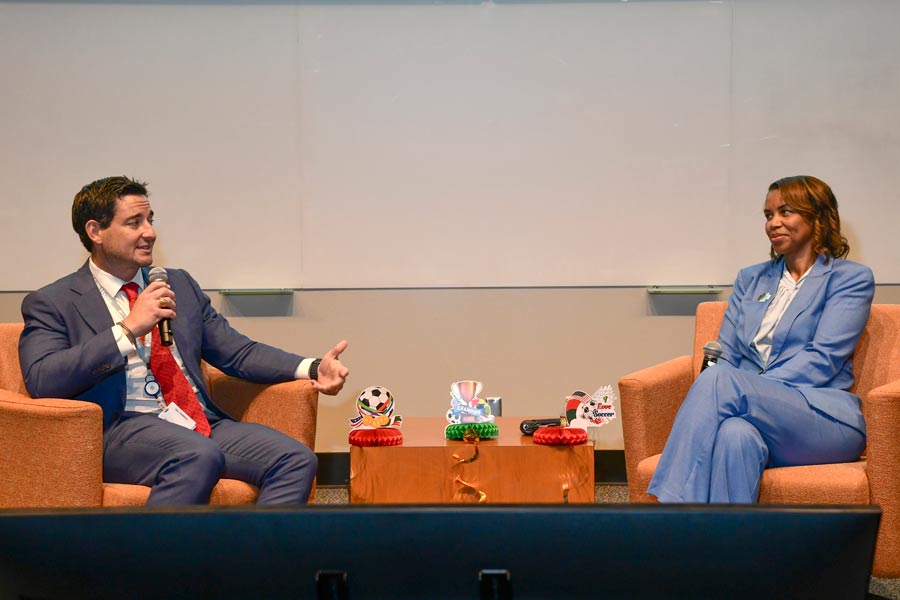
The second Dean’s Dialogue on June 11 offered McGovern Medical School at UTHealth Houston faculty and staff a wide-ranging look at the momentum shaping the university in 2026.
Areas discussed were celebrations of student success, preparations for the FIFA World Cup, updates on strategic growth, and a look ahead at the future of healthcare and research.
Early discussion
Dean LaTanya J. Love, MD, opened the event by reflecting on several milestones across McGovern Medical School during the first half of the year while reinforcing a theme carried over from commencement: leading with gratitude, connection, and purpose.
Love highlighted the Class of 2026’s 100% residency match rate and recent commencement ceremony, where keynote speaker Rex Marco, MD (external link), encouraged graduates and attendees alike to lead with love in their work and relationships. She also welcomed nearly 500 new residents and fellows preparing to begin the next stage of their medical training at UTHealth Houston.
Love also commended faculty participation in the medical school’s AAMC StandPoint survey, which achieved a 74% response rate and will provide meaningful feedback to support future institutional planning and improvement efforts.
FIFA World Cup preparations
From celebrating recent accomplishments to preparing for what lies ahead, the conversation shifted to one of the largest events Houston has hosted in recent years.
The first featured guest of the Dean’s Dialogue was UT Police at Houston Capt. Mike Redmond, who provided an overview of preparations surrounding the ongoing FIFA World Cup matches in Houston, describing the event’s scale as comparable to hosting multiple Super Bowls. Redmond outlined anticipated impacts including increased traffic, pedestrian activity, fan gatherings, and public safety considerations, while emphasizing coordinated planning efforts to minimize disruption across the Texas Medical Center.
Continuing the World Cup discussion from a public health perspective, Luis Ostrosky, MD, professor and division chief of infectious diseases, Memorial Hermann Chair, director of the Laboratory of Mycology Research, and vice chair of medicine for health care quality at McGovern Medical School at UTHealth Houston, discussed infectious disease preparedness ahead of the games. With Houston expected to welcome more than 500,000 international visitors, he outlined preparations for respiratory illnesses, vaccine-preventable diseases, and other public health concerns.
Ostrosky highlighted coordination with state and federal agencies, the creation of a 24/7 infectious disease hotline, and extensive education and screening efforts across UTHealth Houston, Memorial Hermann, and Harris Health System, including protocols related to Ebola preparedness.
Clinical and strategic plan discussions
The discussion then turned inward to the university’s long-term vision and how institutional infrastructure supports the academic mission.
Love welcomed Michael Patriarca, MBA, MS, the new executive vice president and chief business affairs and strategy officer at UTHealth Houston, to discuss how long-term planning supports the institution’s education, research, and clinical missions. Patriarca emphasized that the university’s strategic plan will be community-driven and encouraged participation across UTHealth Houston to help shape its future direction.
Building on those discussions around growth and sustainability, Brian Dean, MBA, MPH, executive vice president of Health Affairs, provided updates on the clinical practice plan.
Dean reported continued clinical advancement, with patient visits increasing more than 7% over the past year and growth occurring across all clinical areas. He highlighted initiatives focused on financial counseling, managed care optimization, expanded clinical space at UT Physicians Multispecialty–Bellaire Station, and operational improvements aimed at strengthening patient access and experience.
Providing additional context behind that growth, Angela Smith, senior associate dean for finance at McGovern Medical School, delivered an overview of education, research, and patient care finances.
Smith noted that state funding and tuition support have remained relatively stable while research expenditures continue to hold steady. She also highlighted improvements in the practice plan, with operating losses significantly reduced compared with both budget projections and the prior fiscal year.
Research, patient safety, operational excellence
The conversation then shifted to research performance and the broader national landscape shaping academic medicine.
John Hancock, MA, MB, BChir, PhD, ScD, senior vice president of research strategy and innovation at UTHealth Houston, reported that research funding reached more than $274 million in awards granted or in progress and expressed optimism for a strong fourth quarter from UTHealth Houston researchers. Hancock also discussed the evolving federal research environment, including ongoing conversations surrounding NIH funding policies and future research regulations.
Turning to clinical excellence and innovation, Bela Patel, MD, vice dean for healthcare quality, highlighted recent achievements in quality and patient safety and shared plans to expand patient safety training for incoming trainees.
Patel also discussed efforts to incorporate artificial intelligence into performance improvement initiatives, positioning the university to continue advancing quality outcomes and operational excellence.
New resource hub and philanthropy focus
Technology remained a focus as Associate Vice President and Deputy Chief Information Officer Bassel Choucair introduced UTHealth Houston | ONE (external link), a new centralized digital platform designed to help employees and learners more easily access university software, tools, and services in one location.
The platform also includes approved artificial intelligence resources and personalized features intended to simplify navigation across institutional systems and improve the user experience.
The Dean’s Dialogue concluded with Tanya Gee, Grateful Patient Program director, who shared how philanthropy can create meaningful opportunities for patients and families to support research, education, and patient care initiatives.
Gee emphasized protecting the patient-physician relationship while introducing new educational resources and streamlined referral pathways designed to help faculty connect interested patients with development opportunities.
If you were unable to attend, or would like discussion, the full recording (external link) is available. If you have any feedback, questions, or topics you want discussed at the next Dean’s Dialogue, fill out the feedback form (external link).