Community lessons help shape future physicians
For future physicians, understanding a patient’s health means understanding more than what happens inside an exam room.
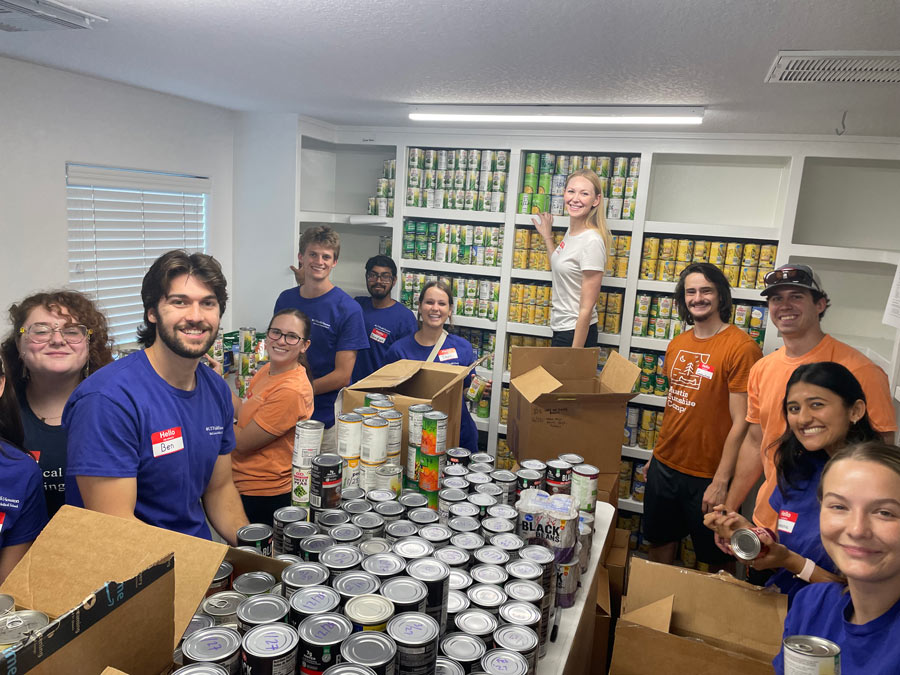
Through the Professional Learning Underscored by Service (PLUS) program at McGovern Medical School at UTHealth Houston, first- and second-year medical students are stepping into communities across Houston to see firsthand how food access, transportation, housing, financial stability, social connection, and other factors can shape health.
The longitudinal service-learning program, launched in 2024 as an evolution of the medical school’s traditional Day of Service, integrates community engagement directly into the preclerkship curriculum. Rather than participating in a single volunteer experience, students develop sustained relationships with community organizations while connecting what they encounter to lessons they are learning in medical school.
Students participate through their McGovern Societies in groups of approximately 10 and are accompanied by faculty facilitators. During visits, students take part in a critical lens walk through the surrounding neighborhoods, examining the communities’ strengths and challenges and learning directly from the organizations and people who live and work there. They then collaborate with their partner organizations on priorities identified by the organizations themselves.
Following each experience, students debrief with a faculty facilitator and complete written reflections. They return to the same organization during the fall and spring semesters of their first and second years, providing at least four opportunities to build relationships, listen to community perspectives, and better understand the connection between physicians, patients, and the community.
For one student working with Harlem River Farms, the experience prompted a shift in how they thought about developing treatment plans.
“It really encouraged me to be intentional about putting myself in my patients’ shoes and crafting a treatment plan that is not only scientifically backed, but practically sound and personalized,” the student wrote in their reflection.
The student described learning to look beyond addressing an immediate medical problem and consider what could prevent it from happening again. For instance, food access and other circumstances in a patient’s life could determine whether a treatment plan that works scientifically will also work for the individual receiving it.
That connection between community experiences and medical education is a central component of PLUS. Students use challenges identified alongside their community partners as part of their social determinants of health team-based learning, bringing observations from the community back into the classroom.
“PLUS gives students the opportunity to move beyond learning about social determinants of health in the abstract and see how challenges such as housing insecurity shape a person’s health and ability to navigate care,” said Anish Patnaik, MD, MPH, assistant professor in the Department of Pediatrics “That firsthand understanding is essential. Physicians are better equipped to address barriers when they have seen how those barriers affect patients’ daily lives. PLUS bridges classroom learning with the lived realities of the communities our students will serve.”
Those lessons also come directly from community members.
During a visit to Magnificat Houses-St. Joseph House, a student stayed for lunch and spoke with a woman about her experiences with healthcare and mental illness. She offered the student a piece of advice: “Never reduce someone to the mental illness diagnosis they may have.”
The woman explained that after receiving her diagnoses, she often felt healthcare professionals saw her only through the lens of mental illness. At times, she said, other health concerns were dismissed or minimized, leaving her feeling overlooked.
It was advice the student wrote they would “never forget.”
Expanding the experience
The program expanded in 2026 with support from a $15,000 Weil Foundation grant focused on integrative medicine. The funding provides first-year students with additional opportunities to explore how culture, community, and access to food influence health and wellness.
As part of the expanded experience, faculty facilitators can accompany students for shared meals at locally owned restaurants in the communities where they serve. The meals provide protected time for reflections while encouraging students to consider the accessibility and affordability of food options available to community members.
Second-year students will also have opportunities to participate in a supplemental cooking class through UTHealth Houston School of Public Health alongside individuals served by their partner organizations. Using ingredients sourced from a community garden or food pantry, the experience will connect practical nutrition and culinary skills with the relationship between food, community, and health.
The 2026 community partners represented a broad spectrum of needs across Houston, including women’s health and safety, aging and social connection, food insecurity, community health and resource access, family stability and economic opportunity, neighborhood health, disability and adaptive health, and health education and science communication.
The program is support by faculty facilitators throughout McGovern Medical School who accompany students and help them process their experiences. Fourth-year medical students Tara Darabadey and Katherine Bender also played instrumental roles in supporting this year’s program.
In their own words
Students anonymously reflected on their PLUS experiences and the lessons they will carry forward into their medical training.
BakerRipley
“I observed vibrancy in the Gulfton community, which appeared to give a sense of hope to those living there. I also appreciated the variety of resources that BakerRipley provides, from early childhood education all the way through senior engagement.
“I think that developing a sense of community throughout the entire lifespan and helping connect neighbors to resources they need to be successful creates a unique strength and community-wide resilience in Gulfton. I also appreciated the green spaces in Gulfton as a means for the community, which is incredibly diverse, to connect without the need for language.”
Harlem River Farms
“It really encouraged me to be intentional about putting myself in my patients’ shoes and crafting a treatment plan that is not only scientifically backed, but practically sound and personalized. I learned how to ask more than, ‘What seems to be the issue, and how can I help?’ but also, ‘How can we make sure this doesn’t happen again?’ through preventive medicine.
“I admired Mr. Ron McFarlane for his sensitivity to his community’s issues and getting down to the root of them so that, at some point in the future, food access won’t be a barrier to their health. That’s a perspective I aim to carry with me: reading charts, asking questions, and crafting treatment plans through the lens of personalized efficacy and the goals of prevention and empowerment.”
Houston Area Women’s Center
“I learned so much about domestic violence and how it can affect entire communities. It is not limited to a gender, race, or socioeconomic status. During their presentation, the facility shared some impactful statistics. The one that stuck out to me the most was the fact that homicide was 500% more likely when there is a handgun in the abusive household.
“Hearing that many women are fatally attacked after leaving or attempting to leave really broke my heart. Many people think that survivors should ‘just leave,’ but it is never that easy. We discussed the many factors that contribute to an extended stay with a perpetrator, such as children, pets, financial insecurity, citizenship status, and so much more. Hearing stories of how children and pets were abused following a woman’s decision to leave was heart-wrenching, to say the least.
“The Houston Area Women’s Center did an amazing job educating future physicians by giving us proper terminology to use when charting or referring to survivors. For example, ‘survivor’ is much more empowering than ‘victim,’ and ‘perpetrator’ is much more appropriate to use as opposed to ‘suspect.’ Emphasizing that we should always come from a place of believing the survivor will be something I take with me for the rest of my career.
“When documenting encounters in the future, I will always say ‘states’ instead of ‘alleged’ because ambiguous terms can be detrimental when courts are reviewing documents. I also learned how to handle these situations with the utmost respect and courtesy for future patients. It is very inappropriate to discuss sensitive matters in front of the abuser or children because it can create a volatile situation after the appointment.
“One thing that I did not even think about beforehand was how giving physical pamphlets or resources could be harmful if their abuser sees them. After hearing all of this information, I now believe I have the tools to handle any possible abuse encounter with the utmost respect, humility, and discretion.”
Metropolitan Multi-Service Center, Adaptive Sports & Recreation
“The number of people who arrived at the center via public transportation, on foot, or using a wheelchair or other mobility device, without assistance or a private vehicle, demonstrated a huge amount of resilience to me. While I am glad that there are forms of public transportation available to people with disabilities and/or mobility aids, this exposed a gap in the accessibility of the space.
“Additionally, as we walked through the neighborhood surrounding the center, we encountered broken sidewalks, had to walk on and off the street, and encountered overgrown trees and grass. This would be very difficult for someone with any difficulty walking or mobilizing to navigate. This is a significant barrier to people accessing the resources provided at the center; however, it also highlights the dedication and commitment of those who persevered.
“It was encouraging to see how varied the services were at the Metropolitan Multi-Service Center. It seemed like there were activities designed for people of varying life stages and activity levels. Exercise machines were adapted for wheelchair users, people using walkers, and those walking independently. There was a wide variety of exercise classes, including water aerobics, agility for people with Parkinson’s disease, and several youth sports.
“In addition, there were art, language, and social organizations. These classes provide a community for the people involved in them. The sense of friendship and belonging developed is a huge asset to the well-being of those using the center.”
Amazing Place (Aging, Geriatrics, and Dementia/Alzheimer’s)
“A moment that expanded my perspective was during a conversation and sharing session with all the women participants at the center. One of the employees was guiding the discussion, which started with us introducing ourselves, and then tangential discussions branched from there.
“Something I noticed was just how quickly conversations could hit a dead end or how some participants could get stuck in a loop of repeating themselves and coming back to a particular topic even after we had moved on. While it’s not the first time I’ve seen this type of thing occur, I have always worried about my ability to navigate it smoothly. I was very impressed with just how skillfully the employee involved kept the conversation flowing or moved on without leaving the participants feeling embarrassed.
“She also had a way of encouraging the participants to contribute even when they maybe didn’t understand the topic or had very blunt or superficial answers. It seemed to me that her energy was crucial to establishing momentum that made the women want to talk, or at the very least allowed them to feel included, even if they didn’t want to speak much themselves.”
Magnificat Houses-St. Joseph House (Mental Health)
“One specific moment from my PLUS service day that challenged my perspective occurred when I had the opportunity to stay for lunch so that I could talk with some of the members about their experiences with healthcare. I was having a conversation with an older woman who shared a few of the mental illness diagnoses that she had received and then gave me a piece of advice that I will not forget.
“She said, ‘Never reduce someone to the mental illness diagnosis they may have.’ She explained that ever since her diagnoses, she feels that providers only view her through that lens and that her mental illness is all that she is seen as. She told me about times her concerns were dismissed or minimized, leading her to feel overlooked.”
Hiram Clarke Multi-Service Center (Community Health and Resource Access)
“For our service day, we set up for an event for children with autism. We set up a sensory area and many tables that contained free school supplies for the kids. While setting up the school supplies, I thought in the moment, ‘Oh, this is nice. It’s nice to get some stuff for free.’ But the more I thought about it, the more I thought about how helpful getting school supplies for free could be to families.
“I remember as a kid going shopping for supplies and being able to get whatever I wanted. It was fun and exciting, and I looked forward to it every year. However, this made me think about the fact that while that was my experience, for many, back-to-school season can be very challenging financially. As an adult now, knowing how much things cost, I’m sure that back-to-school shopping can be very financially draining for many.
“This realization made me understand more and more how important events like this are. They allow children to get the supplies they need so they can learn, while also helping their parents. Additionally, I thought it was great that this event was autism friendly. A lot of our setup included making the space more accessible, and I really appreciated that. I also think having an event like this where families who are in similar situations can connect and build community is great.”
YMCA International Services (Family Support/Immigration)
“While helping clients come through to pick out their back-to-school backpacks, one of the kids picked up a Pokémon-themed backpack and had one of the biggest smiles on their face. Seeing that reminded me that we are not just helping organize and give people a backpack, but also providing them with something more.
“A backpack with school supplies is something many families could not afford without having to worry about whether to purchase food or school supplies. Providing these necessities at no cost allows families and our clients to focus on other aspects of their lives.
“Seeing the kids happy and excited with their new school supplies also made us happy, knowing they don’t have to worry about affording these necessities and can enjoy being kids like their peers. It definitely reminds me of the importance of considering social determinants of health and the stories, challenges, and perseverance that each patient brings with them, often unseen, as they walk through our clinics and hospital floors.”