Turning connections into opportunities
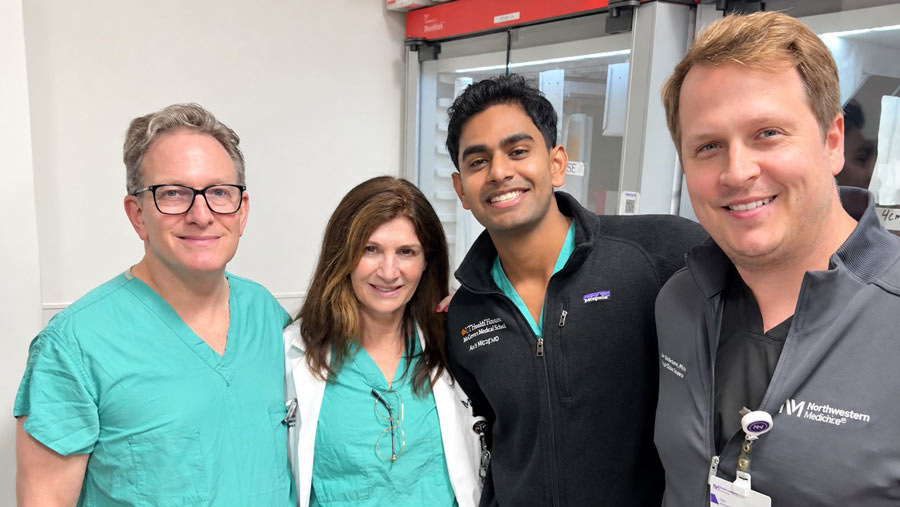
For second-year McGovern Medical School at UTHealth Houston student Akhil Marupudi, one conversation led to another and eventually to a role in a $37 million clinical trial.
Marupudi spent last summer at Northwestern University working on projects including a clinical trial for FibriCheck, a heart-monitoring app. He pursued the opportunity using a mutual contact to make a connection that led to an informal internship.
There, he worked with Dr. Anna Pfenniger, MD, PhD, and Rod Passman, MD, director of the Center for Arrhythmia Research and the Jules J. Reingold Professor of Electrophysiology in the Department of Medicine at Northwestern University Feinberg School of Medicine.
Those relationships didn’t end when the summer did.
Passman is also the principal investigator for REACT-AF, a $37 million clinical trial focused on atrial fibrillation. UTHealth Houston is one of the clinical sites. After working with Marupudi at Northwestern, Passman offered him an opportunity to contribute to the study.
For Marupudi, the experience demonstrates something students can sometimes overlook while concentrating on classes, research, and other demands: Building relationships can create opportunities that may not otherwise exist.
Building relationships before you need them
Networking doesn’t necessarily mean attending an event and collecting business cards. It can start with something much simpler: reaching out to someone whose work interests you, asking a question, meeting people through existing contacts, or becoming involved in organizations related to your interests.
Marupudi’s experience began with that kind of initiative.
Shane Cunha, PhD, associate professor of integrative biology and pharmacology at McGovern Medical School, helped Marupudi make some of his initial connections. But Cunha said the student took responsibility for turning those introductions into opportunities.
“He was the driving force to create an opportunity to work on a NIH-sponsored clinical trial at Northwestern University Feinberg School of Medicine over the summer,” Cunha said. “I am delighted that Akhil will continue working on the REACT-AF clinical trial.”
Marupudi’s network has also helped him find opportunities to work on publications that will be presented at upcoming conferences.
His approach to networking is straightforward: Remember that a professional connection is still a relationship between people.
“You’re in college. You meet people. Obviously, you have to be more professional to MDs and PhDs, but at the end of the day, they’re still human,” Marupudi said. “They still want to have that personal life outside of school. So, never be afraid to approach anyone.”
Creating connections across UTHealth Houston
Students don’t necessarily have to look far to begin building those relationships.
Classes, research projects, student organizations, university events, faculty mentors, alumni, and fellow students can all provide opportunities to meet people with different experiences and expertise.
Those connections can help students learn about specialties and career paths, find mentors, discover research and professional opportunities, and eventually make connections for others.
With seven schools and a location in the Texas Medical Center, UTHealth Houston gives students opportunities to develop relationships both within their own disciplines and across the healthcare community.
Marupudi’s own connections extend beyond his clinical trial work. Alongside his medical degree, he is pursuing a master’s degree in public health, involved in gastrointestinal cancer research, and working with UTHealth Houston alumnus Amier Haidar, MD, MPH, to launch a cardiovascular health initiative aimed at educating youth about heart-healthy lifestyles.
He has also experienced the value of connections closer to home. Last year, Marupudi served as social chair for his class at McGovern Medical School, a role centered on creating opportunities for his classmates to connect with one another. For him, those personal relationships are just as important as professional ones.
“I think it’s really important that you have that group of friends, create that environment where you can meet people and talk to people about stuff that isn’t about research, isn’t about medical school, isn’t about these hard things you’re doing in your life,” Marupudi said.
Taken together, those experiences show that networking doesn’t have to be limited to seeking the next internship, research project, or career opportunity. It can also mean becoming involved, meeting people with shared interests, maintaining relationships, and creating opportunities for others to connect.
The goal isn’t to approach every interaction wondering what it might produce. Marupudi’s experience shows why simply being willing to introduce yourself, express an interest, and maintain relationships can matter. A connection made today could lead to a mentor, collaborator, research project, career insight, or an opportunity a student hadn’t considered.
Resources for building your network
UTHealth Houston offers several ways for students to strengthen their networking skills and make new connections, including:
- Upcoming webinars (external link) focused on resumes, networking, and LinkedIn.
- Student organizations (external link) across UTHealth Houston’s seven schools.
- Mentorship Night (external link), which gives students an opportunity to connect with alumni mentors, ask questions, explore career paths, and build their professional networks.
- Coursera Career Academy (external link), which offers online courses supporting professional growth and career readiness.
For Marupudi, making those connections is part of taking advantage of the opportunities available to students now, rather than waiting until they begin their careers.
“People say you’re in college once. You’re also in medical school once,” Marupudi said. “So, it’s really important that you are making those right connections in the Texas Medical Center and at McGovern Medical School.”