Dr. Kunal Jain Honored for 10 Years of Service to UTHealth Houston
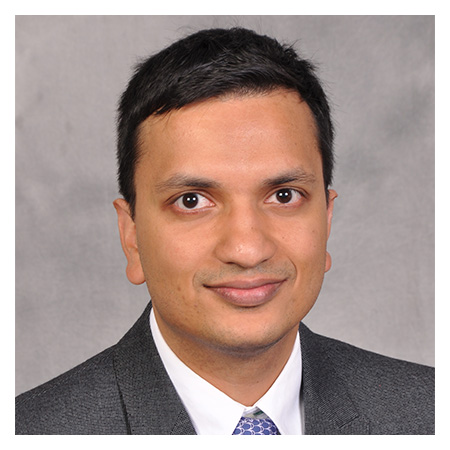 Kunal S. Jain, MD, FACS, joined the Department of Otorhinolaryngology at McGovern Medical School in 2015 after completion of his fellowship training. In the decade since he was recruited to help grow the department’s head and neck cancer program, he has seen treatment for these malignancies advance significantly.
“Regardless of the type of malignancy and treatment, we’re walking our cancer patients through a very difficult period in their lives,” says Dr. Jain, an associate professor of otorhinolaryngology. “It’s important that they understand their disease and the treatment plan. I show them the CT and MRI images of their cancer, which gives them a better idea of what we’ll be tackling together. When it comes to time, we don’t shortchange our patients. I’ve been a patient, too, and am always aware that you feel valued as a person when your doctor takes time to get to know you. That extra time we spend with our cancer patients adds to their emotional wellbeing and ability to cope with the challenges of treatment.”
Dr. Jain’s interest in head and neck cancer surgery began at the age of 17 during a summer research internship at The University of Texas MD Anderson Cancer Center. “That experience solidified my interest in medicine,” he says. “When I got to medical school, I explored other specialties but always gravitated back to what led me there in the first place. ENTs focus on both medical treatment and surgery, which appealed to me. I also find it rewarding to help patients regain abilities they’ve lost or, in cancer’s case, save a life.”
He received his bachelor’s degree in economics from Cornell University, spent his junior year at the London School of Economics and Political Science in the UK, and went on to earn his medical degree at The University of Texas Southwestern Medical Center in Dallas. “I knew I wanted to be a surgeon, and within the broad field of surgery, I rotated through urology, orthopedics, and plastic surgery, but ENT still attracted me in terms of the anatomy, the surgical breadth of what we do, and the impact we have on people’s lives,” he says.
After graduation, Dr. Jain completed his internship in general surgery and his residency in otolaryngology-head and neck surgery at SUNY Upstate Medical University in Syracuse, NY. He joined the faculty at UTHealth Houston after completing a fellowship in head and neck oncology and microvascular reconstruction at the University of Pennsylvania in Philadelphia. Today, he treats patients with benign and malignant tumors of the head and neck, including throat cancer, oral cancer, larynx cancer, locally advanced skin cancer, salivary gland tumors, and thyroid and parathyroid disease, and he also performs reconstructive surgery.
“We follow our cancer patients for five years after treatment, which allows me to develop long-term relationships with them. There aren’t many surgical specialties that offer the opportunity to provide longitudinal care to an individual over time, rather than in isolated episodes,” he says. “Patients grow to trust you. Some ask which doctor I’d go to for non-ENT conditions, and some want to continue seeing me annually, even after five years.”
Dr. Jain’s research is centered on the economics of health care, with a focus on cost-utility analyses of various treatment interventions. “We’re studying how to maximize the value a patient receives from different treatment options, while minimizing the cost,” he says.
He also enjoys training residents. “Several of our residents have gone on to complete head and neck cancer fellowships and are now practicing around the country,” he says. “When they’re first starting out, they call me to talk about technical precision and next steps. Eventually, they gain confidence and stop calling, but I see them regularly at meetings. It’s gratifying to know that we played a role in creating another successful head and neck cancer surgeon.”
In the past decade, immunotherapy has come to be considered a fourth pillar of cancer treatment, along with surgery, chemotherapy, and radiation. “We now use immunotherapy before surgery when appropriate, instead of as a last effort to save a cancer patient who’s already had surgery and chemoradiation and unfortunately had a recurrence,” he says. “There will always be a role for surgery, but I believe we’re gradually reducing the overall morbidity of cancer treatment. It’s an exciting time to be working in oncology.”