Janice Bradley Regains Her Voice
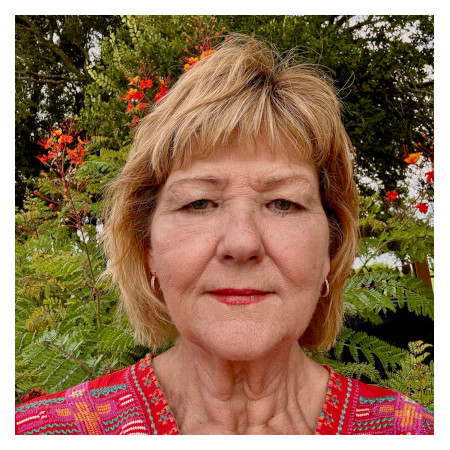 After parathyroid surgery at a community hospital in October 2023, Janice Bradley discovered that her voice had changed. “I sounded like Minnie Mouse and had to repeat everything several times to be understood. It was embarrassing,” she says. “I was in the church choir, and I couldn’t sing. My doctor told me that a voice change after surgery usually resolves itself within a year. When it didn’t, I learned that it likely wouldn’t improve.”
Her ENT in Victoria, Texas, referred her to Andrew Tritter, MD, director of the Texas Voice Performance Institute and the laryngology division in the Department of Otorhinolaryngology at McGovern Medical School at UTHealth Houston. “You always hear that they treat you like a number in the big-city hospitals, and my friends and family urged me to have the surgery done close to home,” Bradley says. “I said, ‘No, I’m going to the best and if that’s in Houston, I’ll go to Houston.’”
When Dr. Tritter examined Bradley’s larynx, he confirmed the diagnosis of paralysis of the left vocal cord. “Mrs. Bradley had the classic symptoms of vocal cord paralysis – a weak, breathy, and high-pitched voice. The vocal cords come together and vibrate to produce sound when air from the lungs passes through them. Their tension and length affect the pitch of the voice,” he says. “When one cord is paralyzed, it sits off to the side, preventing the two vocal cords from coming together to close. This lets too much air escape when talking. She was a perfect candidate for permanent repair through thyroplasty.”
Thyroplasty improves the voice by using an implant to change the position or length of the vocal cords. “During the surgery we place an implant customized to the patient to help push the paralyzed vocal cord into a position where the other one can reach it. In Mrs. Bradley’s case we used a carved piece of silicone to allow the vocal cords to touch and produce sound,” Dr. Tritter says. “Usually, the surgery is done with the patient awake under local anesthetic with minimal intravenous calming medication to help with relaxation. This allows us to test out different implant sizes until we find the one that sounds best.”
“I was a little afraid when he said I would be awake during the surgery so he could ask me to make sounds,” says Bradley, who is 69. “At one point he told me that my voice sounded good but that he thought he could improve it. I said, ‘Okay, go for it!’
“The next day I could talk and called everyone I knew,” she adds. “And it was the same voice I’ve always had. It’s the most wonderful thing to get your voice back. I’m so thankful I went to him, and everyone at the hospital was super caring and kind. It couldn’t have been a better experience.”
Dr. Tritter notes that thyroplasty is the standard of care for vocal cord paralysis. “It’s really a terrific surgery because we’re tuning the patient’s voice in real time, with immediate feedback,” he says. “It’s always gratifying to help a patient, and Mrs. Bradley had a great result.”