Saving Larvell Love
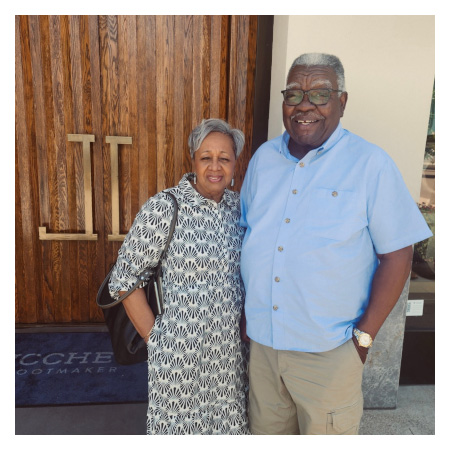 At first, Larvell Love attributed his hoarse voice to snoring. “After a while, I noticed he was having difficulty swallowing,” says his wife, Alice Love, a retired registered nurse. “I said, yes, Larvell, we will be going to the doctor about this.”
“Larvell continued to have the problem, and we all thought he should see an ENT,” his wife says. “We all” included their daughter, a speech-language pathologist; their son, a registered nurse; and their daughter-in-law, an OR technician.
The ENT, Luke Burke, MD, an assistant professor in the Department of Otorhinolaryngology, identified a throat mass on follow-up, and he then sent Love to Kunal Jain, MD, an associate professor in the department. Dr. Jain treats patients with benign and malignant tumors of the head and neck, including throat cancer, oral cancer, larynx cancer, locally advanced skin cancer, salivary gland tumors, and thyroid and parathyroid disease, and he also performs reconstructive surgery.
“We researched Dr. Jain’s success rate, and after we all met him, there was no question in our minds,” Love says. “I felt I had the best of all worlds in my corner.”
Dr. Jain was concerned about the tonsil area and base of his patient’s tongue. “We biopsied the area and the results were negative,” he says. “But looking at the initial imaging, I felt the biopsy result wasn’t truly representative of what was going on. Given my high level of suspicion, I told Mr. Love and his family that it would be worthwhile to repeat the biopsy and take more tissue.”
The second biopsy, done in December 2023, revealed stage 4 mucoepidermoid carcinoma of the oropharynx – salivary gland cancer – a challenging malignancy.
Dr. Jain ordered a PET/CT scan and an MRI. The results showed a 7-centimeter tumor extending from his hyoid bone, which anchors the muscles of the tongue and is crucial for speech and swallowing, up along the lateral pharyngeal wall, and from his tonsils up to the soft palate. “Sometimes we can use robotic surgery to remove a tumor in this area, but because of its size, this was not a possibility,” he says. “Removing Mr. Love’s tongue and larynx would allow us to clear all the cancer with 100% certainty, but most patients don’t want that surgery because it leaves them unable to talk or swallow.”
Love was among them. “I opted for option 2, which was to remove as much tissue as possible and any involved lymph nodes, followed by a strong round of radiation and chemotherapy,” he says.
The tumor originated from a minor salivary gland, and malignant minor salivary gland tumors are not responsive to radiation or chemotherapy as the primary treatment. “In the end, based on Mr. Love’s wishes, we decided to remove the tonsil, the back of the tongue, and a portion of the larynx to clear the cancer,” Dr. Jain says. “We would have to split his jaw to access the tumor, remove part of the hyoid bone, and transfer tissue from his forearm to replace what we removed.”
“We knew he would need a lot of postoperative rehabilitation,” he adds. “We encourage our head-and-neck cancer patients to start therapy before surgery and continue afterwards as part of the treatment. He understood that because his daughter is a speech and swallow therapist.”
Dr. Jain took Love to the OR in January 2024 and performed a successful resection with mandibulotomy and free flap tissue transfer from the forearm. Following surgery, he underwent radiation therapy directed by Mark Amsbaugh, MD, an associate professor in the Vivian L. Smith Department of Neurosurgery, and chemotherapy by Syed Jafri, MBBS, a professor in the Division of Oncology, both at UTHealth Houston. He also saw Carolina Gutiérrez, MD, associate professor of physical medicine and rehabilitation, who specializes in cancer rehabilitation at TIRR Memorial Hermann.
“When we remove large amounts of the tongue and throat, there’s always the concern that the patient will be dependent on a tracheostomy and feeding tube,” Dr. Jain says. ““It was a huge surgery and because of the rehab Mr. Love had before and afterwards, we were able to remove his tracheostomy two weeks later and he has no feeding tube. We put his jaw together with a plate and hid all his scars within skin creases. The skin we transferred from his forearm to his throat has healed very well. He has a very positive attitude, is nearly two years out, and his most recent PET/CT scan was clear.”
Throughout his treatment, the Loves have maintained their sense of humor. “We wanted to be upbeat for Larvell,” Alice Love says. “Some days were very hard, but we kept smiling and moving forward. Before he went in for surgery, my son and daughter and I sat him down and told him all he had to worry about was getting well for us, because we had his back on everything else. It’s okay. He’s here with us and that’s all that matters. We made it through and he’s talking to us today because of Dr. Jain. We could talk all night and not say enough good things about Larvell’s care team.”