A Young Patient Benefits from Cochlear Implantation for Sudden Sensorial Hearing Loss
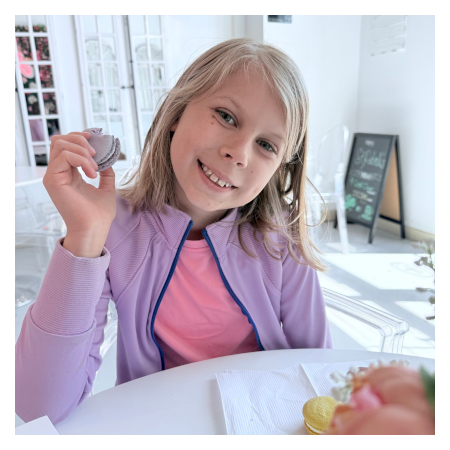 At first, Kate Baumbach thought her 12-year-old daughter’s hearing loss might be caused by fluid in her left ear. “When Helena told me she couldn’t hear very well and her ear felt closed, I thought of the ear tubes she’d had as a toddler and suggested we see her pediatrician,” Baumbach says. “But she didn’t have fluid, and the pediatrician referred us to a local ENT.”
When the ENT discovered that Helena had lost 80% of her normal hearing in the left ear, he referred her to an audiologist. “We thought they would recommend a hearing aid, but they advised us to consider a cochlear implant,” Baumbach says. “We were very surprised that she would qualify.”
The audiologist knew of the expertise of Vivian Kaul, MD, chief of otology and neurotology in the Department of Otorhinolaryngology at UTHealth Houston, and suggested that Baumbach schedule an appointment. “When Helena first heard about cochlear implantation, she said, ‘No, no, no, no, no. I don’t want this,’” Baumbach says. “She was very scared, but Dr. Kaul really put her mind at ease. Helena is analytical and scientific and had a lot of questions about the risks of surgery and the benefits of implantation. Dr. Kaul did a great job of answering all her questions. We liked her personally and felt confident in her skill.”
They discussed the benefits of and options for cochlear implantation during several office visits. “Sudden sensorial hearing loss is commonly caused by a viral infection,” Dr. Kaul says. “Regardless of the virus, the treatment of choice for patients who qualify is cochlear implantation. Our goal is to preserve hearing whenever possible and ideally, we want to use the smallest implant. Hair cells in the inner ear convert sound vibrations into electrical signals that the brain interprets as sound. Helena still had hair cells intact at the apex of her cochlea, so we considered using a shorter implant to preserve those cells. But if she loses more hearing 10 years later, are we going to repeat the surgery using a longer implant? These are the issues we discuss with patient and family.”
In the end, because of Helena’s age and her parents’ wishes, Dr. Kaul and her team chose an implant that exactly matched her cochlear duct length, making it a one-time-only surgery. Implant activation can begin as early as two to three weeks after a patient leaves the OR, but Helena had plans to go to summer camp.
“My recovery took about a week, and I was really happy that everything healed well,” Helena says. “Dr. Kaul cleared me to swim at camp, so we waited longer – about a month – to activate my implant.”
During several visits, an audiologist programmed the implant’s electrodes to deliver electrical stimulation to the auditory nerve, creating the sensation of sound. Over time, Helena is learning to interpret the sounds and integrate them into her daily life.
“I haven’t gotten completely used to it yet,” she says. “It takes a little while.”
“Each individual performs differently with the device due to variability in the human brain,” Dr. Kaul says. “Patients who have recently lost hearing in the affected ear tend to do well. Those who have had long-term hearing loss or recurrent infections or have a condition that affects the brain – stroke, dementia, or autism, for example – tend to have more trouble adapting. Helena is very bright and has no issues, so we don’t expect a prolonged acclimation period. We usually tell patients three to six months but those with good neuroplasticity can adapt sooner, especially if they wear it all day. It takes time for the brain and ear to train to the device, and those who wear it during all waking hours of the day achieve the best results.”
“We’re very grateful that we found Dr. Kaul and moved quickly,” Kate Baumbach says. “After talking with her about cochlear implantation, we felt it was pretty much a no-brainer. It’s also great that Helena, who’s interested in math and science, had the opportunity to be treated by a woman who has succeeded as a surgeon. She’s a great role model.”