SAINT-TMS: A New Era of Accelerated Brain Stimulation for Severe Depression
Major depressive disorder remains one of the leading causes of disability worldwide, and for many patients, standard treatments—including antidepressant medications and traditional transcranial magnetic stimulation (TMS)—do not produce sufficient relief. In recent years, a novel approach known as SAINT-TMS (Stanford Accelerated Intelligent Neuromodulation Therapy) has generated significant interest because of its potential to produce rapid and robust antidepressant effects in individuals with treatment-resistant depression.
SAINT-TMS represents an innovative evolution of conventional TMS protocols, combining accelerated treatment schedules, high-dose stimulation, and personalized targeting of brain networks involved in mood regulation.
What Is SAINT-TMS?
SAINT-TMS is an advanced form of intermittent theta-burst stimulation (iTBS) delivered to the left dorsolateral prefrontal cortex (DLPFC), a brain region involved in cognitive control and emotional regulation.
What makes SAINT-TMS unique is that it integrates three major innovations:
- Precision Targeting
Functional MRI is used to identify the DLPFC region most strongly connected to the subgenual anterior cingulate cortex, a region critically implicated in depression.
- Accelerated Treatment Schedule
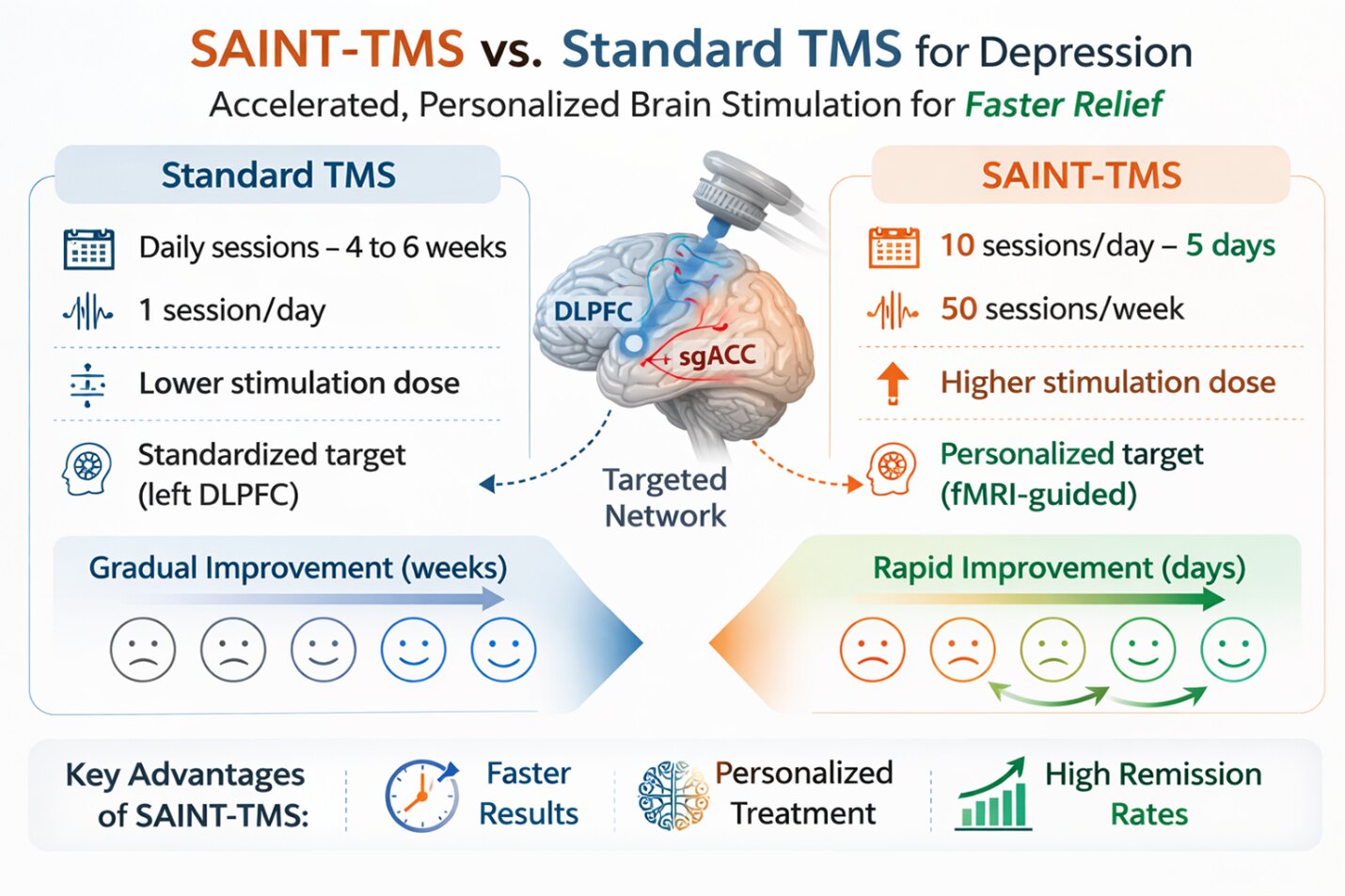
Instead of delivering one session per day over several weeks, SAINT-TMS administers multiple sessions per day over just a few days.
- Higher Stimulation Dose
The protocol delivers a substantially greater cumulative number of stimulation pulses than standard TMS treatments.
Together, these modifications aim to maximize the therapeutic impact of neuromodulation.
How the Treatment Is Delivered
In the SAINT protocol, patients typically receive:
- 10 stimulation sessions per day
- Sessions spaced about 50 minutes apart
- Treatment delivered over five consecutive days
This results in 50 total sessions in one week, dramatically accelerating the treatment timeline compared with standard TMS, which typically involves daily sessions over 4–6 weeks.
Each session uses intermittent theta-burst stimulation, a pattern designed to mimic natural brain rhythms involved in learning and synaptic plasticity.
Clinical Results So Far
Early clinical trials of SAINT-TMS have reported remarkably high response and remission rates in patients with severe treatment-resistant depression.
In a landmark randomized controlled trial, approximately:
- 80–90% of participants responded to treatment
- Around 70–80% achieved remission
Even more striking, many patients experienced substantial symptom improvement within just a few days, rather than the weeks typically required for antidepressant medications.
Importantly, the treatment has also shown potential benefits for individuals experiencing acute suicidal ideation, where rapid symptom relief can be critically important.
Why Target Brain Networks?
Traditional TMS protocols typically stimulate a standardized scalp location. However, modern neuroimaging research has shown that depression involves dysfunctional brain networks, particularly interactions between:
- The dorsolateral prefrontal cortex (DLPFC)
- The subgenual anterior cingulate cortex (sgACC)
SAINT-TMS uses functional connectivity imaging to identify the precise DLPFC location that is most negatively correlated with the sgACC in each patient. Stimulating this personalized target may help restore normal network dynamics.
This approach represents an important step toward precision neuromodulation.
Safety and Tolerability
Like conventional TMS, SAINT-TMS is non-invasive and does not require anesthesia.
Reported side effects are generally mild and may include:
- Scalp discomfort
- Headache
- Fatigue
Importantly, studies to date have found no significant cognitive impairment, unlike some other neuromodulation treatments.
Because of the accelerated schedule, careful clinical monitoring is essential during treatment.
How SAINT-TMS Fits Into the Future of Interventional Psychiatry
SAINT-TMS reflects several broader trends in modern psychiatric treatment:
- Personalized targeting of brain circuits
- Accelerated treatment protocols
- Higher-dose neuromodulation approaches
- Integration of neuroimaging and therapeutics
These developments are helping transform the field of interventional psychiatry, which focuses on using device-based treatments to modulate dysfunctional brain circuits directly.
At the Center for Interventional Psychiatry at UTHealth Houston, our mission is to advance these emerging therapies while continuing to expand access to established treatments such as ECT, TMS, VNS, and ketamine-based interventions for patients with severe mood disorders.
Final Thoughts
For individuals with treatment-resistant depression, waiting weeks or months for symptom improvement can be extraordinarily difficult. The development of accelerated neuromodulation strategies such as SAINT-TMS raises the possibility that rapid antidepressant effects may become increasingly achievable.
While additional large-scale studies are still needed, early findings suggest that SAINT-TMS may represent an important step toward faster, more personalized brain stimulation treatments for depression.
References
Cole EJ, Stimpson KH, Bentzley BS, et al. Stanford Accelerated Intelligent Neuromodulation Therapy for treatment-resistant depression. American Journal of Psychiatry. 2020.
Williams NR, Sudheimer KD, Bentzley BS, et al. High-dose spaced theta-burst TMS as a rapid antidepressant treatment. Brain. 2018.
Contacts
Request for Second Opinion Form: https://Go.uth.edu/CIPIntake (external link)
Phone: (713) 486-2621
Fax: (713) 500-2728
E-mail: [email protected]
Website: https://go.uth.edu/CIP (external link)
Disclaimer
This article was created with the assistance of artificial intelligence (AI) to enhance clarity and readability. All medical and scientific content has been reviewed and approved by Joao L. de Quevedo, MD, PhD, Director of the Center for Interventional Psychiatry at the John S. Dunn Behavioral Sciences Center at UTHealth Houston. This content is for educational purposes only and does not substitute for professional medical advice.