Resveratrol and Mental Health: Could a Natural Compound Support Psychiatric Treatment?
Interest in the relationship between nutrition and mental health has grown substantially in recent years. Increasing evidence suggests that certain dietary compounds may influence brain function and potentially play a role in the prevention or treatment of psychiatric disorders.
A recent review article co-authored by investigators from UTHealth Houston and the University of Southern Santa Catarina (Brazil) examined the potential therapeutic effects of resveratrol, a naturally occurring polyphenol found in grapes, berries, and nuts, across several psychiatric and neurodegenerative disorders.
The review summarizes emerging evidence from clinical studies and animal models, exploring how resveratrol may influence biological pathways linked to depression, bipolar disorder, schizophrenia, Alzheimer’s disease, and autism spectrum disorders.
What Is Resveratrol?
Resveratrol is a polyphenolic compound belonging to the stilbene family. It is found naturally in foods such as:
- Grapes and red wine
- Berries
- Peanuts and nuts
This compound has attracted scientific interest due to its antioxidant, anti-inflammatory, and neuroprotective properties, which may affect multiple biological systems involved in brain health.
Researchers have suggested that resveratrol may affect several important cellular pathways, including those regulating:
- Oxidative stress
- Neuroinflammation
- Cell survival and apoptosis
- Neuroplasticity and neurotrophic signaling
These mechanisms are increasingly recognized as central components of many psychiatric disorders.
Potential Role in Major Depressive Disorder
Major depressive disorder affects hundreds of millions of people worldwide and is associated with complex biological changes involving inflammation, oxidative stress, and impaired neuroplasticity.
Preclinical studies summarized in the review indicate that resveratrol may exert antidepressant-like effects in animal models. These effects include:
- Reduction of anhedonia-like behavior
- Decreased immobility in behavioral tests associated with depression
- Reduced inflammatory markers such as IL-6 and TNF-α
- Increased levels of brain-derived neurotrophic factor (BDNF)
Resveratrol may also activate signaling pathways, such as SIRT1 and CREB, involved in neuronal survival and synaptic plasticity.
Together, these mechanisms suggest that resveratrol could influence biological processes involved in depressive illness.
Bipolar Disorder: Targeting Oxidative Stress
Bipolar disorder is characterized by recurrent episodes of depression and mania and is associated with oxidative stress and mitochondrial dysfunction.
In animal models of mania induced by amphetamine, resveratrol did not reverse manic-like behavior. Still, it reduced oxidative and nitrosative damage in the brain, including markers of lipid and protein oxidation.
These findings suggest that resveratrol may provide neuroprotective effects that could potentially complement established mood stabilizers such as lithium or valproate.
Schizophrenia and Neuroinflammation
Schizophrenia involves complex alterations in neurotransmission, neurodevelopment, and inflammation.
Clinical studies summarized in the review suggest that resveratrol supplementation may improve negative symptoms in patients with schizophrenia when used as an adjunct to antipsychotic treatment.
Animal studies also suggest that resveratrol may:
- Reduce hyperactivity and behavioral abnormalities
- Increase BDNF expression
- Improve antioxidant enzyme activity
- Activate SIRT1 signaling pathways
These biological effects may contribute to improved neuronal resilience.
Alzheimer’s Disease and Neuroprotection
Resveratrol has also been studied extensively in Alzheimer’s disease, where it may influence several key mechanisms of neurodegeneration.
Preclinical studies suggest that resveratrol may:
- Reduce amyloid-beta accumulation
- Improve mitochondrial function
- Reduce oxidative stress
- Increase antioxidant enzyme activity
However, clinical trials in humans have produced mixed results, and additional research is needed to clarify its therapeutic potential.
Autism Spectrum Disorders
Emerging preclinical evidence suggests that resveratrol may improve behavioral and inflammatory changes in animal models of autism spectrum disorder.
Proposed mechanisms include modulation of:
- Neuroinflammatory signaling
- Oxidative stress pathways
- Immune responses
While these findings are promising, human studies are still limited.
A Promising but Still Emerging Field
Although the biological effects of resveratrol appear promising, most evidence currently comes from preclinical models. Clinical trials remain relatively small, and optimal dosing, treatment duration, and patient populations have not yet been clearly established.
Nevertheless, this growing body of research highlights the potential role of nutritional compounds as adjunctive strategies in psychiatric treatment.
Final Thoughts
Psychiatric disorders are complex conditions involving interactions between genetics, environment, lifestyle, and biological pathways such as inflammation and oxidative stress.
Resveratrol represents an intriguing example of how dietary compounds may influence brain health through multiple biological mechanisms. While more clinical research is needed, studies such as this help advance the field of nutritional and translational psychiatry, exploring new possibilities for prevention and treatment.
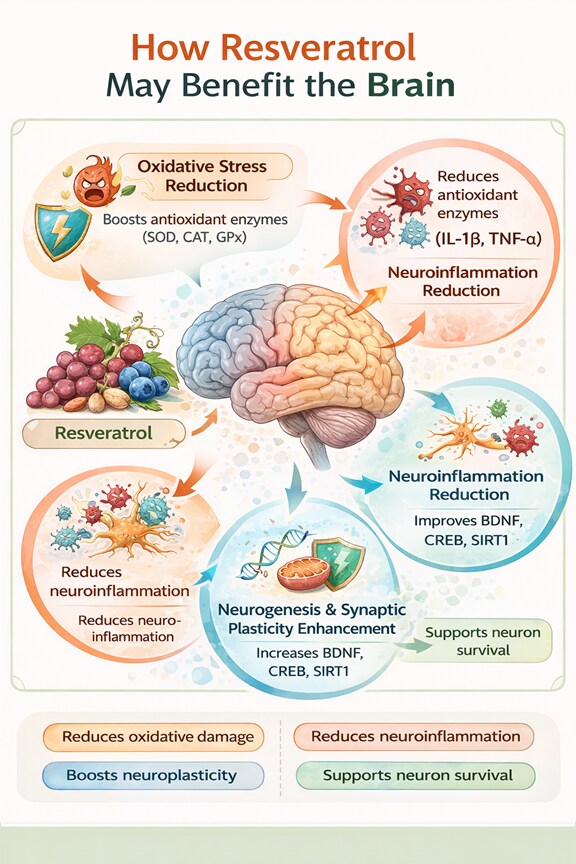
Figure. Proposed neurobiological mechanisms through which resveratrol may influence brain function.
Resveratrol, a polyphenolic compound found in grapes, berries, and nuts, may exert neuroprotective effects through multiple biological pathways. These mechanisms include reducing oxidative stress, suppressing neuroinflammatory signaling, and enhancing neuroplasticity and neuronal survival. Experimental studies suggest that resveratrol increases antioxidant enzyme activity (such as superoxide dismutase and catalase), decreases pro-inflammatory cytokines (including TNF-α and IL-1β), and modulates molecular pathways associated with synaptic plasticity, including SIRT1, CREB, and brain-derived neurotrophic factor (BDNF). Together, these mechanisms may contribute to the potential therapeutic effects of resveratrol observed in preclinical models of depression, bipolar disorder, schizophrenia, and neurodegenerative disorders.
Reference
Menegas S, Keller GS, Possamai-Della T, Aguiar-Geraldo JM, Quevedo J, Valvassori SS.
Potential mechanisms of action of resveratrol in prevention and therapy for mental disorders.
Journal of Nutritional Biochemistry. 2023;121:109435.
Contact
Request for Second Opinion Form – https://Go.uth.edu/CIPIntake (external link)
Phone – (713) 486-2621
Fax – (713) 500-2728
E-mail – [email protected]
Website: https://go.uth.edu/CIP (external link)
Disclaimer
This article was created with the assistance of artificial intelligence (AI) to help organize and refine the presentation of scientific information. All medical and scientific content has been reviewed and approved by Joao L. de Quevedo, MD, PhD, Director of the Center for Interventional Psychiatry at the John S. Dunn Behavioral Sciences Center at UTHealth Houston. The content is intended for educational and informational purposes only and does not substitute for professional medical advice.