A New Brain–Computer Interface for Treatment-Resistant Depression: The Next Frontier in Interventional Psychiatry?
From Neuromodulation to Neurotechnology
Over the past two decades, psychiatry has witnessed remarkable advances in neuromodulation.
Treatments such as transcranial magnetic stimulation (TMS), electroconvulsive therapy (ECT), vagus nerve stimulation (VNS), and deep brain stimulation (DBS) have transformed the care of patients with severe and treatment-resistant psychiatric disorders.
Now, a new generation of technologies is emerging at the intersection of neuroscience, engineering, and psychiatry:
Brain–computer interfaces (BCIs)
A recent announcement from Motif Neurotech marks an important milestone in this evolution. The company has received FDA approval to begin its first clinical trial evaluating an implantable therapeutic BCI for treatment-resistant depression (TRD).
Although still investigational, this technology provides a glimpse into what the future of precision psychiatry may look like.
What Is a Therapeutic Brain–Computer Interface?
Most people associate BCIs with efforts to restore communication or movement in patients with paralysis.
However, BCIs can also be designed to treat psychiatric and neurological disorders.
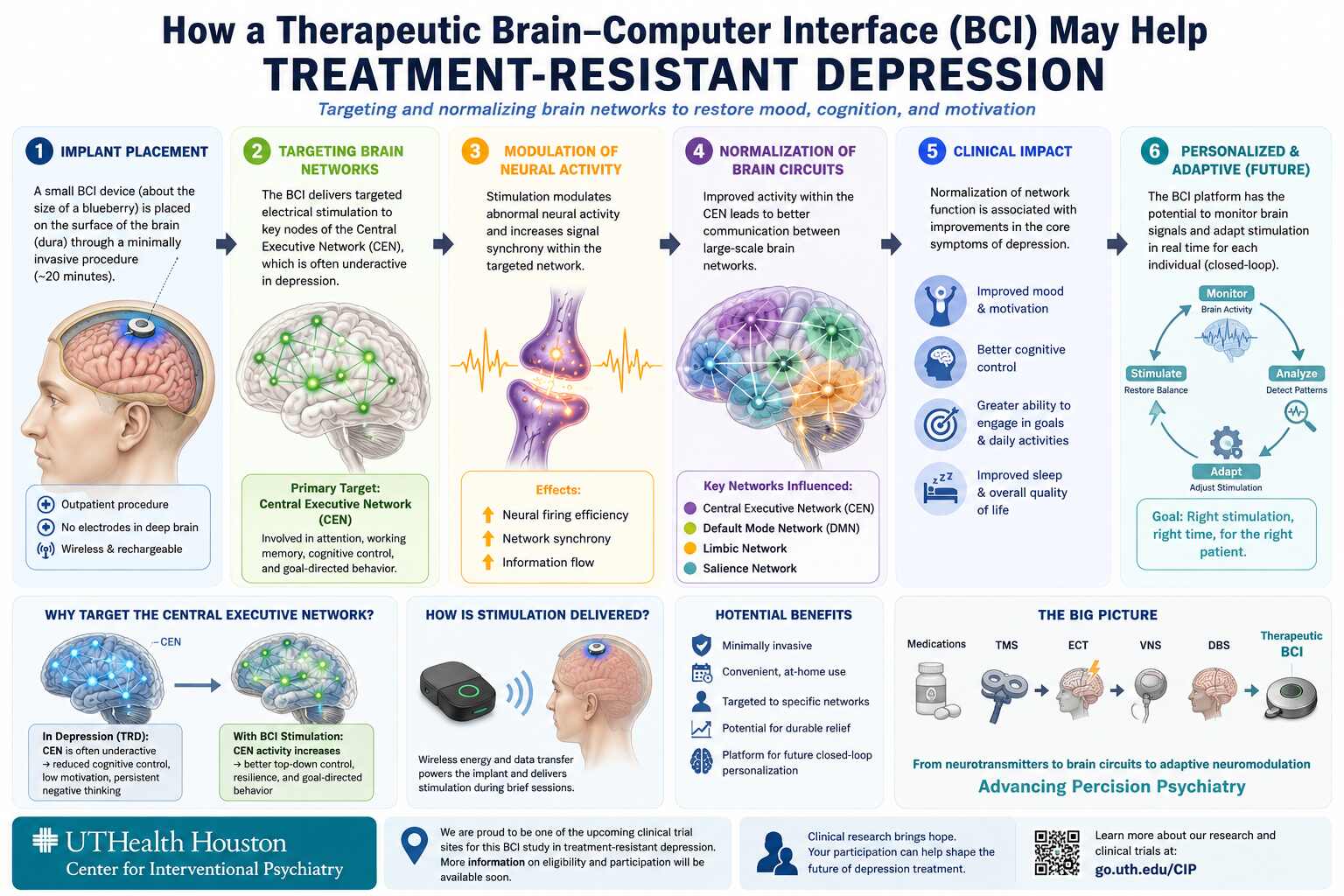
Motif’s device is a miniature implant, approximately the size of a blueberry, that sits within the skull, above the protective membrane covering the brain. Unlike traditional deep-brain stimulation systems, the device does not require electrodes implanted deep within the brain. Instead, it delivers targeted electrical stimulation to specific neural networks involved in depression.
This approach may offer a less invasive alternative to conventional implanted neuromodulation therapies.
Why Target Brain Networks?
Modern neuroscience increasingly views depression as a disorder of dysfunctional brain circuits rather than simply an imbalance of neurotransmitters.
One network of particular interest is the Central Executive Network (CEN).
The CEN plays a critical role in:
- Attention
- Working memory
- Goal-directed behavior
- Cognitive control
Neuroimaging studies have shown that this network is often underactive in individuals with major depressive disorder, particularly those with treatment-resistant illness.
Motif’s device was specifically designed to stimulate this circuit.
The goal is straightforward:
Restore activity within dysfunctional networks and improve mood, cognition, and motivation.
A Different Approach to Implantable Neuromodulation
Traditional deep-brain stimulation requires:
- Intracranial electrode placement
- Implanted pulse generators
- Extension wires
- Multiple programming sessions
Motif’s system takes a different approach.
According to the company, the implant is wirelessly powered by an external wearable device and can deliver stimulation during brief treatment sessions performed at home. The implantation procedure is expected to be performed on an outpatient basis and takes approximately 20 minutes.
If successful, this could represent a significant reduction in procedural complexity compared with conventional DBS.
Why This Matters for Treatment-Resistant Depression
Treatment-resistant depression remains one of the greatest unmet needs in psychiatry.
Despite available therapies, many patients continue to experience:
- Persistent depressive symptoms
- Functional impairment
- Recurrent hospitalization
- Increased suicide risk
While existing interventional treatments can be highly effective, barriers remain:
- Limited access
- Stigma
- Time commitments
- Insurance challenges
- Procedural invasiveness
A minimally invasive, network-targeted implant could potentially address several of these barriers while expanding access to advanced neuromodulation.
The Promise of Personalized Psychiatry
Perhaps the most exciting aspect of therapeutic BCIs is not simply stimulation—it is the possibility of integrating stimulation with brain monitoring.
Future generations of BCIs may be capable of:
- Measuring neural activity continuously
- Identifying biomarkers of depression
- Predicting symptom worsening
- Adjusting treatment in real time
This concept, often referred to as closed-loop neuromodulation, represents one of the ultimate goals of precision psychiatry.
Instead of delivering the same treatment to every patient, therapies could be individualized based on each person’s unique neural signature.
Important Caveats
While the FDA authorization is an important milestone, it is equally important to recognize what it does—and does not—mean.
The approval allows the company to begin a human clinical trial designed to evaluate:
- Safety
- Feasibility
- Early signals of effectiveness
The technology remains investigational, and substantial research will be required before it can become a routine clinical treatment.
As with any emerging intervention, enthusiasm must be balanced with rigorous scientific evaluation.
The Houston Connection
One particularly exciting aspect of this announcement is that Motif Neurotech is based in Houston, a city that has become an increasingly important hub for neuroscience, neurotechnology, and interventional psychiatry.
The convergence of:
- Academic medicine
- Biomedical engineering
- Neuroscience research
- Digital health innovation
continues to accelerate the development of novel approaches for patients with severe psychiatric illness.
Looking Ahead: Bringing Innovation to Patients
One of the most exciting aspects of this development is that the Center for Interventional Psychiatry at UTHealth Houston is expected to become a clinical trial site that will recruit patients for this study in the near future.
Participation in this multicenter trial reflects our commitment to providing patients access to cutting-edge investigational treatments and advancing the science of interventional psychiatry.
As one of the leading academic centers dedicated to treatment-resistant depression, UTHealth Houston continues to evaluate and implement innovative approaches that target the underlying brain circuits involved in mood disorders.
The addition of therapeutic brain–computer interface technology to our research portfolio would complement ongoing efforts involving:
- Transcranial Magnetic Stimulation (TMS)
- Accelerated TMS (SAINT®)
- Electroconvulsive Therapy (ECT)
- Ketamine and Esketamine
- Vagus Nerve Stimulation (VNS)
- Deep Brain Stimulation (DBS)
- Novel pharmacologic and neuromodulation clinical trials
For patients who have exhausted conventional treatment options, participation in clinical research offers an opportunity not only to access emerging therapies but also to contribute to the development of future standards of care.
We anticipate sharing additional information regarding study eligibility and recruitment as the trial becomes available locally.
UTHealth Houston Perspective
At the Center for Interventional Psychiatry at UTHealth Houston, we closely follow—and increasingly help shape—the development of emerging technologies that have the potential to transform psychiatric care.
The anticipated participation of our center in the upcoming Motif Neurotech clinical trial reflects our commitment to advancing innovative, circuit-based treatments for patients with treatment-resistant depression.
The evolution of psychiatric treatment increasingly points toward:
- Circuit-based interventions
- Precision targeting
- Biomarker-guided treatment
- Personalized neuromodulation
Therapeutic BCIs represent a natural extension of this movement.
While much work remains before these systems become part of routine practice, the initiation of human trials is an important step forward and highlights how rapidly the field is advancing.
Final Thoughts
A decade ago, the idea of treating depression with a miniature brain–computer interface might have sounded like science fiction.
Today, it is entering clinical testing.
Whether Motif’s technology ultimately succeeds remains to be determined. But the broader message is clear:
Psychiatry is entering an era in which brain circuits can be measured, targeted, and potentially modulated with unprecedented precision.
For patients living with treatment-resistant depression, that future cannot come soon enough.
As interventional psychiatry continues to evolve, technologies like therapeutic BCIs may help bridge the gap between neuroscience discoveries and personalized clinical care—bringing us closer to a future in which treatment is tailored not only to symptoms, but also to the unique neural circuitry of each patient.
References
Motif Neurotech. Motif Neurotech Receives FDA Approval to Begin First Clinical Trial of its Therapeutic BCI for Treatment-Resistant Depression. April 2026.
Wired. A Brain Implant for Depression Is About to Be Tested in Humans. April 2026.
Contact
Center for Interventional Psychiatry
John S. Dunn Behavioral Sciences Center
UTHealth Houston
Request for Second Opinion Form: https://Go.uth.edu/CIPIntake (external link)
Phone: (713) 486-2621
Fax: (713) 500-2728
E-mail: [email protected]
Website: https://go.uth.edu/CIP (external link)
Disclaimer
This article discusses an investigational neurotechnology that has received FDA authorization to begin human clinical testing. FDA authorization to conduct a clinical trial does not imply that the device has been demonstrated to be safe or effective for routine clinical use. Additional research is required before this technology can be considered for widespread clinical application.
The Center for Interventional Psychiatry at UTHealth Houston anticipates participating as a clinical trial site for this study. Any future patient recruitment will occur under Institutional Review Board (IRB) oversight and in accordance with applicable regulatory requirements.
This article was created with the assistance of artificial intelligence (AI) to help organize and refine the presentation of scientific information. All medical and scientific content has been reviewed and approved by Joao L. de Quevedo, MD, PhD, Executive Director of the Center for Interventional Psychiatry at the John S. Dunn Behavioral Sciences Center at UTHealth Houston.
The content is intended for educational and informational purposes only and does not constitute medical advice. Individuals experiencing depression or other psychiatric symptoms should seek evaluation and treatment from a qualified healthcare professional.