When Two Failed Antidepressants Are Not Enough: Rethinking Treatment-Resistant Depression
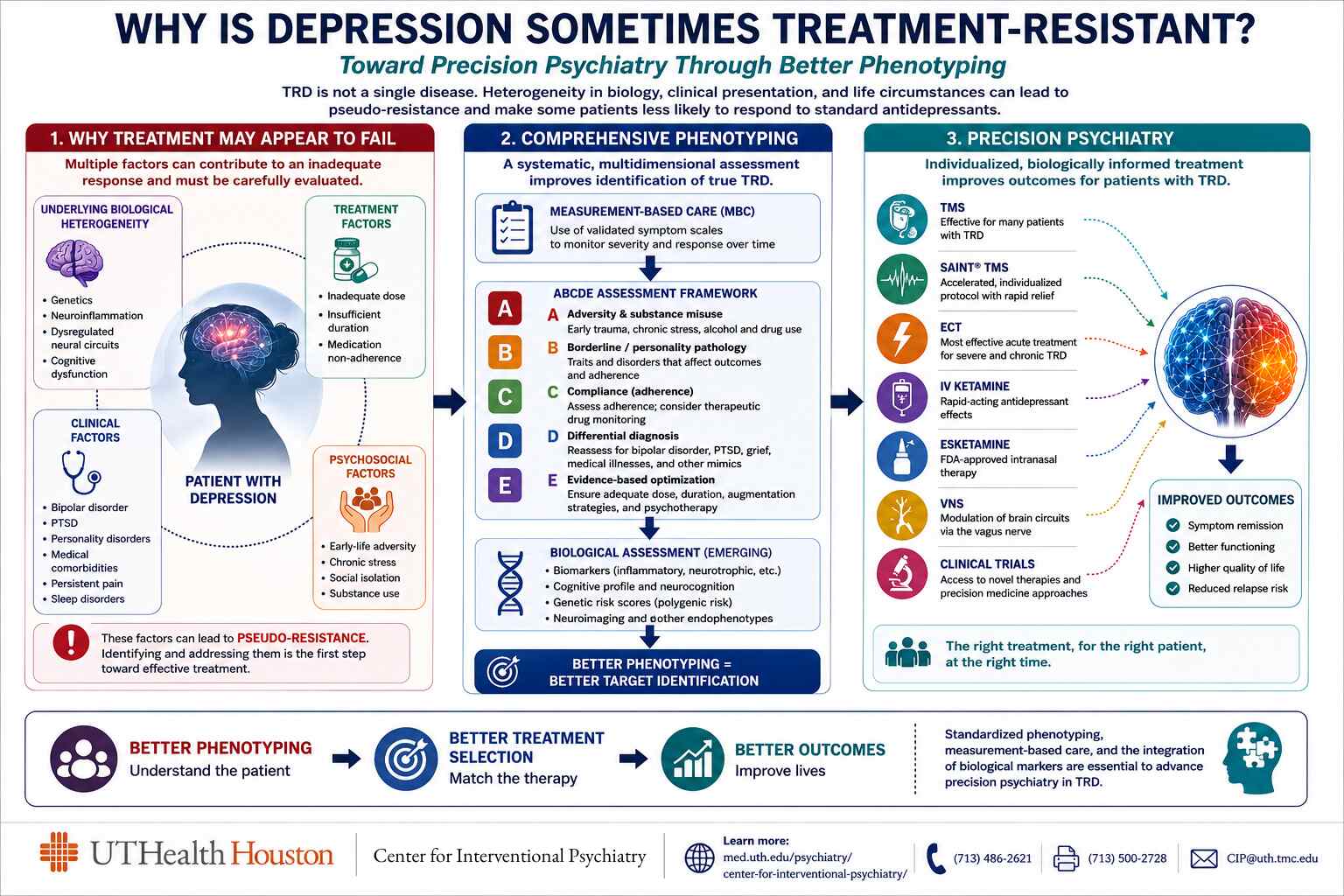 Are We Defining Treatment-Resistant Depression Correctly?
Treatment-resistant depression (TRD) affects millions of people worldwide and represents one of the greatest challenges in modern psychiatry. Patients with TRD experience greater disability, poorer quality of life, higher healthcare utilization, and substantially increased medical costs compared with individuals whose depression responds to standard treatments.
Yet despite decades of research, one fundamental question remains:
What exactly do we mean by “treatment-resistant depression”?
A thought-provoking narrative review recently published in Frontiers in Pharmacology suggests that the answer may be far more complex than simply counting the number of failed antidepressant medications. The authors argue that our current definitions of TRD may oversimplify a highly heterogeneous disorder and that improving how we define TRD is essential for advancing both patient care and research.
The Problem with the Current Definition
Most clinical guidelines define TRD as the failure to respond to at least two antidepressants given at adequate doses and for an adequate duration.
Although practical, this definition assumes that every treatment trial is comparable and that every patient has truly received an optimal course of therapy.
In reality, many factors can complicate this assumption, including:
- Inadequate medication dosing
- Poor adherence
- Premature treatment discontinuation
- Misdiagnosis
- Medical or psychiatric comorbidities
- Persistent psychosocial stressors
As a result, some patients labeled as “treatment resistant” may actually have pseudo-resistance—a lack of improvement due to factors other than true biological resistance.
Depression Is Not One Disease
Another key message of the review is that major depressive disorder itself is remarkably heterogeneous.
Two patients may both meet diagnostic criteria for depression while having entirely different:
- Symptom profiles
- Underlying biology
- Cognitive impairments
- Inflammatory status
- Genetic risk factors
- Clinical trajectories
If depression is heterogeneous, then treatment resistance is likely to be equally diverse. This “double-layer” of heterogeneity makes it difficult to identify which patients truly have biologically resistant illness and which may benefit from different diagnostic or therapeutic approaches.
Beyond Counting Medication Failures
The authors propose that clinicians should evaluate much more than the number of unsuccessful antidepressant trials.
They emphasize the importance of:
- Confirming medication adherence
- Ensuring adequate dose and duration
- Reassessing the diagnosis
- Identifying psychiatric and medical comorbidities
- Evaluating psychosocial adversity
- Using standardized symptom rating scales
These steps help distinguish true treatment resistance from potentially reversible causes of poor response.
The ABCDE Framework
One particularly practical contribution of the review is the ABCDE mnemonic, summarized in Figure 2 of the paper, to guide the assessment of apparent treatment resistance.
The framework encourages clinicians to consider:
A – Adversity and substance misuse
Early-life trauma, ongoing psychosocial stressors, and alcohol or drug use may significantly affect treatment response.
B – Borderline personality or other personality pathology
Personality traits and disorders can complicate diagnosis, treatment adherence, and long-term outcomes.
C – Compliance (Adherence)
Poor adherence remains one of the leading causes of pseudo-resistance. Therapeutic drug monitoring may be helpful in selected patients.
D – Differential diagnosis
Clinicians should reconsider conditions such as bipolar disorder, PTSD, prolonged grief disorder, or relevant medical illnesses before concluding that depression is treatment-resistant.
E – Evidence-based optimization
Treatment should be systematically optimized using measurement-based care, early response monitoring, and algorithm-guided treatment adjustments before labeling a patient as having TRD.
This simple framework highlights how careful clinical assessment remains essential even as psychiatry moves toward more sophisticated biological models.
Why Measurement-Based Care Matters
The review strongly supports the routine use of Measurement-Based Care (MBC).
Instead of relying solely on clinical impressions, MBC incorporates validated symptom-rating scales at regular intervals to objectively monitor treatment response.
Evidence summarized in the review indicates that MBC is associated with:
- More timely treatment adjustments
- Higher response rates
- Faster remission
- Reduced clinical inertia
Unfortunately, structured symptom monitoring remains underused in everyday practice, potentially delaying recognition of ineffective treatments and prolonging patient suffering.
Toward Precision Psychiatry
The authors also review emerging biological predictors of treatment resistance, including:
- Polygenic risk scores
- Inflammatory biomarkers
- Cognitive dysfunction
- Personality traits
- Neurocognitive profiles
While none of these biomarkers are currently ready for routine clinical use, they point toward a future in which treatment decisions may be guided by an individual’s biological profile rather than by trial and error alone.
The UTHealth Houston Perspective
At the Center for Interventional Psychiatry at UTHealth Houston, we recognize that successful treatment of TRD begins with an accurate diagnosis and a comprehensive assessment.
Our multidisciplinary approach emphasizes:
- Careful confirmation of the diagnosis
- Systematic evaluation of previous treatment adequacy
- Measurement-based care using validated symptom scales
- Assessment of psychiatric and medical comorbidities
- Individualized treatment planning
For patients who continue to experience significant symptoms despite optimized treatment, we offer a full continuum of evidence-based interventional therapies, including:
- Transcranial Magnetic Stimulation (TMS)
- Accelerated SAINT® TMS
- Electroconvulsive Therapy (ECT)
- Intranasal Esketamine
- Intravenous Ketamine
- Vagus Nerve Stimulation (VNS)
- Clinical research studies evaluating emerging therapies
As precision psychiatry evolves, our goal is not simply to determine whether a patient has treatment-resistant depression—but to understand why treatment has not worked and identify the intervention most likely to help.
Looking Ahead
This review reminds us that treatment-resistant depression is not a single disease but a complex clinical syndrome shaped by biological, psychological, and social factors.
Improving how we define TRD will likely improve everything that follows—from clinical decision-making and research to biomarker discovery and personalized treatment.
Precision psychiatry begins not only with better treatments, but also with better definitions.
Reference
Paribello P, Isayeva U, Lazzardi S, et al. The relevance of phenotypic definition in treatment-resistant forms of major depressive disorder: A narrative review. Frontiers in Pharmacology. 2026.
Contact
Center for Interventional Psychiatry
John S. Dunn Behavioral Sciences Center
UTHealth Houston
Request for Second Opinion Form: https://Go.uth.edu/CIPIntake (external link)
Phone: (713) 486-2621
Fax: (713) 500-2728
E-mail: [email protected]
Website: https://go.uth.edu/CIP (external link)
Disclaimer
This article summarizes findings from a recently published scientific review and is intended for educational purposes only. The concepts discussed reflect the current scientific literature and should not replace individualized medical evaluation or treatment recommendations. Individuals experiencing symptoms of depression should seek assessment from a qualified mental health professional.
This article was created with the assistance of artificial intelligence (AI) to help organize and refine the presentation of scientific information. All medical and scientific content has been reviewed and approved by Joao L. de Quevedo, MD, PhD, Executive Director of the Center for Interventional Psychiatry at the John S. Dunn Behavioral Sciences Center at UTHealth Houston.