MeRT® Receives FDA Clearance for PTSD: A New Step Toward Personalized Neuromodulation
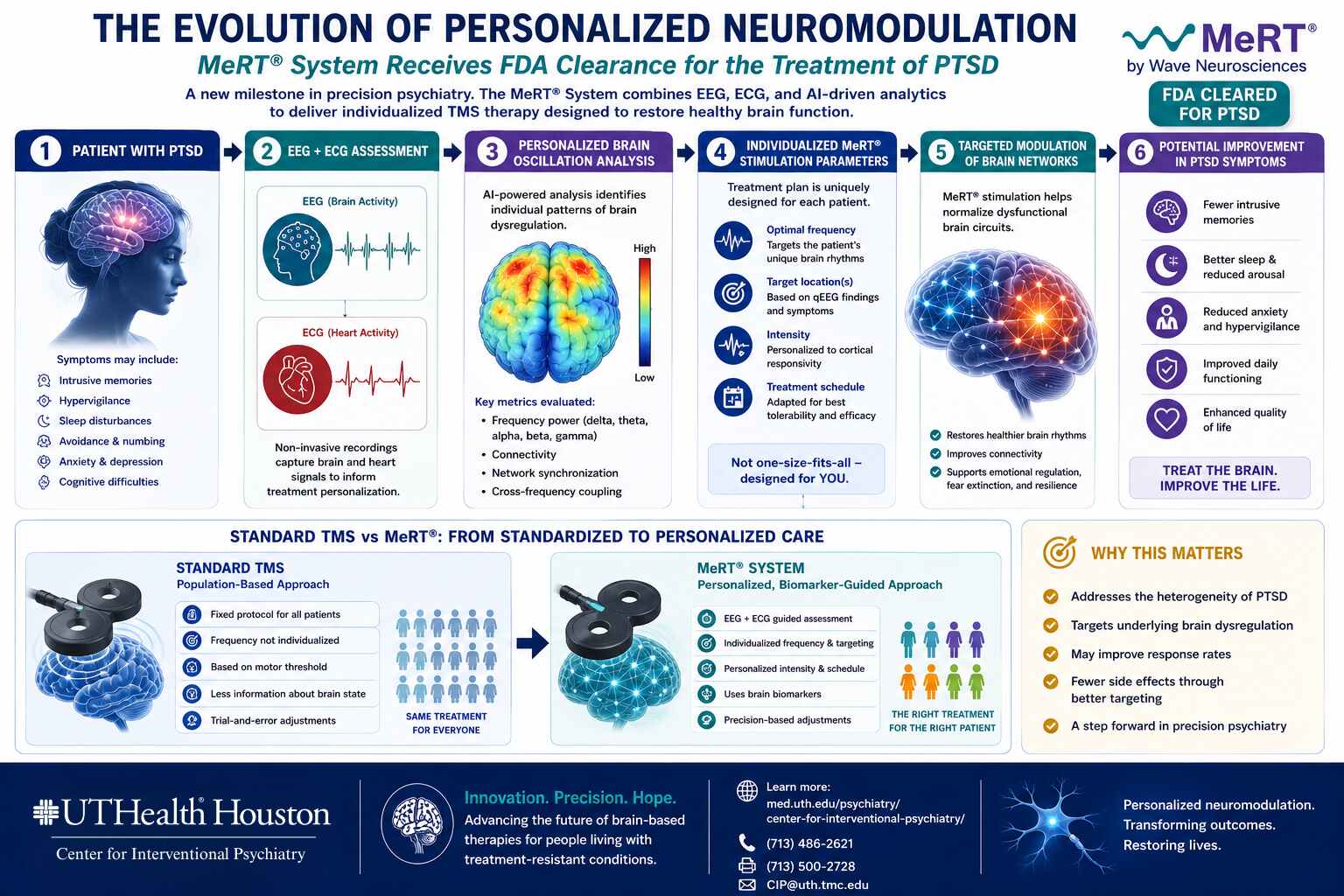 A New Milestone for Personalized Brain Stimulation
Neuromodulation continues to evolve at an extraordinary pace.
While repetitive transcranial magnetic stimulation (TMS) has become an established treatment for major depressive disorder, investigators have long sought ways to make brain stimulation more individualized. One promising approach is Magnetic EEG/ECG-Guided Resonance Therapy (MeRT®), which combines electroencephalography (EEG), electrocardiography (ECG), and personalized TMS protocols.
Recently, Wave Neurosciences announced that the U.S. Food and Drug Administration (FDA) granted clearance for its MeRT® System for the treatment of post-traumatic stress disorder (PTSD), representing an important milestone for precision neuromodulation.
Although additional clinical evidence will continue to shape the role of MeRT in psychiatric practice, this clearance reflects growing interest in tailoring neuromodulation to each patient’s unique brain physiology.
What Is MeRT®?
MeRT® builds upon conventional repetitive TMS but adds an individualized assessment before treatment begins.
The process includes:
- Quantitative electroencephalography (qEEG)
- Electrocardiography (ECG)
- Computer-assisted analysis of brain oscillations
- Personalized selection of stimulation frequency and treatment parameters
Rather than using identical stimulation settings for every patient, MeRT attempts to match treatment to the individual’s electrophysiological characteristics.
The underlying concept is that psychiatric disorders may involve abnormal neural synchronization, and restoring healthier patterns of brain activity could improve symptoms.
Why Is PTSD an Important Target?
Post-traumatic stress disorder affects millions of individuals worldwide and can profoundly impair daily functioning.
Patients may experience:
- Intrusive memories
- Hypervigilance
- Sleep disturbances
- Emotional numbing
- Depression
- Anxiety
- Cognitive difficulties
Although psychotherapy and pharmacotherapy remain first-line treatments, many patients continue to experience persistent symptoms despite multiple interventions.
This has stimulated growing interest in neuromodulation approaches capable of directly influencing dysfunctional brain networks involved in fear processing, emotional regulation, and executive control.
How Does MeRT Differ From Conventional TMS?
Traditional TMS protocols generally use standardized stimulation parameters based on established clinical trials.
MeRT introduces an additional level of personalization.
Conventional TMS
- Standard treatment protocol
- Motor-threshold–based dosing
- Fixed stimulation frequency
- Evidence-based population approach
MeRT®
- EEG-guided assessment
- Individualized stimulation frequency
- Personalized treatment planning
- Dynamic adjustment based on electrophysiological data
The ultimate goal is to move beyond a “one-size-fits-all” model toward precision neuromodulation.
Precision Psychiatry in Action
The MeRT approach reflects one of the most important trends in modern psychiatry:
Treat the individual—not simply the diagnosis.
Increasingly, researchers are exploring biomarkers that may help predict which treatments are most likely to benefit a particular patient.
Examples include:
- EEG biomarkers
- Functional MRI
- Genetic markers
- Digital biomarkers
- Neurocognitive testing
Rather than relying solely on trial and error, future psychiatric care may increasingly integrate these biological measures to guide treatment selection.
What Does FDA Clearance Mean?
FDA clearance is an important regulatory milestone.
However, it is important to distinguish FDA clearance from broader questions regarding comparative clinical effectiveness.
Clearance indicates that the device has met the regulatory requirements for its intended use. Ongoing clinical research will continue to clarify:
- Which patients benefit most
- Long-term durability
- Comparative effectiveness versus existing treatments
- Optimal integration with psychotherapy and medication
As with all emerging technologies, continued scientific evaluation remains essential.
Implications for Interventional Psychiatry
The MeRT announcement reflects a broader transformation occurring across the field.
Interventional psychiatry is rapidly moving toward:
- Circuit-based treatments
- Personalized stimulation protocols
- Biomarker-guided therapy
- Artificial intelligence–assisted treatment planning
- Closed-loop neuromodulation
Future therapies may increasingly adapt treatment in real time based on each patient’s neural activity.
The UTHealth Houston Perspective
At the Center for Interventional Psychiatry at UTHealth Houston, we closely follow innovations that have the potential to improve outcomes for patients with difficult-to-treat psychiatric disorders.
Our program currently provides a comprehensive continuum of evidence-based interventional treatments, including:
- Transcranial Magnetic Stimulation (TMS)
- Accelerated SAINT® TMS
- Electroconvulsive Therapy (ECT)
- Intranasal Esketamine
- Intravenous Ketamine
- Vagus Nerve Stimulation (VNS)
- Deep Brain Stimulation (DBS)
- Clinical research involving emerging neuromodulation technologies
The FDA clearance of the MeRT® System underscores the growing movement toward individualized brain stimulation and reinforces the importance of continued research into precision psychiatry.
Looking Ahead
The future of neuromodulation is unlikely to be defined solely by stronger stimulation or newer devices.
Instead, it will likely be characterized by greater personalization.
Technologies that combine neurophysiological assessment with individualized treatment protocols may help clinicians better match therapies to each patient’s unique brain biology.
Whether MeRT ultimately proves superior to conventional TMS will require additional high-quality comparative studies. Nevertheless, this FDA clearance represents another important step toward a future in which psychiatric treatments become increasingly precise, personalized, and biologically informed.
References
- MagVenture. Wave Neurosciences’ MeRT® System Receives FDA Clearance for PTSD.
- Wave Neurosciences. MeRT® System for Post-Traumatic Stress Disorder.
Contact
Center for Interventional Psychiatry
John S. Dunn Behavioral Sciences Center
UTHealth Houston
Request for Second Opinion Form: https://Go.uth.edu/CIPIntake (external link)
Phone: (713) 486-2621
Fax: (713) 500-2728
E-mail: [email protected]
Website: https://go.uth.edu/CIP (external link)
Disclaimer
This article summarizes a recent regulatory announcement and is intended for educational and informational purposes only. FDA clearance of a medical device does not necessarily establish superiority over existing treatments or guarantee effectiveness for every patient. Clinical decisions should be based on a comprehensive evaluation by qualified healthcare professionals and the totality of available scientific evidence.
This article was created with the assistance of artificial intelligence (AI) to help organize and refine the presentation of scientific information. All medical and scientific content has been reviewed and approved by Joao L. de Quevedo, MD, PhD, Executive Director of the Center for Interventional Psychiatry at the John S. Dunn Behavioral Sciences Center at UTHealth Houston.