Catatonia Revisited: Toward a New Systems Model of Brain Dysfunction
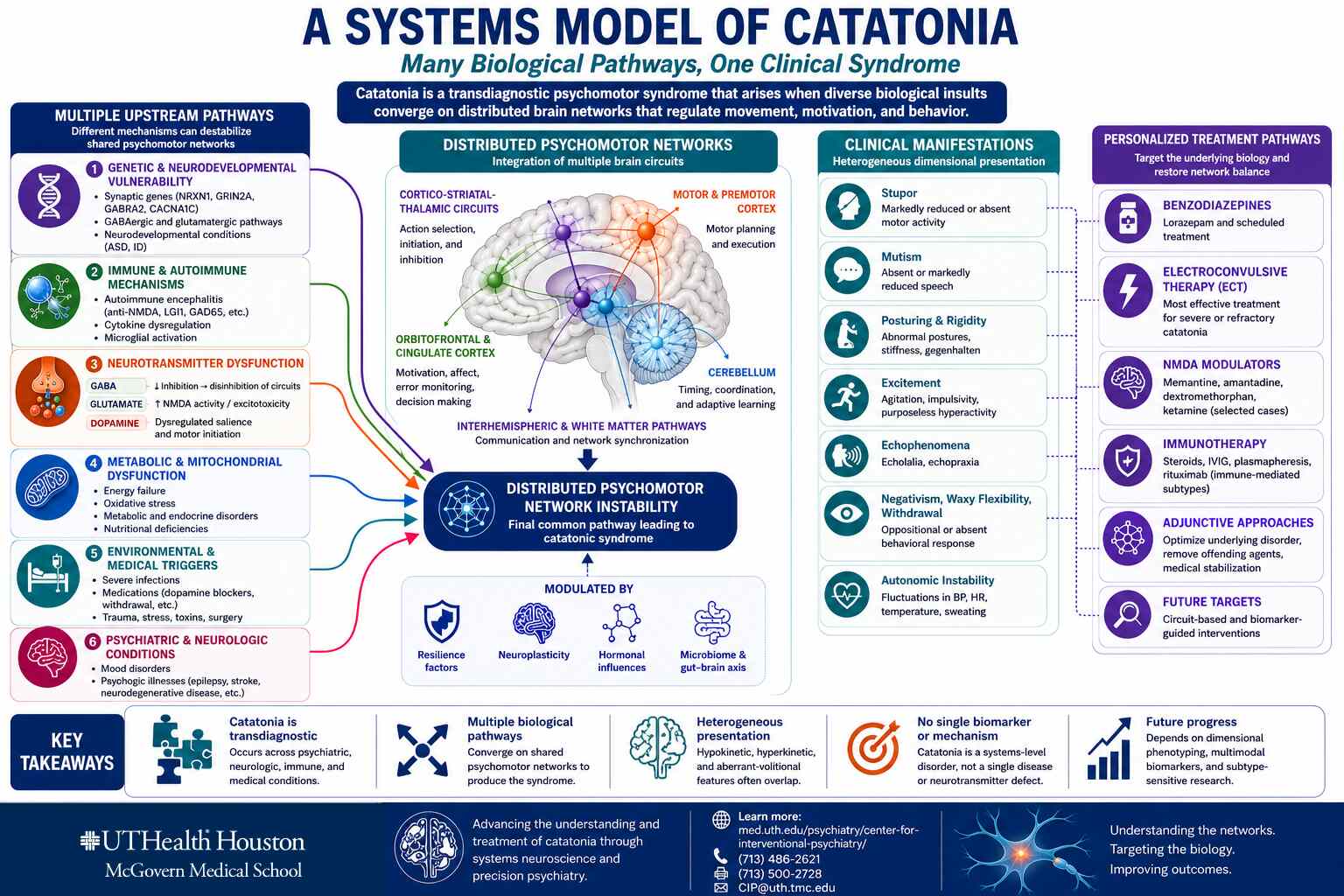 Catatonia Is More Than a Psychiatric Syndrome
For over a century, catatonia has often been viewed through the lens of schizophrenia. Although this historical perspective shaped psychiatric practice for decades, modern evidence tells a different story.
Today, catatonia is recognized as a transdiagnostic psychomotor syndrome that occurs across a remarkably broad range of conditions, including:
- Major depressive disorder
- Bipolar disorder
- Schizophrenia spectrum disorders
- Autoimmune encephalitis
- Neurological disorders
- Autism spectrum disorders
- General medical illnesses
This remarkable clinical diversity raises an important question:
How can such different diseases produce a remarkably similar syndrome?
In our recently accepted review in Progress in Neuro-Psychopharmacology & Biological Psychiatry, we propose a new answer: catatonia is best understood as a disorder of distributed brain networks rather than a disease of a single neurotransmitter, brain region, or psychiatric diagnosis.
From One Disease to One Brain Network
Historically, competing theories attempted to explain catatonia through:
- Dopamine dysfunction
- GABA deficiency
- Glutamate abnormalities
- Schizophrenia
- Mood disorders
Each theory explains part of the syndrome, but none explains all of it.
Instead, we propose that diverse biological insults converge on shared psychomotor control networks responsible for movement, motivation, emotional expression, volition, and behavioral responsiveness. When these networks become unstable, the recognizable syndrome of catatonia emerges, regardless of the underlying disease.
A Disorder of Brain Circuits
Current neuroimaging studies consistently implicate dysfunction across interconnected brain regions, including:
- Cortico-striatal-thalamic circuits
- Motor and premotor cortex
- Orbitofrontal cortex
- Anterior cingulate cortex
- Cerebellum
- Interhemispheric white matter pathways
Rather than functioning independently, these regions operate as integrated networks that coordinate purposeful movement, emotional regulation, and behavioral responses.
Catatonia appears to arise when communication within these distributed networks becomes disrupted.
Beyond Neurotransmitters
One of the central messages of our review is that no single neurotransmitter explains catatonia.
Instead, multiple neurochemical systems interact:
GABA
Supports inhibitory control and likely contributes to the dramatic response many patients experience with lorazepam.
Glutamate (NMDA)
Plays an important role in autoimmune encephalitis and helps explain why NMDA-modulating agents such as memantine or amantadine may benefit selected patients.
Dopamine
Modulates motivation, movement initiation, and behavioral output, helping explain why dopamine-blocking medications can sometimes worsen catatonia.
These systems interact dynamically within vulnerable neural circuits rather than acting independently.
The Immune System Matters
Increasing evidence also suggests that immune dysfunction contributes to catatonia in selected patients.
Perhaps the clearest example is anti-NMDA receptor encephalitis, in which autoimmune disruption of glutamatergic signaling frequently produces severe psychiatric symptoms accompanied by catatonia.
Our review argues that immune activation should not be viewed as a universal cause of catatonia, but rather as one of several biological pathways that can destabilize psychomotor networks.
One Syndrome, Multiple Biological Routes
Perhaps the most important concept introduced in our review is that catatonia represents a final common phenotype.
Different upstream mechanisms, including:
- Genetic susceptibility
- Neurodevelopmental abnormalities
- Autoimmune disorders
- Mood disorders
- Psychosis
- Metabolic disease
- Neurotransmitter dysfunction
may all converge on the same distributed psychomotor networks.
This explains why patients with vastly different diagnoses can develop remarkably similar clinical presentations.
Why This Matters Clinically
Viewing catatonia as a systems disorder has important implications for patient care.
Rather than asking:
“Which disease caused the catatonia?”
Clinicians should increasingly ask:
“Which biological pathway is destabilizing this patient’s psychomotor networks?”
The answer may influence treatment selection, including:
- Lorazepam
- Electroconvulsive therapy (ECT)
- NMDA-modulating therapies
- Immunotherapy
- Future circuit-based interventions
This framework also helps explain why some patients respond dramatically to one therapy while others require an entirely different approach.
The UTHealth Houston Perspective
At the Center for Interventional Psychiatry at UTHealth Houston, catatonia represents one of the clearest examples of why psychiatry is moving toward systems neuroscience.
Understanding how distributed brain circuits, neurotransmitters, immune mechanisms, and genetics interact may ultimately lead to:
- Earlier diagnosis
- Better biological phenotyping
- Precision treatments
- Novel biomarkers
- More individualized care
As our understanding evolves, the goal is no longer to recognize catatonia, but to understand the biological pathways driving it in each patient.
Looking Ahead
The future of catatonia research will likely focus on:
- Multimodal neuroimaging
- Immune biomarkers
- Genetics
- Electrophysiology
- Artificial intelligence
- Precision psychiatry
Rather than searching for a single cause, future research will likely identify biologically meaningful subtypes, each requiring different therapeutic approaches.
That represents a major shift, from viewing catatonia as a diagnosis to understanding it as a network disorder with multiple biological routes.
Reference
Toledo G, Gusmao CTP, Carvalho R, et al. Toward a Systems Model of Catatonia: Circuits, Neurochemistry, Immune Perturbation, and Biological Heterogeneity. Progress in Neuro-Psychopharmacology & Biological Psychiatry. Accepted July 2026. https://pubmed.ncbi.nlm.nih.gov/42431537/ (external link)
Contact
Center for Interventional Psychiatry
John S. Dunn Behavioral Sciences Center
UTHealth Houston
Request for Second Opinion Form: https://Go.uth.edu/CIPIntake (external link)
Phone: (713) 486-2621
Fax: (713) 500-2728
E-mail: [email protected]
Website: https://go.uth.edu/CIP (external link)
Disclaimer
This article summarizes findings from a recently accepted peer-reviewed scientific review and is intended for educational and informational purposes only. The concepts discussed reflect current scientific evidence and evolving models of catatonia pathophysiology. They should not replace individualized clinical evaluation or treatment decisions.
This article was created with the assistance of artificial intelligence (AI) to help organize and refine the presentation of scientific information. All medical and scientific content has been reviewed and approved by Joao L. de Quevedo, MD, PhD, Executive Director of the Center for Interventional Psychiatry at the John S. Dunn Behavioral Sciences Center at UTHealth Houston.