Personalized Brain Mapping Improves Accelerated TMS Outcomes: Another Step Toward Precision Psychiatry
 A New Era of Precision Neuromodulation
Transcranial magnetic stimulation (TMS) has become one of the most important noninvasive treatments for patients with treatment-resistant depression (TRD). Yet, despite remarkable technological advances, one fundamental aspect of treatment has remained largely unchanged for nearly two decades:
Where do we stimulate the brain?
Most TMS treatments continue to use standardized scalp measurements to identify the stimulation target. While this approach has demonstrated excellent efficacy and safety, it assumes that the optimal target is essentially the same for every patient.
A landmark randomized clinical trial recently published in JAMA Psychiatry challenges that assumption. The investigators demonstrate that using functional MRI (fMRI) connectivity to personalize the stimulation target significantly improves the antidepressant effects of accelerated TMS, providing some of the strongest evidence yet that individualized neuromodulation can enhance clinical outcomes.
Why Targeting Matters
The therapeutic effects of TMS depend on stimulating the left dorsolateral prefrontal cortex (DLPFC), a region that plays a central role in cognitive control and emotional regulation.
Traditionally, clinicians identify this target using external scalp landmarks such as the Beam F3 method.
However, decades of neuroimaging research have shown that:
- Brain anatomy varies substantially between individuals.
- Functional brain networks are organized differently from one patient to another.
- Depression reflects dysfunction within distributed neural circuits rather than a single anatomical location.
These observations raise an important question:
Could personalized brain mapping improve treatment response?
Connectivity-Guided TMS
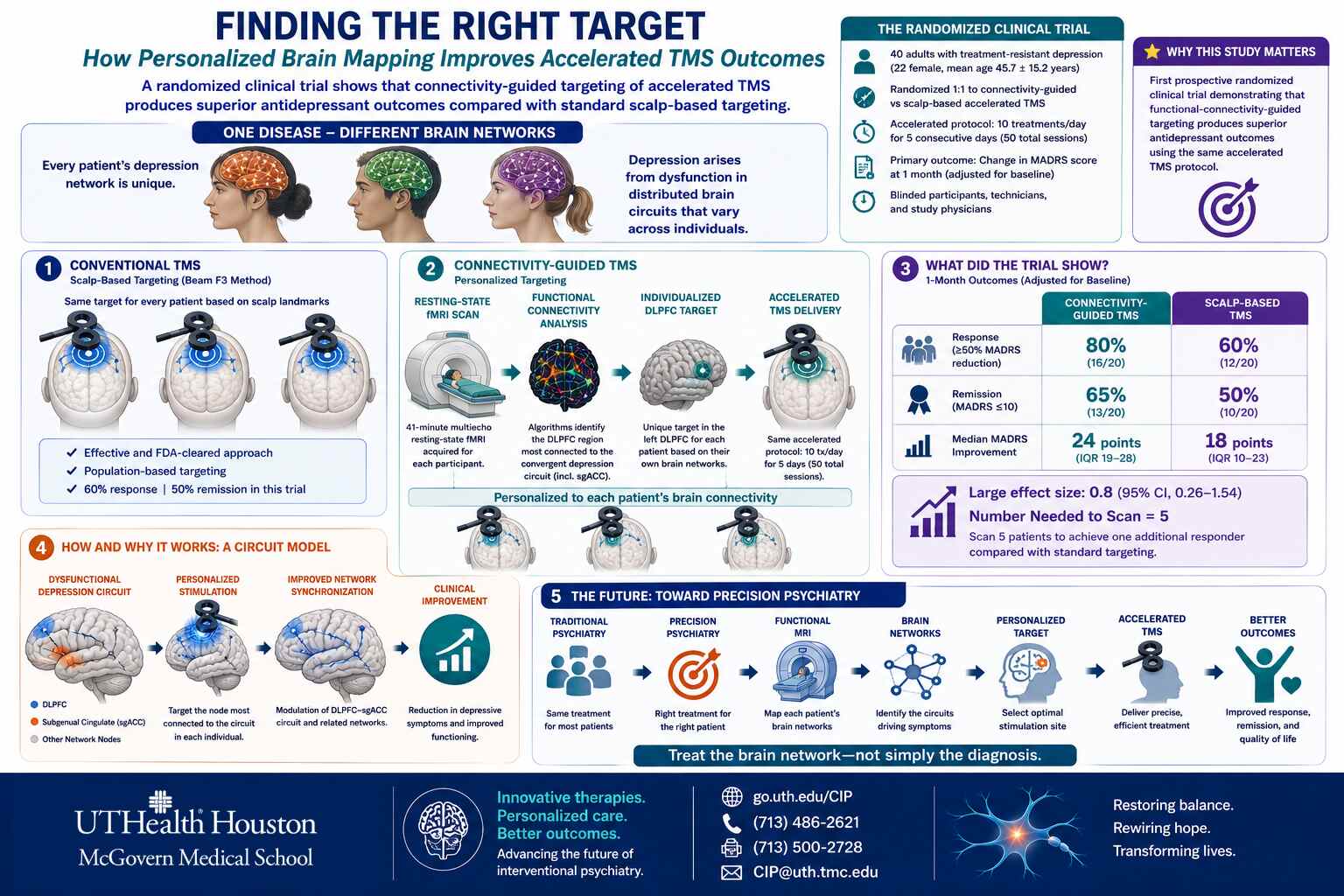
Rather than stimulating the same anatomical location in every patient, the investigators performed 41-minute resting-state functional MRI scans before treatment.
Using these scans, they identified the region in each participant’s left DLPFC that showed the strongest connectivity to a previously validated convergent depression circuit, which incorporates the subgenual anterior cingulate cortex and other regions implicated in depression.
Patients were then randomized to receive either:
- Connectivity-guided accelerated TMS, or
- Conventional scalp-based accelerated TMS
Importantly, every other aspect of treatment, including stimulation intensity, accelerated treatment schedule (10 sessions/day for five consecutive days), neuronavigation, and clinical follow-up, was identical.
Better Targeting, Better Outcomes
The results clearly favored individualized targeting.
One month after treatment:
- Median MADRS improvement:
- 24-point reduction with connectivity-guided targeting
- 18-point reduction with scalp-based targeting
- Clinical response:
- 80% with connectivity-guided TMS
- 60% with scalp-based TMS
- Remission:
- 65% versus 50%
The investigators also reported a large treatment effect size (0.8) and estimated that imaging 5 patients would yield 1 additional responder compared with conventional targeting.
Every Brain Is Different
One of the most fascinating findings was that individualized targets were both:
- Highly reproducible within the same patient
- Significantly different across different patients
This suggests that depression does not arise from dysfunction at one universal brain location.
Instead, each patient may have a unique pattern of network dysfunction that requires individualized stimulation.
These findings strongly support the broader movement toward precision psychiatry, where treatment decisions are guided by each patient’s biological characteristics rather than by standardized protocols alone.
Does This Mean Conventional TMS Is Obsolete?
Not at all.
One important message from this study is that standard scalp-based targeting remains highly effective.
Even using conventional targeting:
- 60% of patients responded
- 50% achieved remission
This reinforces that conventional TMS remains an excellent treatment option, particularly in centers where advanced neuroimaging is unavailable.
However, when functional imaging can be incorporated into clinical care, personalized targeting may further improve outcomes.
Implications for Accelerated TMS
Accelerated TMS protocols, including SAINT® TMS, already represent a major advance in the treatment of TRD by delivering multiple stimulation sessions each day over only five days.
This study suggests that the next frontier may not simply be faster treatment, but smarter targeting.
Rather than changing the stimulation protocol itself, the investigators improved outcomes by selecting a more biologically meaningful target based on each patient’s functional brain connectivity.
This represents an important evolution toward truly individualized neuromodulation.
The UTHealth Houston Perspective
At the Center for Interventional Psychiatry at UTHealth Houston, we believe the future of depression treatment lies at the intersection of neuroscience, neuroimaging, and precision medicine.
Our comprehensive interventional psychiatry program currently offers:
- Intranasal Esketamine
- Intravenous Ketamine
- Transcranial Magnetic Stimulation (TMS)
- Accelerated SAINT® TMS
- Electroconvulsive Therapy (ECT)
- Vagus Nerve Stimulation (VNS)
- Deep Brain Stimulation (DBS)
- Innovative clinical trials evaluating next-generation therapies
Studies such as this one reinforce the growing importance of individualized brain circuit targeting and support ongoing efforts to develop more personalized approaches to neuromodulation.
Looking Ahead
Psychiatry is rapidly moving beyond treating diagnoses alone.
Instead, the field is beginning to identify the specific brain circuits responsible for each patient’s symptoms and tailor interventions accordingly.
Connectivity-guided TMS represents one of the clearest examples of this transformation.
As neuroimaging, biomarkers, and computational neuroscience continue to evolve, future treatments may increasingly combine:
- Functional MRI
- EEG biomarkers
- Artificial intelligence
- Personalized stimulation protocols
- Closed-loop neuromodulation
Together, these advances are bringing us closer to the ultimate goal of precision psychiatry, delivering the right treatment to the right patient at the right time.
References
Taylor JJ, Kare MR, Haj-Darwish D, et al. Connectivity- vs Scalp-Based Targeting of Accelerated Transcranial Magnetic Stimulation for Depression: A Randomized Clinical Trial. JAMA Psychiatry. Published online June 24, 2026.
Contact
Center for Interventional Psychiatry
John S. Dunn Behavioral Sciences Center
UTHealth Houston
Request for Second Opinion Form: https://Go.uth.edu/CIPIntake (external link)
Phone: (713) 486-2621
Fax: (713) 500-2728
E-mail: [email protected]
Website: https://go.uth.edu/CIP (external link)
Disclaimer
This article summarizes findings from a recently published randomized clinical trial and is intended for educational and informational purposes only. While connectivity-guided accelerated TMS demonstrated improved outcomes compared with conventional scalp-based targeting in this study, additional multicenter research is needed before this approach becomes standard clinical practice. Treatment decisions should always be individualized and made in consultation with qualified healthcare professionals.
This article was created with the assistance of artificial intelligence (AI) to help organize and refine the presentation of scientific information. All medical and scientific content has been reviewed and approved by Joao L. de Quevedo, MD, PhD, Executive Director of the Center for Interventional Psychiatry at the John S. Dunn Behavioral Sciences Center at UTHealth Houston.