How Electroconvulsive Therapy May Reset the Adult Brain: New Research Reveals Cellular Reprogramming and Circuit Remodeling
 ECT Works Remarkably Well—but why?
Electroconvulsive therapy (ECT) remains the most effective acute treatment for severe depression, psychotic depression, catatonia, and many cases of treatment-resistant depression. Its clinical benefits can be rapid, profound, and, with appropriate continuation treatment, durable.
Yet one of the most important questions in biological psychiatry has remained unresolved:
How does ECT produce such powerful antidepressant effects?
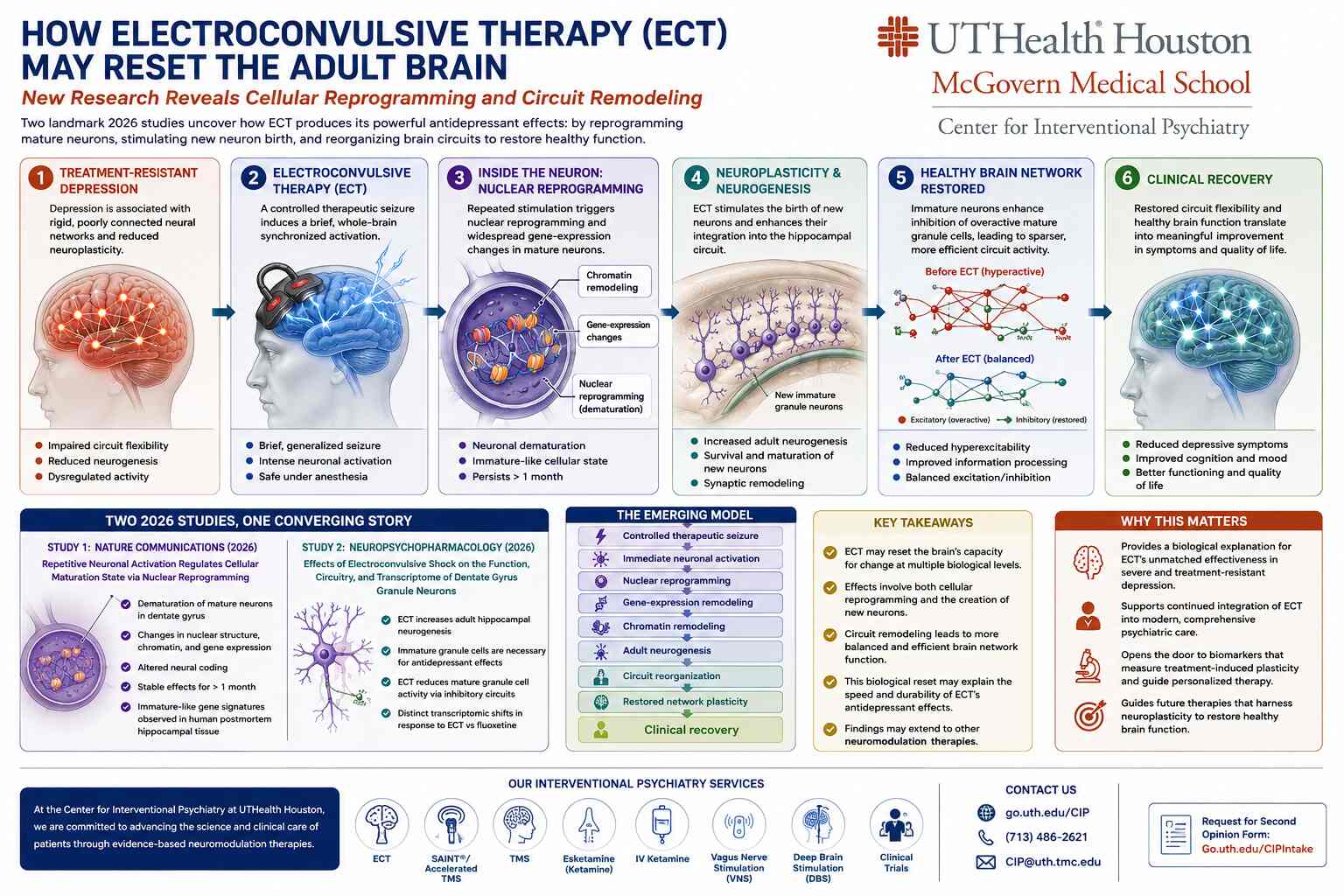
Two complementary studies published in 2026 provide important new clues. Together, they suggest that ECT does far more than alter neurotransmitter levels. Repeated therapeutic brain stimulation may induce nuclear reprogramming, long-lasting changes in gene expression, adult hippocampal neurogenesis, and circuit-level reorganization.
The emerging picture is that ECT may work, at least in part, by restoring the brain’s capacity to change.
Beyond Neurotransmitters: ECT as a Neuroplasticity Treatment
For decades, depression treatments were often explained primarily through serotonin, norepinephrine, dopamine, and other neurotransmitter systems.
Those systems remain important, but they are only part of the story.
Modern neuroscience increasingly views major depression as a disorder involving impaired plasticity across distributed brain networks. In this framework, effective treatments do not simply increase or decrease a neurotransmitter. They help the brain:
- revise maladaptive patterns,
- strengthen healthier connections,
- reorganize dysfunctional circuits,
- and regain flexibility.
The two new studies support this broader model.
One found that repeated neuronal stimulation produced a long-lasting immature-like cellular state in adult hippocampal neurons, accompanied by changes in nuclear structure, gene expression, and neural coding. These changes persisted for more than one month.
The second showed that electroconvulsive stimulation increased adult-born hippocampal neurons and that these immature granule cells were necessary for key antidepressant-like behavioral effects in a chronic stress model.
Study 1: Repeated Stimulation May Reprogram Mature Neurons
In the first study, published in Nature Communications, investigators developed a mouse model by repeatedly stimulating granule cells in the dentate gyrus, a hippocampal region involved in memory, emotional regulation, and stress adaptation.
The protocol was designed to model important biological features of repeated ECT while allowing precise control over neuronal activation.
After repeated stimulation, mature neurons shifted toward an immature-like state—a process the investigators described as dematuration. This did not represent neuronal damage or degeneration. Instead, the cells adopted characteristics associated with greater developmental plasticity.
The researchers observed:
- altered nuclear architecture,
- widespread changes in gene expression,
- chromatin remodeling,
- modified synaptic gene expression,
- changes in neural coding,
- and a cellular state that remained stable for more than one month.
This suggests that repeated brain stimulation can produce a durable change in cellular identity, not merely a transient biochemical response.
What Does “Neuronal Dematuration” Mean?
The term “dematuration” can be misleading if interpreted as deterioration.
In this context, it refers to mature neurons temporarily regaining some features of younger, more plastic cells.
These features may include:
- greater capacity for structural remodeling,
- altered excitability,
- increased responsiveness to environmental input,
- reorganization of synaptic programs,
- and renewed flexibility in how circuits process information.
The findings suggest that ECT may create a biological window during which rigid, maladaptive brain networks become more capable of change.
That possibility is especially relevant to severe depression, where neural systems involved in mood, reward, cognition, and self-referential processing may become pathologically stable.
Calcium Signaling and Nuclear Reprogramming
The investigators also explored how repeated stimulation produced this immature-like state.
Blocking calcium entry prevented the reduction in calbindin, a marker of mature dentate gyrus granule cells. The study, therefore, identified calcium-dependent signaling as an important early step in the dematuration process.
The authors also found large-scale, persistent changes in chromatin accessibility after repeated stimulation, indicating that the genome itself had entered a different regulatory state.
This is a major conceptual advance.
Rather than viewing ECT as producing a short-lived surge in neurotransmission, these findings suggest that repeated therapeutic stimulation may change how neurons regulate their genes over time.
Evidence Relevant to the Human Brain
Importantly, the researchers did not rely solely on animal experiments.
They reanalyzed postmortem dentate gyrus tissue from patients with mood disorders who had or had not received ECT. The ECT-exposed samples showed an immature-like gene-expression pattern that overlapped with normal hippocampal development. Similar changes were seen in synapse-related genes.
These observations do not prove that the same mechanism fully explains clinical response in living patients. However, they strengthen the translational relevance of the animal findings and suggest that ECT-related neuronal reprogramming may also occur in the human hippocampus.
Study 2: Adult-Born Neurons May Be Necessary for Antidepressant Effects
The second study, published in Neuropsychopharmacology, focused on adult hippocampal neurogenesis.
The dentate gyrus is one of the few brain regions where new neurons continue to be generated in adulthood. These immature granule cells differ from mature neurons in important ways: they are highly plastic, integrate new information, and help regulate activity across hippocampal circuits.
The investigators found that repeated electroconvulsive stimulation increased markers of immature granule cells in both dorsal and ventral regions of the dentate gyrus.
More importantly, when hippocampal neurogenesis was disrupted, key antidepressant-like behavioral effects of electroconvulsive stimulation were reduced or lost.
This suggests that neurogenesis is not simply an associated biological effect. In this model, it appears to be functionally important for treatment response.
How New Neurons May Change the Circuit
The second study also helps explain how immature neurons may influence the larger hippocampal network.
Although immature granule cells are themselves highly excitable, they can indirectly reduce the activity of mature granule cells through inhibitory pathways. The study found that repeated electroconvulsive stimulation reduced markers of mature granule-cell activity, and that this reduction was sustained after repeated, but not single, stimulation.
This may help restore a healthier pattern of hippocampal information processing.
Instead of widespread, noisy, or poorly regulated activation, the dentate gyrus may return to a sparser and more selective coding state. Such a shift could improve the way the brain distinguishes contexts, regulates stress responses, and updates emotional memories.
A Unified Biological Model
Taken together, the two studies suggest that ECT may act through several interacting layers:
Controlled therapeutic seizure
↓
Intense but regulated neuronal activation
↓
Calcium-dependent intracellular signaling
↓
Nuclear and chromatin reprogramming
↓
Immature-like neuronal state
↓
Adult hippocampal neurogenesis
↓
Changes in excitation and inhibition
↓
Circuit remodeling
↓
Restored network plasticity
↓
Clinical improvement
This model helps explain why ECT may be more effective than treatments that act through a narrower mechanism.
ECT appears to influence the brain simultaneously at the molecular, cellular, synaptic, circuit, and behavioral levels.
Why Repeated Treatments Matter
Both studies also reinforce the importance of treatment repetition.
In the Nature Communications study, a shorter stimulation course produced changes that largely faded, whereas repeated stimulation over a longer period produced more durable gene-expression and chromatin effects.
Likewise, in the Neuropsychopharmacology study, repeated electroconvulsive stimulation increased neurogenesis and produced sustained changes in circuit activity more clearly than a single stimulation.
This mirrors clinical experience. ECT is administered in a series because its therapeutic effects build over time. The biology described in these studies offers a plausible explanation: repeated stimulation may be required to move the brain from a transient response into a more stable plastic state.
What These Findings Do Not Yet Prove
These studies are highly informative, but they should be interpreted carefully.
Most of the mechanistic experiments were performed in mice. Animal models can reveal causal pathways, but they cannot fully reproduce the complexity of human depression or clinical ECT.
The postmortem human data strengthen the translational relevance of the findings, but they do not establish a direct link between neuronal dematuration and clinical remission in individual patients.
Several questions remain:
- Which cellular changes are essential for recovery?
- Which are adaptive, and which may contribute to adverse effects?
- How long does the plastic state last in humans?
- Can biomarkers identify when this state has been achieved?
- Can the same mechanisms be activated more selectively?
These are important next steps for the field.
The UTHealth Houston Perspective
At the Center for Interventional Psychiatry at UTHealth Houston, we view ECT not simply as a treatment of last resort, but as one of the most powerful and biologically sophisticated therapies in psychiatry.
Our ECT program treats patients with:
- treatment-resistant depression,
- psychotic depression,
- bipolar depression,
- catatonia,
- severe suicidality,
- and other complex neuropsychiatric conditions.
These new studies support a modern understanding of ECT: it may not merely suppress symptoms or alter neurotransmitter levels. It may help the brain recover by restoring plasticity, generating new neurons, changing gene regulation, and reorganizing dysfunctional circuits.
This framework also reinforces the importance of comprehensive care around ECT. A period of enhanced plasticity may create an opportunity for continued pharmacotherapy, psychotherapy, rehabilitation, sleep restoration, and relapse-prevention strategies to consolidate recovery.
Looking Ahead
The broader significance of this work extends beyond ECT.
Many effective interventions in interventional psychiatry may converge on a shared endpoint: restoration of adaptive neuroplasticity.
These include:
- ketamine and esketamine,
- repetitive transcranial magnetic stimulation,
- accelerated TMS and SAINT® TMS,
- electroconvulsive therapy itself,
- magnetic seizure therapy,
- vagus nerve stimulation,
- deep brain stimulation,
- and emerging closed-loop neuromodulation technologies.
Future research may enable clinicians to measure treatment-induced plasticity directly, identify patients most likely to benefit, and tailor stimulation dose, target, frequency, and continuation schedules to each individual’s biology.
The long-term goal is not simply to stimulate the brain more strongly.
It is to stimulate it more intelligently—at the right circuit, with the right dose, during the right biological window.
These two studies bring us closer to understanding how that may be possible.
References
- Murano T, Hagihara H, Tajinda K, et al. Repetitive neuronal activation regulates cellular maturation state via nuclear reprogramming. Nature Communications. 2026;17:5881.
- Santiago AN, Castello Saval J, Nguyen P, et al. Effects of electroconvulsive shock on the function, circuitry, and transcriptome of dentate gyrus granule neurons. Neuropsychopharmacology. 2026;51:1258–1266.
Contact
Center for Interventional Psychiatry
John S. Dunn Behavioral Sciences Center
UTHealth Houston
Request for Second Opinion Form: https://Go.uth.edu/CIPIntake (external link)
Phone: (713) 486-2621
Fax: (713) 500-2728
E-mail: [email protected]
Website: https://go.uth.edu/CIP (external link)
Disclaimer
This article summarizes findings from the scientific literature and is intended for educational and informational purposes only. Some therapies discussed may be FDA-approved for specific indications, while others remain investigational or are discussed in the context of ongoing research. Treatment decisions should always be individualized and made in consultation with a qualified healthcare professional.
This article was created with the assistance of artificial intelligence (AI) to help organize and refine the presentation of scientific information. All medical and scientific content has been reviewed and approved by Joao L. de Quevedo, MD, PhD, Executive Director of the Center for Interventional Psychiatry at the John S. Dunn Behavioral Sciences Center at UTHealth Houston.
The content is intended for educational purposes only and does not constitute medical advice.