Targeting Anhedonia: Can Precision Dopamine Therapy Transform the Treatment of Depression?
 Moving Beyond Depression as a Single Disease
Major depressive disorder is often treated as a single condition, yet every clinician recognizes that no two patients experience depression in the same way. Some struggle primarily with sadness, others with anxiety, insomnia, guilt, or cognitive impairment. For many patients, however, one symptom stands out as particularly disabling:
Anhedonia—the inability to experience pleasure, motivation, or reward.
Anhedonia is more than simply “feeling sad.” Patients frequently describe losing interest in hobbies, relationships, work, and exercise, and even in engaging in everyday life. It is one of the strongest predictors of functional disability, poor antidepressant response, and suicide risk, yet it remains inadequately addressed by many conventional antidepressants.
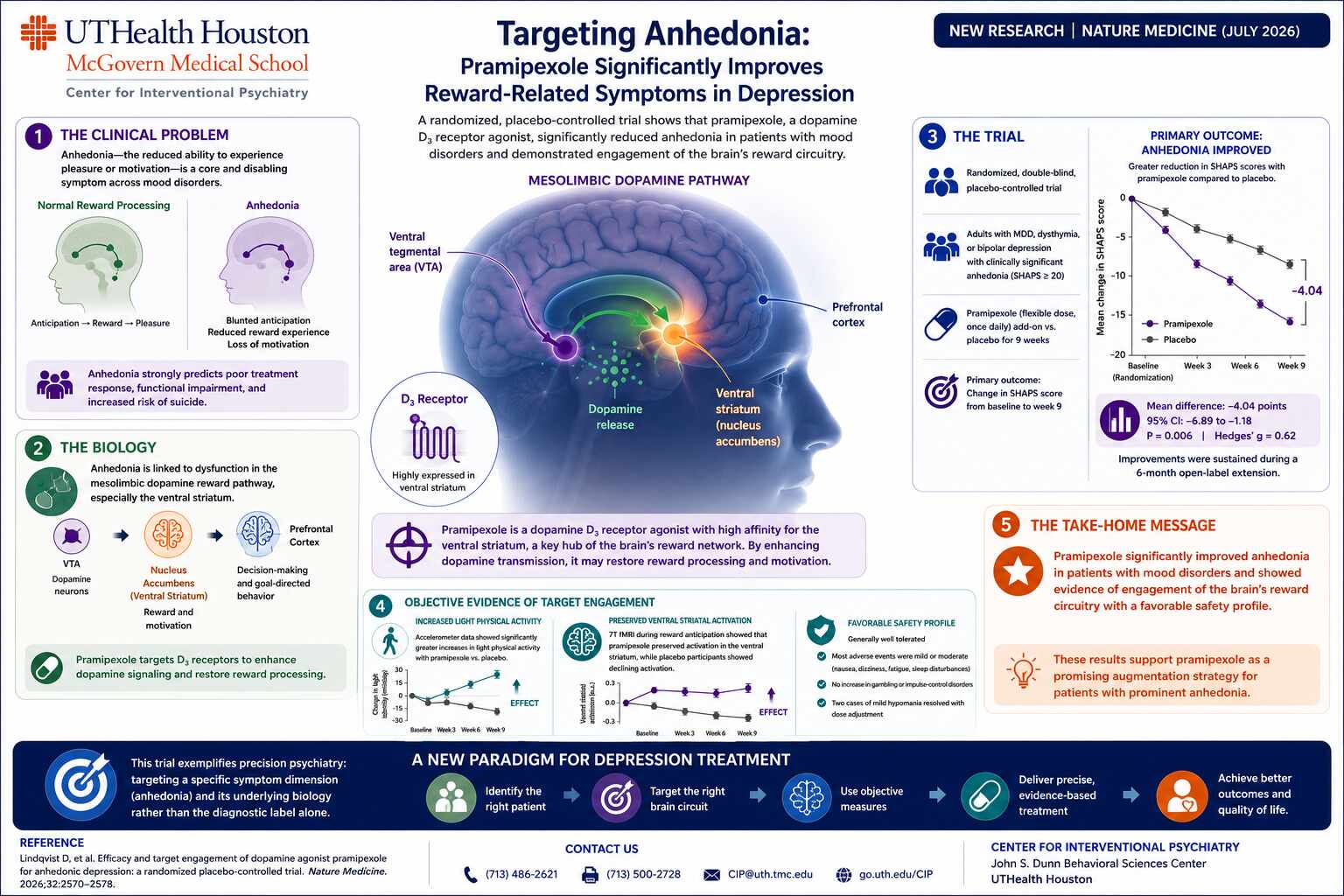
A landmark randomized clinical trial recently published in Nature Medicine offers a compelling new direction. Rather than treating depression as a single disorder, investigators targeted a biologically meaningful symptom domain—anhedonia—and demonstrated that pramipexole, a dopamine D3 receptor agonist, significantly improved reward-related symptoms while providing evidence of engagement of the brain’s reward circuitry.
Why Anhedonia Matters
Although sadness is often considered the hallmark of depression, anhedonia may be even more closely linked to long-term disability.
Patients with prominent anhedonia often report:
- Loss of motivation
- Reduced anticipation of pleasure
- Emotional numbness
- Social withdrawal
- Reduced physical activity
- Difficulty experiencing reward
These symptoms frequently persist despite treatment with serotonin-based antidepressants and are associated with poorer clinical outcomes. The authors emphasize that anhedonia represents a clinically important depression endophenotype that likely reflects dysfunction within the brain’s mesolimbic dopamine reward system rather than generalized depressive pathology.
A Precision Psychiatry Trial
One of the most innovative aspects of this study was its design.
Rather than enrolling patients solely because they met criteria for major depressive disorder, investigators recruited adults with:
- Major depressive disorder
- Persistent depressive disorder (dysthymia)
- Bipolar depression
provided they all exhibited clinically significant anhedonia.
This transdiagnostic strategy reflects an emerging principle of precision psychiatry: targeting biologically meaningful symptom dimensions instead of relying exclusively on traditional diagnostic categories.
Participants continued their stable antidepressant or mood-stabilizing treatment and were randomized to receive either adjunctive pramipexole or placebo for nine weeks.
Why Dopamine?
Most currently available antidepressants primarily influence serotonin and norepinephrine.
Pramipexole works differently.
It is a dopamine agonist with particularly high affinity for the dopamine D3 receptor, which is highly expressed in the ventral striatum, a central hub of the brain’s reward network.
Reduced dopaminergic signaling within this circuit has long been implicated in motivational deficits and anhedonia. By enhancing dopamine transmission, pramipexole may restore normal reward processing rather than simply improving mood.
The Study Met Its Primary Endpoint
The trial enrolled 85 participants, with 82 included in the primary analysis.
The primary outcome was the change in the Snaith-Hamilton Pleasure Scale (SHAPS) after nine weeks.
The results were encouraging:
- Significant improvement in anhedonia
- Mean treatment difference of −4.04 SHAPS points
- Moderate effect size (Hedges’ g = 0.62)
- P = 0.006
Importantly, improvements continued during the six-month open-label extension, suggesting that benefits may be durable with continued treatment.
More Than Subjective Improvement
One of the most compelling features of this trial was its use of objective biological and behavioral outcome measures.
Instead of relying exclusively on rating scales, investigators incorporated:
- wearable accelerometers,
- high-field (7 Tesla) functional MRI,
- inflammatory biomarkers,
- dopamine metabolites,
- neuropsychological testing,
- reward-processing paradigms.
This multidimensional approach represents the future of antidepressant clinical trials.
Patients Became More Active
Anhedonia often manifests behaviorally as reduced engagement in everyday activities.
To measure this objectively, participants wore accelerometers throughout the trial.
Compared with placebo, pramipexole significantly increased light physical activity, indicating that patients were not only reporting improvement—they were becoming more physically engaged in daily life. Furthermore, higher levels of light physical activity were associated with lower anhedonia scores.
This represents one of the first antidepressant trials to integrate continuous wearable technology as an objective measure of treatment response.
Imaging the Brain’s Reward System
Perhaps the study’s most exciting finding came from the neuroimaging sub-study.
Using 7-Tesla functional MRI and the Monetary Incentive Delay task, investigators examined activity within the ventral striatum, a key component of the brain’s reward circuit.
Patients receiving a placebo demonstrated a decline in reward-related activation over time.
By contrast, pramipexole largely preserved ventral striatal activation during reward anticipation, providing direct evidence that the medication engaged its intended neural target.
This type of target-engagement evidence is still uncommon in psychiatry and represents an important advance toward mechanism-based treatment development.
Safety and Tolerability
Pramipexole was generally well tolerated.
Most adverse events, including nausea, dizziness, fatigue, and sleep disturbances, were mild to moderate and manageable through dose adjustment.
Two patients developed mild hypomanic symptoms that were resolved with dose reduction or discontinuation, highlighting the importance of careful monitoring, particularly in patients with bipolar-spectrum illness. Importantly, no increase in gambling disorders or severe impulse-control disorders was observed during the randomized phase.
A Shift Toward Symptom-Based Treatment
Perhaps the most important contribution of this study is conceptual.
Rather than asking,
“Does this medication treat depression?”
The investigators asked,
“Does this medication treat anhedonia?”
This subtle change reflects a broader transformation occurring across neuroscience.
Future treatments may increasingly target:
- anhedonia,
- cognitive dysfunction,
- suicidality,
- psychomotor slowing,
- inflammation,
- circadian dysregulation,
rather than broad diagnostic categories alone.
This approach closely aligns with the principles of the Research Domain Criteria (RDoC) framework and the movement toward precision psychiatry.
UTHealth Houston Perspective
At the Center for Interventional Psychiatry at UTHealth Houston, we increasingly recognize that treatment-resistant depression is biologically heterogeneous. While many patients benefit from conventional antidepressants, others present with prominent anhedonia, motivational deficits, cognitive impairment, or psychomotor slowing that may require different therapeutic strategies.
This study reinforces an important principle: precision psychiatry begins by identifying the dominant biological processes driving an individual’s symptoms. Instead of asking only “What diagnosis does this patient have?”, we should also ask “Which neural circuits are dysfunctional, and how can we target them?”
Although pramipexole is not currently FDA-approved for depression, these findings provide strong evidence that dopamine-targeted augmentation may be an effective strategy for carefully selected patients with prominent anhedonia, particularly when conventional serotonergic approaches have been insufficient.
Looking Ahead
This study represents much more than a positive clinical trial.
It illustrates a new model for antidepressant research—one that combines:
- symptom-based patient selection,
- neurobiological mechanisms,
- objective behavioral measurements,
- advanced neuroimaging,
- biomarker assessment,
- and neural target engagement.
The future of depression treatment will likely rely less on trial-and-error prescribing and more on identifying the specific neural systems underlying each patient’s symptoms.
For patients whose depression is dominated by impaired motivation and reward processing, restoring dopamine function may prove to be an essential component of personalized care.
Studies like this move psychiatry closer to that future.
References
Lindqvist D, et al. Efficacy and target engagement of dopamine agonist pramipexole for anhedonic depression: a randomized placebo-controlled trial. Nature Medicine. 2026.
Contact
Center for Interventional Psychiatry
John S. Dunn Behavioral Sciences Center
UTHealth Houston
Request for Second Opinion Form: https://Go.uth.edu/CIPIntake (external link)
Phone: (713) 486-2621
Fax: (713) 500-2728
E-mail: [email protected]
Website: https://go.uth.edu/CIP (external link)
Disclaimer
This article summarizes findings from scientific literature and is intended for educational and informational purposes only. Some therapies discussed may be FDA-approved for specific indications, while others are discussed in the context of emerging research or off-label clinical practice. Treatment decisions should always be individualized and made in consultation with a qualified healthcare professional.
This article was created with the assistance of artificial intelligence (AI) to help organize and refine the presentation of scientific information. All medical and scientific content has been reviewed and approved by Joao L. de Quevedo, MD, PhD, Executive Director of the Center for Interventional Psychiatry at the John S. Dunn Behavioral Sciences Center at UTHealth Houston.