A Single Dose of an LSD-Derived Therapy for Depression? Phase 3 Results Signal a Potential New Era in Psychedelic Medicine
Psychedelic Medicine Continues Its Rapid Evolution
The field of interventional psychiatry is undergoing one of its most transformative periods in decades. Following renewed interest in ketamine, esketamine, psilocybin, and other novel neuroplasticity-promoting therapies, another important milestone has emerged.
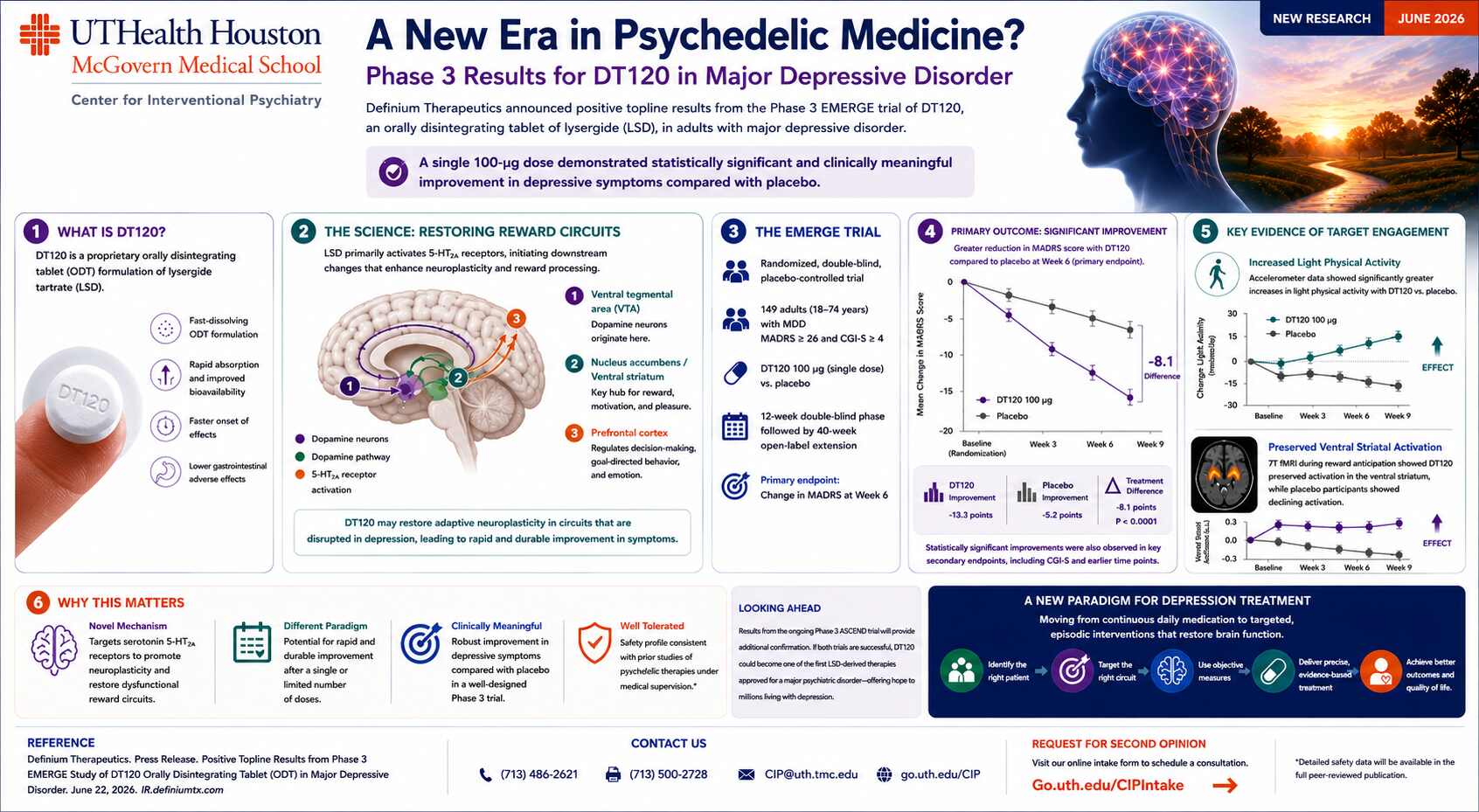
Definium Therapeutics recently announced positive topline results from its Phase 3 EMERGE trial evaluating DT120, an orally disintegrating formulation of lysergide (LSD), in adults with major depressive disorder (MDD). According to the company, the study met its primary endpoint, demonstrating statistically significant and clinically meaningful improvement in depressive symptoms after a single 100-µg dose of DT120 compared with placebo. (Definium Therapeutics (external link))
While these findings are based on a company press release rather than a peer-reviewed publication, they represent one of the most significant developments to date in the clinical development of psychedelic therapies for depression.
What Is DT120?
DT120 is a proprietary orally disintegrating tablet (ODT) formulation of lysergide tartrate (LSD).
Unlike traditional oral LSD preparations, DT120 uses a fast-dissolving formulation designed to provide:
- Rapid absorption
- Improved bioavailability
- Faster onset of therapeutic effects
- Lower gastrointestinal adverse effects
The formulation was developed to improve consistency and facilitate administration in supervised clinical settings. (Definium Therapeutics (external link))
The EMERGE Trial
EMERGE is the first of two pivotal Phase 3 studies evaluating DT120 for major depressive disorder.
The study enrolled 149 adults between 18 and 74 years of age with:
- DSM-5 major depressive disorder
- MADRS score ≥26
- CGI-S score ≥4
Participants were randomized to receive either:
- DT120 ODT 100 µg
- Placebo
The double-blind treatment phase lasted 12 weeks and was followed by a 40-week open-label extension. The primary endpoint was change in the Montgomery-Åsberg Depression Rating Scale (MADRS) at Week 6. (Definium Therapeutics (external link))
Positive Topline Results
According to Definium Therapeutics, EMERGE successfully met its primary endpoint.
Patients receiving DT120 experienced:
- Mean MADRS improvement: −13.3 points
- Placebo improvement: −5.2 points
- Treatment difference: −8.1 MADRS points
- P < 0.0001
The company also reported statistically significant improvements across key secondary endpoints, including Clinical Global Impression–Severity (CGI-S) scores and earlier reductions in depressive symptoms. (Definium Therapeutics (external link))
If these findings are confirmed in peer-reviewed analyses, the magnitude of improvement would compare favorably with many currently available antidepressant treatments.
Why Is This Important?
Traditional antidepressants generally require daily administration for weeks before patients experience meaningful improvement.
DT120 represents a fundamentally different therapeutic strategy.
Rather than continuously modulating monoamine neurotransmission, psychedelic therapies are hypothesized to produce:
- Rapid alterations in brain network dynamics
- Increased synaptic plasticity
- Enhanced cognitive flexibility
- Disruption of maladaptive patterns of self-referential thinking
- Long-lasting psychological and neurobiological changes after a limited number of dosing sessions
Although the precise mechanisms remain under investigation, LSD primarily acts as a 5-HT₂A receptor agonist, initiating downstream changes that may promote adaptive neural remodeling. (Definium Therapeutics (external link))
A Different Treatment Paradigm
Perhaps the most remarkable aspect of DT120 is that the therapeutic model differs dramatically from conventional pharmacotherapy.
Instead of asking patients to take medication every day indefinitely, psychedelic-assisted treatments seek to produce durable clinical improvement after one or a small number of supervised treatment sessions.
This concept shifts psychiatry toward an episodic intervention model, more closely resembling interventional procedures such as:
- Electroconvulsive therapy (ECT)
- Accelerated transcranial magnetic stimulation (SAINT® TMS)
- Ketamine infusion therapy
Rather than chronic symptom suppression, these interventions aim to induce lasting changes in brain function.
Important Caveats
Although the results are encouraging, several important limitations should be emphasized.
At present:
- The findings have been announced only through a company press release.
- Full study data have not yet undergone peer review.
- Detailed safety analyses have not yet been published.
- Longer-term durability remains under investigation.
- Regulatory review has not yet occurred.
Accordingly, DT120 remains an investigational therapy and is not approved by the U.S. Food and Drug Administration (FDA) for the treatment of depression. (Definium Therapeutics (external link))
The Broader Psychedelic Landscape
The EMERGE results add to growing evidence supporting the therapeutic potential of psychedelic compounds.
Several agents are currently being evaluated across psychiatric disorders, including:
- Psilocybin
- Lysergide (LSD)
- 5-MeO-DMT
- Ibogaine derivatives
- MDMA (for PTSD)
- Other next-generation psychedelic compounds
Together, these programs reflect an important shift toward therapies that may promote rapid and durable neuroplasticity rather than relying solely on chronic neurotransmitter modulation.
UTHealth Houston Perspective
At the Center for Interventional Psychiatry at UTHealth Houston, we are witnessing a profound transformation in the treatment of mood disorders.
Novel interventions—including ketamine, esketamine, accelerated TMS, neuromodulation, and investigational psychedelic therapies—share an increasingly recognized biological theme: the promotion of adaptive neuroplasticity and restoration of dysfunctional brain networks.
The Phase 3 EMERGE results are encouraging and suggest that psychedelic-assisted therapies may eventually become an additional evidence-based option for carefully selected patients with major depressive disorder.
However, these findings should be interpreted with appropriate scientific caution until the complete data are published and independently reviewed.
Looking Ahead
If the positive findings from EMERGE are confirmed by the second pivotal ASCEND study and subsequent regulatory review, DT120 could become one of the first LSD-derived therapies approved for a major psychiatric disorder. The ongoing ASCEND trial, which includes an additional low-dose arm designed to help preserve blinding, is expected to provide another critical test of efficacy. (Definium Therapeutics (external link))
More broadly, the study reflects a changing philosophy in psychiatry. Future treatments may increasingly focus on restoring healthy brain network function through brief, highly targeted interventions rather than relying exclusively on continuous daily medication.
For patients with major depressive disorder, that possibility represents an exciting new frontier—but one that must continue to be guided by rigorous science, careful regulation, and long-term safety evaluation.
References
- Definium Therapeutics. Positive Topline Results from the Phase 3 EMERGE Study of DT120 Orally Disintegrating Tablet in Major Depressive Disorder. June 22, 2026. (Definium Therapeutics (external link))
- ClinicalTrials.gov. EMERGE: A Phase 3 Trial of DT120 for Major Depressive Disorder (NCT06941844). (ClinicalTrials.gov (external link))
Contact
Center for Interventional Psychiatry
John S. Dunn Behavioral Sciences Center
UTHealth Houston
Request for Second Opinion Form: https://Go.uth.edu/CIPIntake (external link)
Phone: (713) 486-2621
Fax: (713) 500-2728
E-mail: [email protected]
Website: https://go.uth.edu/CIP (external link)
Disclaimer
This article summarizes publicly available information regarding an investigational therapy and is intended for educational and informational purposes only. DT120 (lysergide tartrate orally disintegrating tablet) is an investigational product and has not been approved by the U.S. Food and Drug Administration for the treatment of major depressive disorder. The results discussed are based on a company announcement of top-line Phase 3 findings and should be considered preliminary until the full data are peer-reviewed and published. Treatment decisions should always be individualized and made in consultation with a qualified healthcare professional.
This content was developed with the assistance of artificial intelligence (AI) as a scientific writing support tool. It was reviewed, edited, and approved by Joao L. de Quevedo, MD, PhD, Executive Director of the Center for Interventional Psychiatry at UTHealth Houston. Every effort has been made to ensure the accuracy and balance of the information presented; however, readers should consult the original scientific publications and healthcare professionals when making clinical decisions.
When discussing investigational therapies, the information reflects currently available evidence and does not imply FDA approval or endorsement unless explicitly stated.
© Center for Interventional Psychiatry, John S. Dunn Behavioral Sciences Center, UTHealth Houston.