DATAd: A Common Language for Treatment-Resistant Depression Transforming How We Communicate, Track, and Personalize Care for Difficult-to-Treat Depression
 Why Do We Need a Better Way to Describe Treatment-Resistant Depression?
Treatment-resistant depression (TRD) remains one of the greatest challenges in modern psychiatry. Despite decades of research and multiple proposed staging systems, clinicians still lack a universally accepted method to communicate a patient’s treatment history efficiently and consistently.
The consequences are significant. Patients referred for specialty consultation frequently arrive with years of fragmented medical records, incomplete medication histories, uncertain psychotherapy exposure, and poorly documented advanced interventions. Valuable clinical time is often spent reconstructing previous treatments rather than discussing the next evidence-based step.
A newly published paper from members of the National Network of Depression Centers (NNDC) Treatment-Resistant Depression Task Group, which I had the privilege of co-authoring, proposes DATAd—a simple, scalable communication and tracking system designed to standardize how clinicians document and communicate treatment history in depression.
Rather than introducing another staging model, DATAd provides something the field has long needed: a common clinical language.
The Challenge of Treatment-Resistant Depression
Treatment-resistant depression has traditionally been defined as failure to respond to two adequate antidepressant trials. However, that seemingly simple definition masks enormous complexity.
Questions quickly arise:
- Should two SSRIs count as two separate failures?
- Does psychotherapy matter?
- What about augmentation strategies?
- Should ketamine, electroconvulsive therapy (ECT), or transcranial magnetic stimulation (TMS) be incorporated?
- Does treatment resistance refer only to the current episode or to lifetime illness?
Not surprisingly, existing definitions vary widely, resulting in inconsistent prevalence estimates, heterogeneous research populations, and communication difficulties among clinicians.
Existing Staging Systems: Valuable but Incomplete
Several staging models have significantly advanced TRD research, including:
- Antidepressant Treatment History Form (ATHF-SF2)
- Thase and Rush Staging Model
- European Staging Model
- Massachusetts General Hospital Staging Model
- Maudsley Staging Model
Each contributes important concepts but differs in how it weighs medication adequacy, psychotherapy, augmentation strategies, illness duration, and advanced interventions. Importantly, many of these systems were developed before widespread adoption of modern interventional treatments such as ketamine, esketamine, accelerated TMS, and other neuromodulation approaches.
Rather than replacing these staging systems, DATAd complements them by focusing on clear communication of treatment history.
Introducing DATAd
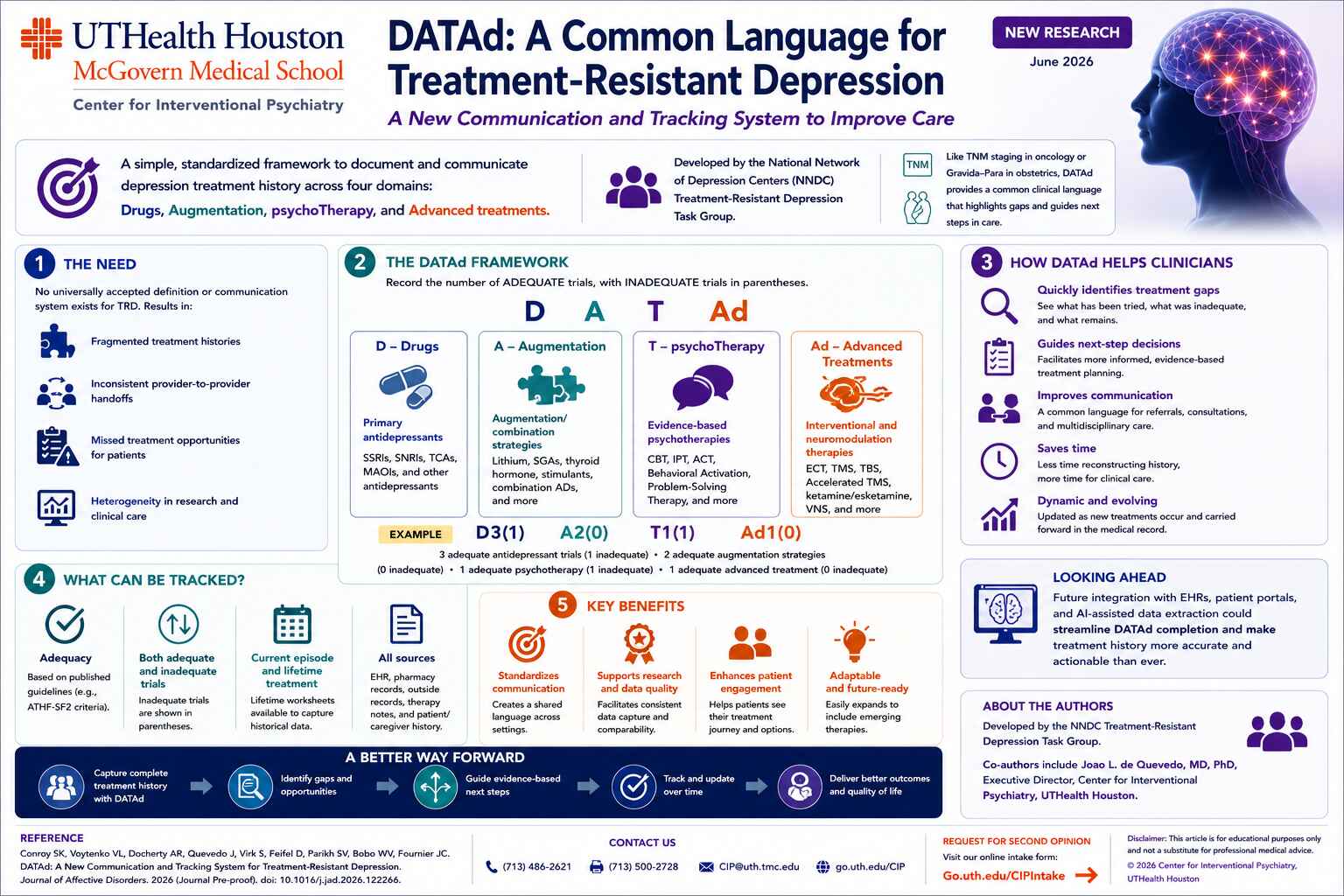
DATAd stands for:
- D — Drugs
- A — Augmentation/Combination therapies
- T — psychoTherapy
- Ad — Advanced Treatments
For each domain, clinicians record:
- the number of adequate treatment trials
- followed by the number of inadequate trials in parentheses.
For example:
D3(1) A2(0) T1(1) Ad1(0)
Immediately communicates:
- three adequate antidepressant trials
- one incomplete antidepressant trial
- two augmentation strategies
- one adequate psychotherapy
- one incomplete psychotherapy
- one advanced intervention
In just a few characters, a clinician can understand years of treatment history.
A Modern Framework for Modern Depression Care
Perhaps DATAd’s greatest innovation is recognizing that depression treatment extends well beyond antidepressant medications.
Drugs
The D category records primary antidepressants including:
- SSRIs
- SNRIs
- TCAs
- MAOIs
- Other antidepressants
Augmentation
The A category captures evidence-based augmentation strategies including:
- Lithium
- Second-generation antipsychotics
- Thyroid hormone (T3)
- Stimulants
- Combination antidepressants
- Other augmenting agents
Psychotherapy
The T category acknowledges that psychotherapy is a core evidence-based treatment and includes modalities such as:
- Cognitive Behavioral Therapy (CBT)
- Interpersonal Psychotherapy (IPT)
- Acceptance and Commitment Therapy (ACT)
- Behavioral Activation
- Problem-Solving Therapy
Advanced Treatments
The Ad category explicitly incorporates contemporary interventional psychiatry, including:
- Electroconvulsive Therapy (ECT)
- Transcranial Magnetic Stimulation (TMS)
- Theta Burst Stimulation (TBS)
- Accelerated TMS protocols
- Intravenous ketamine
- Intranasal esketamine
- Vagus Nerve Stimulation (VNS)
By incorporating these advanced interventions into the same framework, DATAd better reflects current standards of specialty depression care.
More Than Documentation—A Clinical Decision Tool
DATAd is not intended to record history.
It is designed to improve clinical decision-making.
A completed DATAd worksheet immediately reveals:
- treatments already exhausted
- treatment categories never attempted
- repeated inadequate trials
- potential treatment gaps
- opportunities for evidence-based next steps
Rather than reconstructing years of fragmented treatment history during every consultation, clinicians can rapidly focus on selecting the most appropriate next intervention.
A Dynamic Rather Than Static Framework
Unlike traditional staging systems, DATAd is designed to evolve.
The worksheet can be:
- updated after each new treatment
- incorporated into consultation reports
- embedded within electronic health records
- shared among treating clinicians
- adapted for research studies
The authors envision DATAd as a living clinical document that follows patients throughout their treatment journey rather than as a one-time severity score.
Looking Toward the Future
One particularly exciting aspect of DATAd is its adaptability.
The framework was intentionally designed to accommodate future developments, including:
- electronic health record integration
- patient portal implementation
- standardized referral workflows
- automated extraction of treatment histories
- artificial intelligence-assisted pre-population of treatment records
As additional therapies become available, the framework can be expanded without fundamentally changing its structure.
The UTHealth Houston Perspective
As one of the authors of this framework and as Executive Director of the Center for Interventional Psychiatry at UTHealth Houston, I believe DATAd addresses one of the most important—and often underappreciated—challenges in caring for patients with treatment-resistant depression: communication.
Our Center serves as a regional referral program for patients with complex, difficult-to-treat mood disorders. Many individuals arrive after years of care involving multiple psychiatrists, primary care physicians, therapists, hospitalizations, and interventional treatments. Reconstructing these histories can be extraordinarily time-consuming.
DATAd was developed to simplify that process.
By providing a concise, standardized summary of prior treatments across medications, augmentation strategies, psychotherapy, and advanced interventions, the framework has the potential to improve referral quality, facilitate multidisciplinary collaboration, and accelerate individualized treatment planning.
Importantly, DATAd was not designed to replace existing staging systems or clinical judgment. Instead, it complements these approaches by providing a common language that enables clinicians to quickly identify treatment gaps, communicate recommendations more effectively, and maintain an evolving longitudinal record of care.
At UTHealth Houston, where interventional psychiatry is integrated with comprehensive medication management, psychotherapy, and research, this type of harmonized communication has the potential to improve both clinical practice and patient outcomes meaningfully.
Looking Ahead
Psychiatry is entering an era of increasingly personalized care.
As our therapeutic options continue to expand—from novel pharmacotherapies to neuromodulation and psychedelic-assisted treatments—the ability to communicate treatment history clearly will become just as important as the treatments themselves.
DATAd represents an important step toward that future.
Much as the TNM classification transformed oncology and the Gravida–Para notation standardized obstetrics, DATAd has the potential to become a universally recognized language for documenting treatment history in depression.
If validated through the ongoing multicenter NNDC studies, it could improve continuity of care, facilitate research, enhance referral quality, and ultimately help clinicians deliver more individualized, evidence-based treatment for patients with difficult-to-treat depression.
Reference
Conroy SK, Voytenko VL, Docherty AR, Quevedo J, Virk S, Feifel D, Parikh SV, Bobo WV, Fournier JC. DATAd: A New Communication and Tracking System for Treatment-Resistant Depression. Journal of Affective Disorders. 2026 (Journal Pre-proof).
Contact
Center for Interventional Psychiatry
John S. Dunn Behavioral Sciences Center
UTHealth Houston
Request for Second Opinion: https://Go.uth.edu/CIPIntake (external link)
Phone: (713) 486-2621
Fax: (713) 500-2728
Email: [email protected]
Website: https://go.uth.edu/CIP (external link)
Disclaimer
This article is intended for educational and informational purposes only and should not be considered medical advice or a substitute for consultation with a qualified healthcare professional.
This content was developed with the assistance of artificial intelligence (AI) as a scientific writing support tool. It was reviewed, substantially edited, and approved by Joao L. de Quevedo, MD, PhD, who is a co-author of the original publication discussed in this article. Every effort has been made to ensure the accuracy, scientific balance, and clinical relevance of the information presented; however, readers should consult the original publication and current clinical guidelines when making patient-care decisions.
The opinions expressed in this article are intended to facilitate scientific education and discussion and do not necessarily represent the official views of the National Network of Depression Centers or the Journal of Affective Disorders.
© Center for Interventional Psychiatry, John S. Dunn Behavioral Sciences Center, UTHealth Houston.