Electroconvulsive Therapy and Precision Psychiatry: Lessons from a Rare Genetic Form of Treatment-Resistant Schizophrenia
 When Precision Psychiatry Meets Electroconvulsive Therapy
Precision psychiatry is often discussed in the context of biomarkers, artificial intelligence, and genomics. Yet, in daily clinical practice, we still rarely tailor psychiatric treatments based on an individual’s genetic diagnosis.
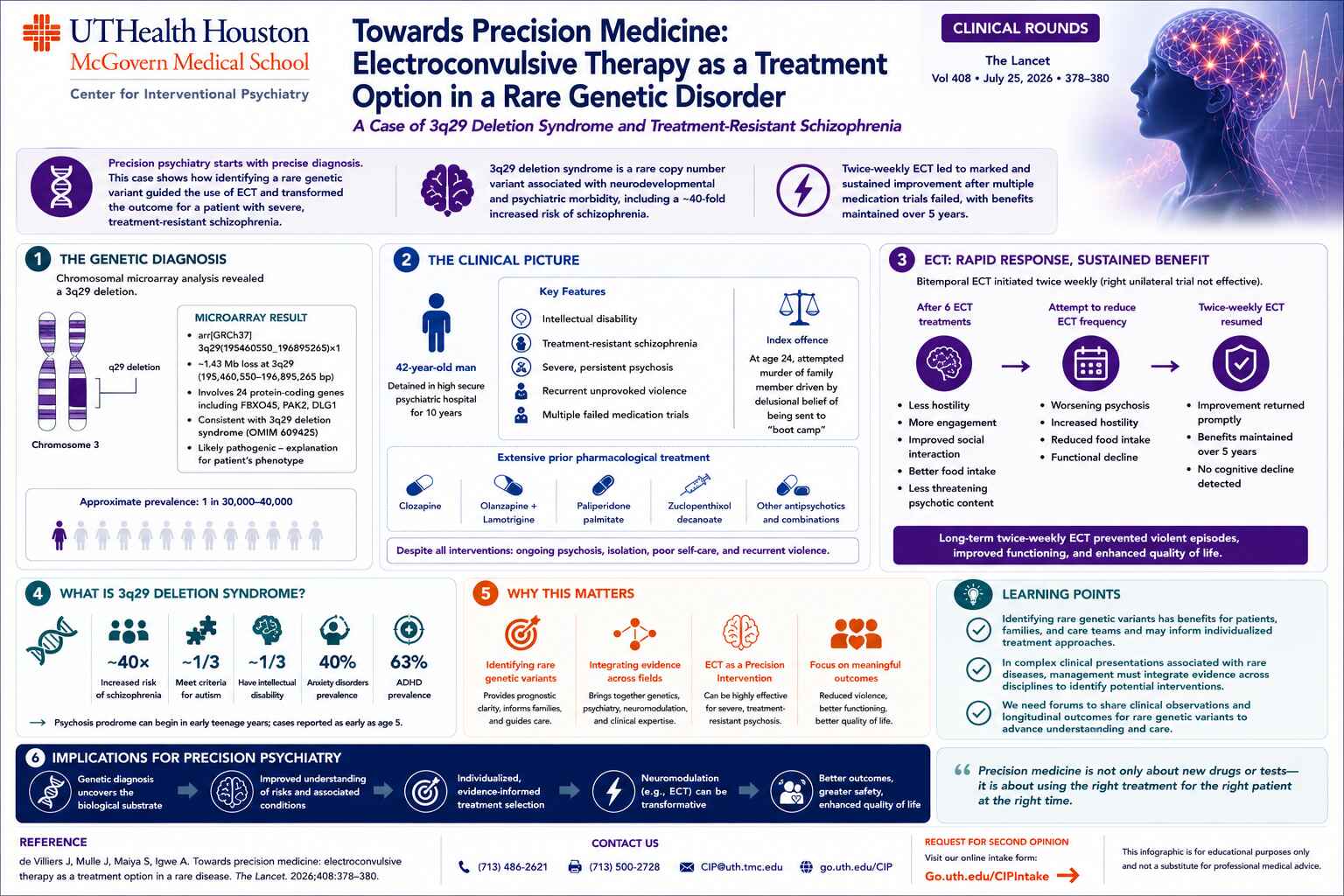
A recent Lancet Clinical Rounds article illustrates how precision medicine can directly influence treatment decisions. The authors describe a remarkable case of a patient with 3q29 deletion syndrome, treatment-resistant schizophrenia, and intellectual disability who experienced sustained clinical improvement with long-term twice-weekly electroconvulsive therapy (ECT) after failing multiple pharmacological interventions.
Although this is a single-patient report, it highlights an emerging paradigm in psychiatry: integrating genetic diagnosis with evidence-based neuromodulation to individualize treatment.
Understanding 3q29 Deletion Syndrome
The 3q29 deletion syndrome is a rare chromosomal copy-number variant affecting approximately 1 in 30,000–40,000 individuals.
The syndrome is associated with a broad spectrum of neurodevelopmental and psychiatric manifestations, including:
- Intellectual disability
- Autism spectrum disorder
- Anxiety disorders
- Attention-deficit/hyperactivity disorder
- A dramatically increased risk of schizophrenia
Perhaps most strikingly, individuals carrying this deletion have an approximately 40-fold increased risk of developing schizophrenia, making it one of the strongest known genetic risk factors for psychotic illness.
A Challenging Clinical Presentation
The article describes a 42-year-old man with:
- 3q29 deletion syndrome
- Intellectual disability
- Treatment-resistant schizophrenia
- Severe, persistent psychosis
- Recurrent violence requiring long-term hospitalization in a high-security psychiatric facility
Over many years, he underwent extensive pharmacological treatment, including:
- Clozapine
- Olanzapine
- Lamotrigine augmentation
- Paliperidone palmitate
- Zuclopenthixol decanoate
Despite these interventions, he remained severely psychotic, socially isolated, and highly aggressive. His quality of life was profoundly impaired, and repeated medication adjustments failed to achieve meaningful clinical improvement.
Why Electroconvulsive Therapy?
After reviewing the limited literature on schizophrenia associated with 3q29 deletion syndrome, the clinical team concluded that electroconvulsive therapy augmentation represented the most promising evidence-based option.
ECT was initiated twice weekly.
The response was both rapid and clinically meaningful.
After only six treatments, the patient demonstrated:
- reduced hostility
- improved engagement with staff
- increased social interaction
- improved nutritional intake
- less threatening psychotic content
Although psychotic symptoms persisted, they became substantially less distressing and no longer drove violent behavior.
A Powerful Observation: Continuous ECT Was Necessary
Perhaps the most fascinating aspect of the case was what happened when clinicians attempted to reduce treatment frequency.
Each reduction in ECT resulted in:
- worsening psychosis
- renewed hostility
- decreased food intake
- behavioral deterioration
When twice-weekly ECT was resumed, improvement returned promptly.
Over the following five years, continuous maintenance ECT:
- prevented violent episodes
- maintained improved functioning
- enhanced quality of life
- produced no detectable cognitive decline
These observations strongly support the concept that, for some patients with severe treatment-resistant psychotic disorders, maintenance ECT may function as an ongoing disease-modifying intervention rather than simply an acute rescue treatment.
Precision Psychiatry in Action
Although the article focuses on ECT, its broader message concerns precision psychiatry.
Identification of the patient’s rare genetic syndrome fundamentally altered clinical thinking.
Rather than repeatedly cycling through medications, clinicians integrated:
- genetic diagnosis
- published evidence
- expert consultation
- individualized neuromodulation
into a precision treatment strategy.
The authors argue that identifying pathogenic genetic variants provides multiple practical benefits, including improved prognostic understanding, recognition of associated medical conditions, enhanced family counseling, and the possibility of selecting treatments that are more likely to succeed.
Lessons Beyond Rare Diseases
Although 3q29 deletion syndrome is uncommon, the principles illustrated by this case are broadly relevant.
Increasingly, psychiatry is moving toward treatments guided by:
- biological mechanisms
- clinical phenotype
- genetic architecture
- objective biomarkers
- individualized risk profiles
Rather than viewing schizophrenia—or depression—as single diseases, precision psychiatry recognizes that they likely represent collections of biologically distinct disorders requiring different therapeutic approaches.
Implications for Electroconvulsive Therapy
ECT remains one of the most effective treatments available in psychiatry.
Yet misconceptions continue to limit its use.
This report reinforces several important concepts:
- ECT is effective beyond severe depression.
- It has an established role in treatment-resistant schizophrenia.
- Long-term maintenance ECT can be both feasible and beneficial in carefully selected patients.
- Clinical benefit may persist even when psychotic symptoms do not completely resolve.
- Functional improvement and quality of life are meaningful treatment goals.
Perhaps most importantly, this case reminds us that successful psychiatric treatment is not always defined by complete symptom elimination. Meaningful reductions in aggression, distress, and disability can dramatically transform a patient’s life.
The UTHealth Houston Perspective
At the Center for Interventional Psychiatry at UTHealth Houston, we routinely care for patients with severe, treatment-resistant psychiatric illnesses, including individuals with treatment-resistant depression, catatonia, bipolar disorder, and schizophrenia.
This case highlights two themes that increasingly define the future of psychiatric care.
First, electroconvulsive therapy remains one of the most powerful evidence-based interventions available, particularly for patients who have not responded to multiple pharmacological treatments.
Second, precision psychiatry extends far beyond pharmacogenomics. Integrating genetic information, clinical phenotype, and individualized treatment strategies allows clinicians to move beyond traditional diagnostic labels toward more biologically informed care.
Although reports such as this cannot establish definitive treatment recommendations, they provide valuable clinical observations that stimulate further research and remind us that individualized medicine often begins with careful observation of individual patients.
Looking Ahead
As genetic testing becomes increasingly integrated into psychiatric practice, rare syndromes such as 3q29 deletion syndrome may serve as important models for understanding the biological heterogeneity of severe mental illness.
Future studies may identify genetic subgroups that preferentially respond to specific neuromodulation strategies, including electroconvulsive therapy, transcranial magnetic stimulation, ketamine, or other emerging interventions.
Ultimately, the future of psychiatry will likely combine genomics, neurobiology, biomarkers, and advanced therapeutics to deliver truly personalized care.
Cases like this remind us that precision psychiatry is no longer a distant aspiration—it is already beginning to influence clinical decision-making.
Reference
de Villiers J, Mulle J, Maiya S, Igwe A. Towards precision medicine: electroconvulsive therapy as a treatment option in a rare disease. The Lancet. 2026;408:378–380.
Contact
Center for Interventional Psychiatry
John S. Dunn Behavioral Sciences Center
UTHealth Houston
Request for Second Opinion: https://Go.uth.edu/CIPIntake (external link)
Phone: (713) 486-2621
Fax: (713) 500-2728
Email: [email protected]
Website: https://go.uth.edu/CIP (external link)
Disclaimer
This article is intended for educational and informational purposes only and should not be considered medical advice or a substitute for consultation with a qualified healthcare professional.
This content was developed with the assistance of artificial intelligence (AI) as a scientific writing support tool. It was reviewed, substantially edited, and approved by Joao L. de Quevedo, MD, PhD, Executive Director of the Center for Interventional Psychiatry at UTHealth Houston. Every effort has been made to ensure the accuracy, scientific balance, and clinical relevance of the information presented; however, readers should consult the original publication and current clinical guidelines when making patient-care decisions.
The opinions expressed in this article are those of the author and are intended to promote scientific education and discussion.
© Center for Interventional Psychiatry, John S. Dunn Behavioral Sciences Center, UTHealth Houston.