Psychedelic Therapies for Treatment-Resistant Depression: Are We Entering a New Era?
A New Chapter in the Treatment of Depression
Few areas of psychiatry have evolved as rapidly over the past decade as the treatment of treatment-resistant depression (TRD). Once limited primarily to medication switches and electroconvulsive therapy (ECT), clinicians now have access to an expanding array of evidence-based interventions, including transcranial magnetic stimulation (TMS), accelerated TMS protocols such as SAINT®, ketamine, intranasal esketamine, vagus nerve stimulation (VNS), and an increasingly robust portfolio of investigational therapies.
Among the most exciting developments is the resurgence of psychedelic-assisted therapies. After decades of limited scientific investigation, rigorous clinical trials are demonstrating that psychedelic compounds may produce rapid, meaningful, and sometimes durable improvements in patients whose depression has not responded to conventional treatments.
While these therapies remain investigational in the United States, their clinical development has accelerated dramatically. We may be witnessing the beginning of one of the most significant paradigm shifts in psychiatry since the introduction of modern antidepressants.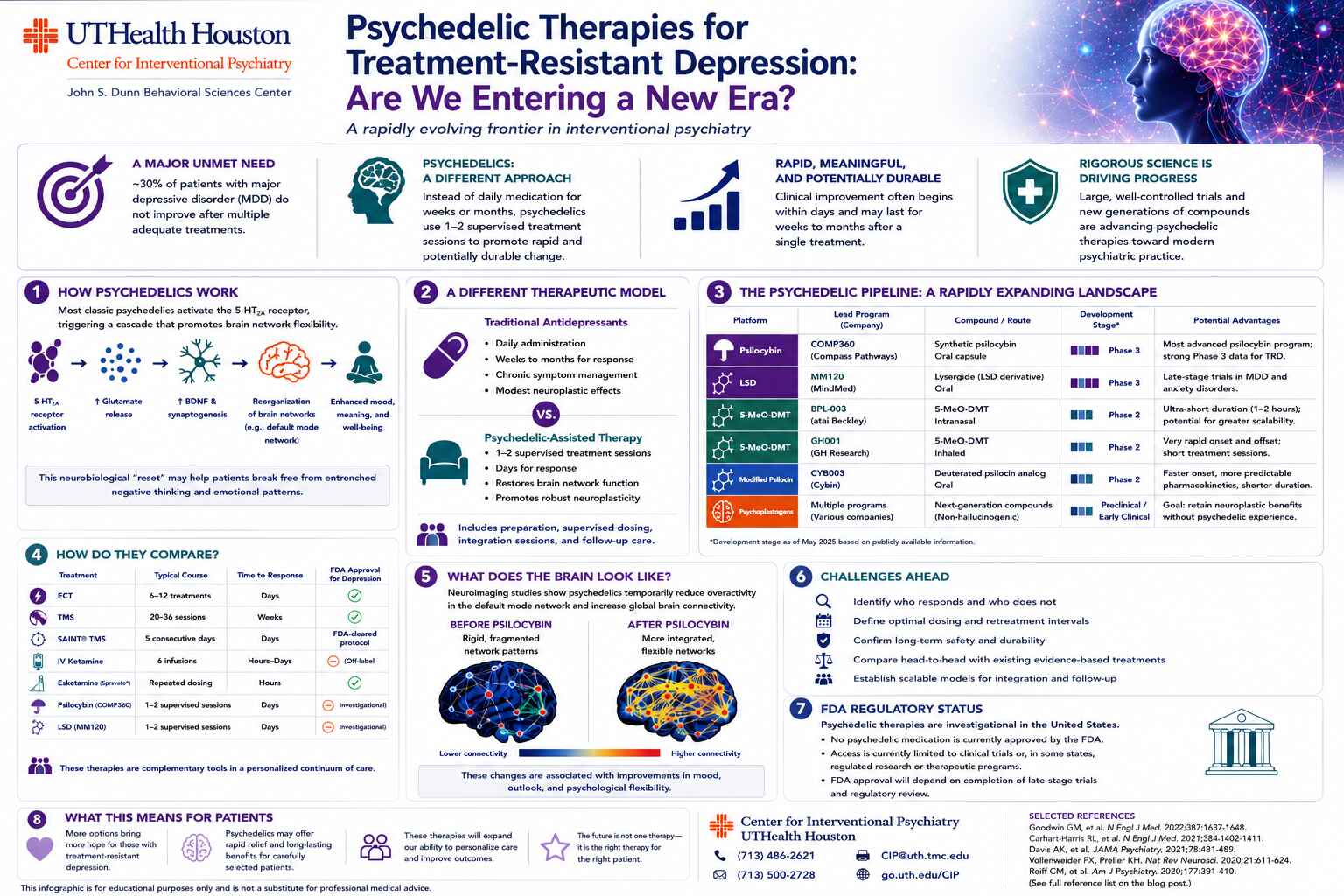
The Challenge of Treatment-Resistant Depression
Major depressive disorder affects more than 280 million people worldwide and remains one of the leading causes of disability.
Although conventional antidepressants have transformed psychiatric care, approximately 30% of patients fail to achieve adequate improvement despite multiple evidence-based treatments. These individuals are considered to have treatment-resistant depression (TRD).
Patients with TRD frequently experience:
- Persistent depressive symptoms
- Functional impairment
- Reduced quality of life
- Increased risk of hospitalization
- Greater risk of suicide
- Higher healthcare utilization
The need for novel therapeutic approaches has never been greater.
Why Psychedelics?
Classic psychedelics—including psilocybin, lysergic acid diethylamide (LSD), N, N-dimethyltryptamine (DMT), and 5-methoxy-N, N-dimethyltryptamine (5-MeO-DMT)—appear to work fundamentally differently from traditional antidepressants.
Rather than requiring daily administration over weeks or months, psychedelic therapies are administered during one or a small number of carefully supervised treatment sessions.
Clinical improvement often begins within days and, in some patients, may persist for weeks or even months after a single treatment.
This represents an entirely different therapeutic philosophy.
A Different Therapeutic Model
Traditional antidepressants generally work by chronically modifying monoamine neurotransmission.
Psychedelic therapies seek to produce rapid neurobiological change after a brief intervention.
Instead of continuous daily medication, treatment consists of:
- Careful patient selection
- Preparation sessions
- One or two supervised dosing sessions
- Structured psychological support
- Long-term integration and follow-up
This episodic model resembles other interventional psychiatric treatments such as:
- Electroconvulsive Therapy (ECT)
- Accelerated TMS (SAINT®)
- Ketamine infusion therapy
The objective is not simply temporary symptom suppression but the restoration of healthier brain network function.
How Do Psychedelics Work?
Although research continues, several biological mechanisms have emerged.
Most classic psychedelics primarily activate the serotonin 5-HT₂A receptor, initiating a cascade of downstream effects that include:
- Increased glutamatergic neurotransmission
- Enhanced synaptic plasticity
- Increased brain-derived neurotrophic factor (BDNF)
- Formation of new dendritic spines
- Strengthening of synaptic connectivity
- Increased cognitive flexibility
- Reorganization of dysfunctional brain networks
Neuroimaging studies suggest these compounds temporarily reduce excessive activity within the default mode network (DMN)—a network involved in self-referential thinking, rumination, and negative emotional processing.
This transient “reset” may help explain why many patients report profound changes in perspective, emotional processing, and psychological flexibility that extend well beyond the acute treatment experience.
COMP360: Leading the Field
Among psychedelic therapies currently in development, COMP360, a pharmaceutical-grade synthetic formulation of psilocybin developed by Compass Pathways, is the most advanced program for treatment-resistant depression.
COMP360 is administered as a single oral capsule under carefully controlled conditions with standardized psychological support before, during, and after treatment.
Its clinical development program has become the largest and most rigorous ever conducted for a psychedelic medicine.
Following encouraging Phase 2 studies, two pivotal Phase 3 clinical trials demonstrated statistically significant and clinically meaningful improvements in adults with treatment-resistant depression.
Several important observations have emerged:
- Improvement often begins within days.
- Many patients maintain clinical benefit for months.
- The treatment has demonstrated a favorable safety profile when administered in specialized clinical settings.
- Positive findings have now been replicated across multiple large clinical trials.
If approved by the U.S. Food and Drug Administration (FDA), COMP360 could become the first approved psilocybin-based therapy for treatment-resistant depression.
Beyond Psilocybin: A Rapidly Expanding Pipeline
Psilocybin represents only one component of an increasingly diverse development pipeline.
| Therapeutic Platform | Lead Program | Current Development* |
| Psilocybin | COMP360 (Compass Pathways) | Phase 3 |
| LSD | MM120 (MindMed) | Phase 3 |
| 5-MeO-DMT | BPL-003 (atai Beckley) | Phase 2 |
| 5-MeO-DMT | GH001 (GH Research) | Phase 2 |
| Modified Psilocin | CYB003 (Cybin) | Phase 2 |
| Psychoplastogens | Multiple programs | Preclinical/Early Clinical |
*Development status at the time of writing.
Ultra-Short-Acting Psychedelics
One of the most exciting innovations involves 5-MeO-DMT formulations.
Unlike psilocybin sessions that typically require 6–8 hours, compounds such as BPL-003 and GH001 may complete treatment sessions within 1–2 hours, potentially making psychedelic therapy substantially more scalable for routine clinical practice.
Modified Psychedelic Molecules
Several companies are developing modified psychedelic compounds designed to optimize clinical delivery.
For example, CYB003, a deuterated psilocin analog, aims to provide:
- Faster onset
- More predictable pharmacokinetics
- Reduced interpatient variability
- Shorter treatment duration
The Next Generation: Psychoplastogens
Perhaps the most intriguing area of development involves psychoplastogens.
These novel compounds seek to preserve the remarkable neuroplastic effects of psychedelic medications while minimizing—or even eliminating—the hallucinatory experience.
If successful, psychoplastogens could fundamentally transform psychiatric practice by allowing rapid biological antidepressant treatments without prolonged psychedelic sessions.
Whether the psychedelic experience itself contributes to therapeutic benefit remains one of the most important unanswered questions in contemporary psychiatry.
How Do Psychedelic Therapies Compare with Existing Interventional Treatments?
| Treatment | Typical Treatment Course | Time to Response | FDA Approval Status |
| Electroconvulsive Therapy (ECT) | 6–12 treatments | Days | Approved |
| Transcranial Magnetic Stimulation (TMS) | 20–36 sessions | Weeks | Approved |
| SAINT® TMS | Five consecutive days | Days | FDA-cleared protocol |
| Intravenous Ketamine | Series of infusions | Hours–Days | Off-label |
| Intranasal Esketamine | Repeated maintenance dosing | Hours | Approved |
| Psilocybin (COMP360) | 1–2 supervised sessions | Days | Investigational |
| LSD (MM120) | 1–2 supervised sessions | Days | Investigational |
Rather than replacing existing therapies, psychedelic medicines will likely become additional options within a personalized continuum of care.
Challenges That Still Need Answers
Despite extraordinary progress, several important questions remain.
Researchers continue to investigate:
- Which patients are most likely to respond?
- What biomarkers predict treatment success?
- How durable are clinical benefits?
- When should repeat treatments be administered?
- How should psychological support be standardized?
- How do psychedelic therapies compare directly with ECT, ketamine, esketamine, or accelerated TMS?
- Can psychoplastogens reproduce therapeutic benefits without inducing altered states of consciousness?
Answering these questions will shape how psychedelic therapies are ultimately integrated into routine psychiatric practice.
The UTHealth Houston Perspective
At the Center for Interventional Psychiatry at UTHealth Houston, our mission is to provide patients with access to the most advanced evidence-based treatments while actively participating in the development of tomorrow’s therapies through clinical research.
We believe a single intervention will not define the future of depression treatment. Instead, it will be characterized by precision psychiatry—matching the right treatment to the right patient at the right time.
That future already includes medication management, psychotherapy, ECT, ketamine and esketamine, TMS, accelerated TMS (SAINT®), vagus nerve stimulation, and participation in innovative clinical trials. Psychedelic-assisted therapies may soon become another important component of this comprehensive continuum of care.
Looking Ahead
The history of depression treatment has been marked by periods of incremental progress punctuated by transformative breakthroughs.
Electroconvulsive therapy revolutionized psychiatry in the 1930s. Antidepressants reshaped treatment beginning in the 1950s. Neuromodulation expanded therapeutic possibilities over the past three decades.
Today, psychedelic-assisted therapies may represent the next major chapter.
Whether they ultimately become first-line interventions for carefully selected patients or remain specialized treatments for treatment-resistant illness, they are already transforming our scientific understanding of depression and challenging long-held assumptions about how durable recovery can be achieved.
For patients living with treatment-resistant depression, that transformation represents far more than scientific progress—it represents renewed hope.
Selected References
Landmark Clinical Trials
- Goodwin GM, Aaronson ST, Alvarez O, et al. Single-Dose Psilocybin for a Treatment-Resistant Episode of Major Depression. N Engl J Med. 2022;387:1637–1648.
- Carhart-Harris RL, Giribaldi B, Watts R, et al. Trial of Psilocybin versus Escitalopram for Depression. N Engl J Med. 2021;384:1402–1411.
- Davis AK, Barrett FS, May DG, et al. Effects of Psilocybin-Assisted Therapy on Major Depressive Disorder. JAMA Psychiatry. 2021;78:481–489.
Mechanisms of Action
- Vollenweider FX, Preller KH. Psychedelic Drugs: Neurobiology and Potential for Treatment of Psychiatric Disorders. Nat Rev Neurosci. 2020;21:611–624.
- Ly C, Greb AC, Cameron LP, et al. Psychedelics Promote Structural and Functional Neural Plasticity. Cell Reports. 2018;23:3170–3182.
- Daws RE, Timmermann C, Giribaldi B, et al. Increased Global Integration in the Brain After Psilocybin Therapy for Depression. Nat Med. 2022;28:844–851.
- Olson DE. Biomolecular Mechanisms and Therapeutic Potential of Psychoplastogens. Cell. 2022;185:393–408.
Reviews
- Reiff CM, Richman EE, Nemeroff CB, et al. Psychedelics and Psychedelic-Assisted Psychotherapy. Am J Psychiatry. 2020;177:391–410.
- Barnett BS, Mauney EE, King F IV. Psychedelic-Assisted Therapy: An Overview for the Internist. Cleve Clin J Med. 2025;92:171–180.
- Nichols DE. Psychedelics. Pharmacol Rev. 2016;68:264–355.
- Yaden DB, Griffiths RR. The Subjective Effects of Psychedelics Are Necessary for Their Enduring Therapeutic Effects. ACS Pharmacol Transl Sci. 2021;4:568–572.
Clinical Development Programs
- Compass Pathways. COMP360 Clinical Development Program.
- MindMed. MM120 Clinical Development Program.
- atai Life Sciences/Beckley Psytech. BPL-003 Clinical Development Program.
- GH Research. GH001 Clinical Development Program.
- Cybin Inc. CYB003 Clinical Development Program.
Contact
Center for Interventional Psychiatry
John S. Dunn Behavioral Sciences Center
UTHealth Houston
Request for Second Opinion: https://Go.uth.edu/CIPIntake (external link)
Phone: (713) 486-2621
Fax: (713) 500-2728
Email: [email protected]
Website: https://go.uth.edu/CIP (external link)
Disclaimer
This article is intended for educational and informational purposes only and should not be considered medical advice or a substitute for consultation with a qualified healthcare professional.
This content was developed with the assistance of artificial intelligence (AI) as a scientific writing support tool. It was reviewed, substantially edited, and approved by Joao L. de Quevedo, MD, PhD, Executive Director of the Center for Interventional Psychiatry at UTHealth Houston. Every effort has been made to ensure the accuracy, scientific balance, and clinical relevance of the information presented; however, readers should consult original scientific publications, current clinical guidelines, and qualified healthcare professionals when making treatment decisions.
The discussion of investigational psychedelic therapies reflects the current state of scientific research. It should not be interpreted as an endorsement or indication that these treatments have received approval by the U.S. Food and Drug Administration unless explicitly stated.
© Center for Interventional Psychiatry, John S. Dunn Behavioral Sciences Center, UTHealth Houston.