Can Vagus Nerve Stimulation Reduce Suicidal Thoughts in Treatment-Resistant Depression? New Evidence from the RECOVER Trial
 Hope Beyond Symptom Reduction
For patients living with treatment-resistant depression (TRD), the burden extends far beyond persistent sadness. Many struggle with chronic suicidal thoughts, profound functional impairment, and years of unsuccessful treatments. While several therapies—including electroconvulsive therapy (ECT) and ketamine—can rapidly reduce suicidal ideation, relatively few long-term interventions have demonstrated sustained benefits specifically for suicidal thinking.
A recently published analysis from the RECOVER trial, published in the Journal of Clinical Psychiatry, provides encouraging evidence that vagus nerve stimulation (VNS) may significantly reduce suicidal ideation in individuals with severe, chronic treatment-resistant depression. I was honored to serve as one of the investigators and co-authors of this important multicenter study.
Why This Study Matters
Suicide remains one of the leading causes of death among individuals with major depressive disorder, and the risk is particularly high in patients with treatment-resistant depression.
Although VNS has been approved in the United States as an adjunctive treatment for chronic treatment-resistant depression for nearly two decades, its potential impact on suicidal ideation has remained incompletely understood. Earlier studies suggested possible benefit, but more rigorous evidence was needed.
The RECOVER trial was designed to help answer this important clinical question using one of the largest randomized, sham-controlled investigations of VNS ever conducted in treatment-resistant depression.
What Is Vagus Nerve Stimulation?
Vagus nerve stimulation is an implantable neuromodulation therapy that delivers mild electrical impulses to the left cervical vagus nerve through a small pulse generator implanted beneath the skin of the chest.
Unlike ketamine or ECT, VNS is not intended as an emergency intervention. Instead, it is designed to produce gradual and sustained improvement over months by modulating neural circuits involved in mood regulation, emotional processing, and neuroplasticity.
For many patients, the therapeutic benefits continue to accumulate over time, making VNS an attractive option for individuals with chronic, highly refractory depression.
The RECOVER Trial
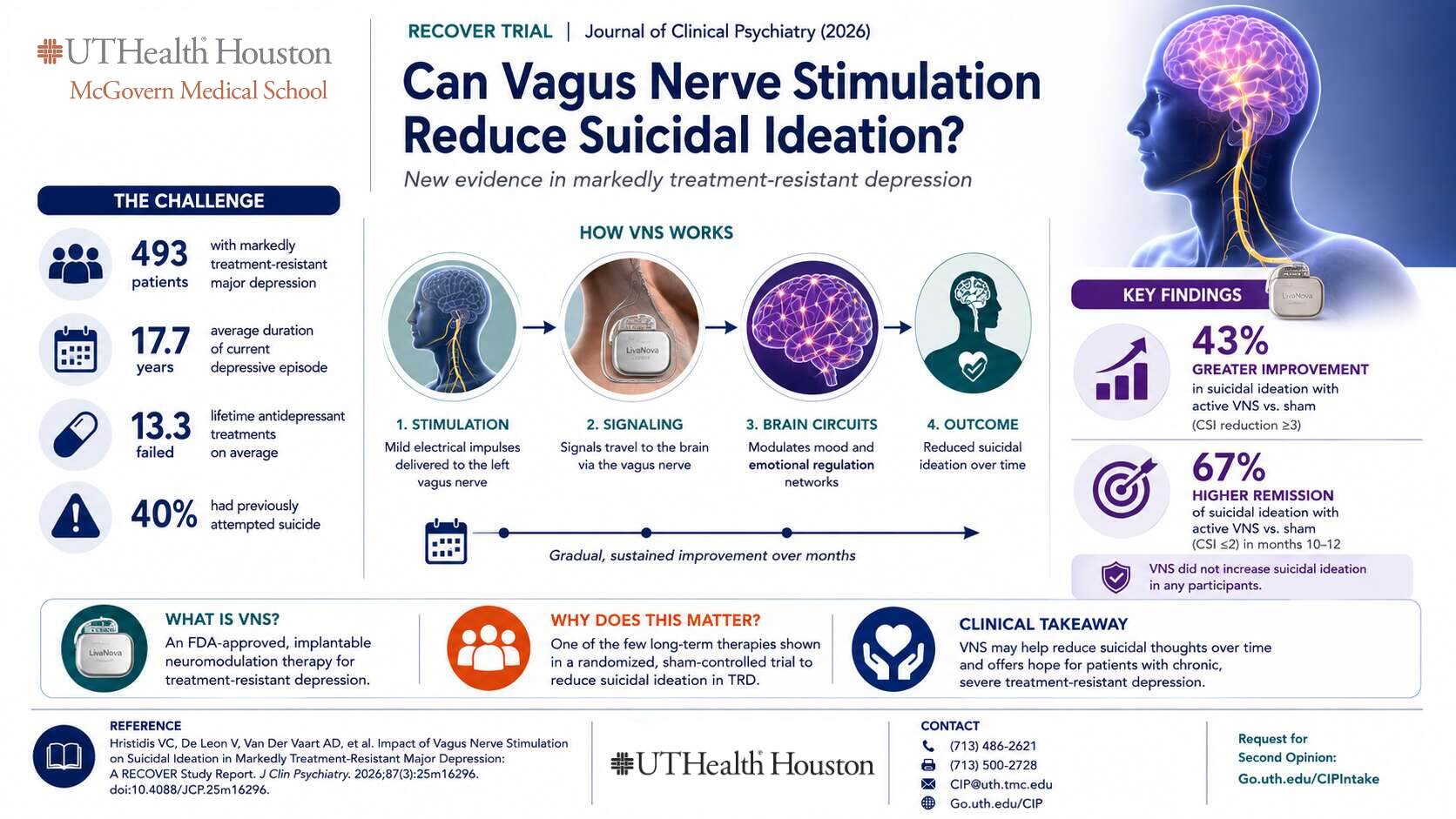
The RECOVER study enrolled 493 adults with markedly treatment-resistant major depressive disorder.
Participants represented an exceptionally difficult-to-treat population:
- At least four failed antidepressant treatments during the current depressive episode.
- An average of 13.3 lifetime unsuccessful antidepressant trials.
- A current depressive episode lasting an average of 17.7 years.
- More than 40% had previously attempted suicide.
- Nearly three-quarters had already received advanced treatments such as ECT, transcranial magnetic stimulation (TMS), or esketamine.
Participants were randomly assigned to receive either:
- Active VNS plus treatment as usual, or
- Sham VNS plus treatment as usual,
and were followed for twelve months in a rigorous triple-blind clinical trial.
Measuring Suicidal Ideation
Rather than relying on a single questionnaire, investigators developed a Composite Suicidal Ideation (CSI) Score, integrating suicide-related items from three validated depression rating scales.
This composite measure incorporated both clinician-rated and patient-reported assessments, providing a more comprehensive evaluation of suicidal thinking throughout the study.
What Did the Study Find?
The results were encouraging.
Among participants who entered the study with clinically meaningful suicidal ideation:
- Active VNS produced significantly greater reductions in suicidal ideation than sham stimulation.
- Patients receiving active VNS were 43% more likely to experience clinically meaningful improvement in suicidal thoughts.
- During the final three months of the blinded study, patients receiving active VNS were 67% more likely to achieve remission of suicidal ideation than those receiving sham stimulation.
Equally reassuring, VNS did not increase suicidal ideation among participants who entered the study without suicidal thoughts, nor did it worsen suicidal thinking among those who already had it.
Why Is This Important?
These findings are clinically meaningful because relatively few psychiatric interventions have demonstrated sustained reductions in suicidal ideation over extended periods.
Rather than functioning as an acute crisis intervention, VNS appears to provide a gradual and durable reduction in suicidal thinking as depressive symptoms improve over time.
For patients with chronic treatment-resistant depression, this represents an important therapeutic goal—helping reduce one of the most devastating consequences of severe mood disorders.
An Important Perspective
Like all clinical research, this study should be interpreted within its context.
VNS is not a treatment for an acute suicidal crisis. Individuals experiencing active suicidal intent require immediate evaluation and evidence-based emergency care.
Instead, these findings suggest that VNS may become an important component of long-term suicide risk reduction in carefully selected patients with chronic treatment-resistant depression.
The authors also note that the composite suicidal ideation outcome used in this analysis was exploratory and should be further validated in future studies.
What This Means for Patients
Patients with treatment-resistant depression frequently ask whether meaningful improvement remains possible after multiple medications, psychotherapy, TMS, ketamine, or even ECT have failed to provide lasting recovery.
The answer is increasingly yes.
Neuromodulation continues to expand the therapeutic options available for patients with difficult-to-treat depression, and VNS represents one of the few interventions capable of producing sustained clinical improvement over many years.
Although VNS is not appropriate for every patient, the growing body of evidence suggests that it may improve depressive symptoms, daily functioning, quality of life, and potentially reduce chronic suicidal ideation in carefully selected individuals.
The UTHealth Houston Perspective
At the Center for Interventional Psychiatry at UTHealth Houston, we are committed to advancing the field of interventional psychiatry through both clinical innovation and participation in multicenter research.
As one of the participating centers in the RECOVER trial, we are proud to have contributed to this important study, which advances our understanding of how vagus nerve stimulation may benefit patients living with chronic treatment-resistant depression.
Research such as RECOVER reinforces our commitment to offering patients comprehensive, evidence-based care while helping develop the next generation of treatments for severe mood disorders.
Looking Ahead
The future of interventional psychiatry lies in personalized neuromodulation.
As our understanding of depression biology continues to evolve, therapies such as VNS, deep brain stimulation, accelerated TMS, ketamine-based treatments, and emerging brain-computer interfaces may increasingly be tailored to the unique clinical characteristics of each patient.
The RECOVER trial represents another important step toward that future, demonstrating that neuromodulation has the potential not only to improve depressive symptoms but also to reduce one of the most devastating aspects of treatment-resistant depression: persistent suicidal ideation.
For patients who have exhausted conventional treatment options, that represents a meaningful reason for hope.
Reference
Hristidis VC, De Leon V, Van Der Vaart AD, et al. Impact of Vagus Nerve Stimulation on Suicidal Ideation in Markedly Treatment-Resistant Major Depression: A RECOVER Study Report. Journal of Clinical Psychiatry. 2026;87(3):25m16296. doi:10.4088/JCP.25m16296.
Contact
Center for Interventional Psychiatry
John S. Dunn Behavioral Sciences Center
UTHealth Houston
Request for Second Opinion: https://Go.uth.edu/CIPIntake (external link)
Phone: (713) 486-2621
Fax: (713) 500-2728
Email: [email protected]
Website: https://Go.uth.edu/CIP (external link)
Disclaimer
This article is intended for educational and informational purposes only and should not be considered medical advice or a substitute for consultation with a qualified healthcare professional.
This content was developed with the assistance of artificial intelligence (AI) as a scientific writing support tool. It was reviewed, substantially edited, and approved by Joao L. de Quevedo, MD, PhD, Executive Director of the Center for Interventional Psychiatry at UTHealth Houston and a co-author of the publication discussed in this article. Every effort has been made to ensure the accuracy, scientific balance, and clinical relevance of the information presented; however, readers should consult the original publication and current clinical guidelines when making patient-care decisions.
The opinions expressed in this article are those of the author and are intended to promote scientific education and discussion.
© Center for Interventional Psychiatry, John S. Dunn Behavioral Sciences Center, UTHealth Houston.