Depression in Neurodegenerative Disease: Why Precision Psychiatry May Transform Care
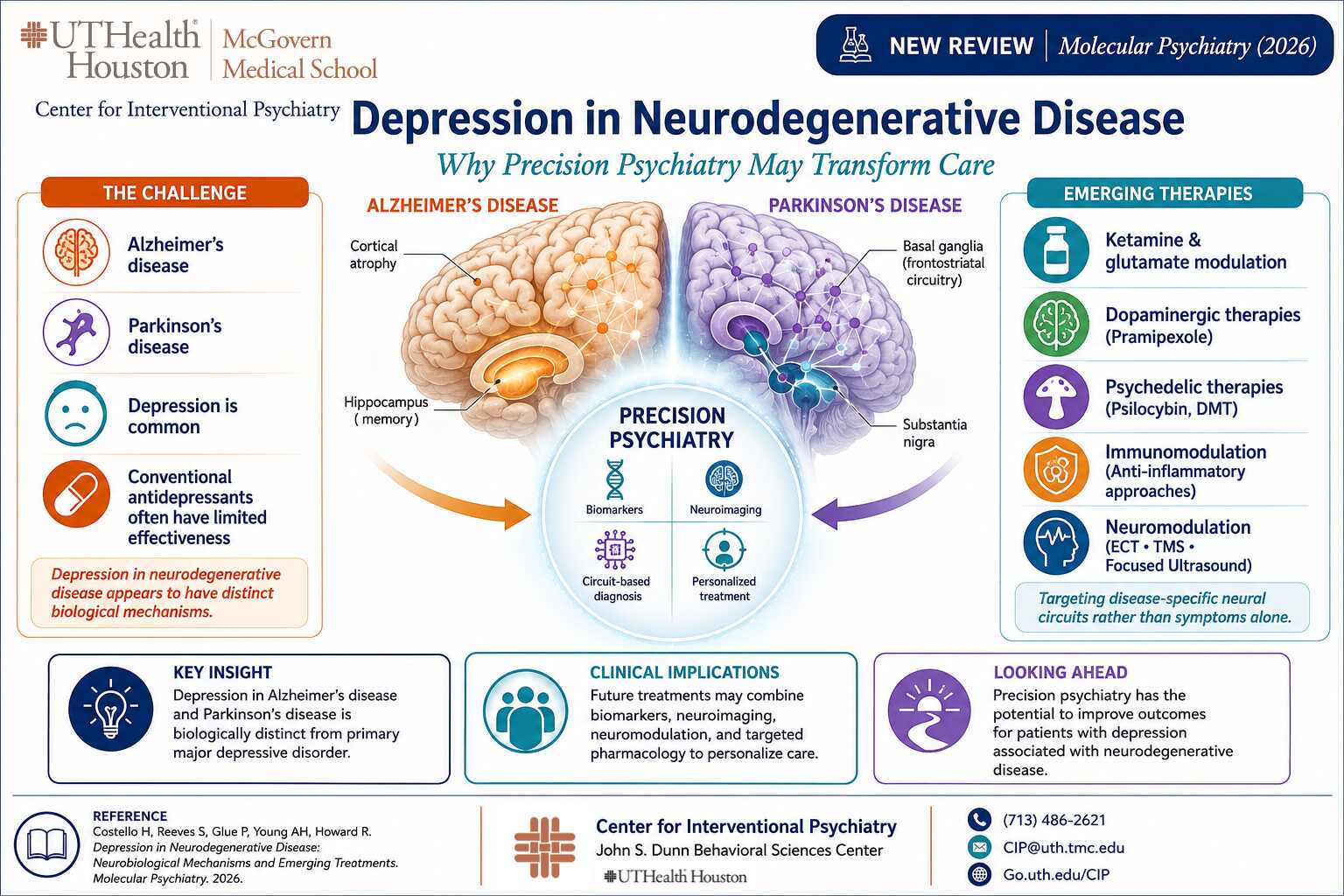 Depression in Alzheimer’s and Parkinson’s Disease: An Unmet Clinical Need
Depression is among the most common and disabling complications of neurodegenerative disorders. Nearly 42% of patients with Alzheimer’s disease (AD) and 35% of those with Parkinson’s disease (PD) experience clinically significant depressive symptoms, which are associated with accelerated cognitive decline, poorer quality of life, increased healthcare utilization, and higher mortality. Yet despite this enormous burden, currently available antidepressants often provide little or no meaningful benefit in these populations.
A timely review recently published in Molecular Psychiatry argues that depression associated with neurodegenerative disease is not simply “major depression occurring in an older person.” Instead, it may represent a biologically distinct disorder driven by disease-specific changes in brain circuitry and neurotransmitter systems. This concept has profound implications for how we diagnose, study, and ultimately treat depression in these patients.
A Different Biology Requires Different Treatments
Traditional antidepressants primarily target serotonin and norepinephrine signaling. However, Alzheimer’s disease and Parkinson’s disease disrupt multiple interacting systems, including:
- Dopaminergic reward pathways
- Glutamatergic neurotransmission
- Serotonergic circuits
- Neuroinflammatory pathways
- Brain network connectivity
- Synaptic plasticity
These widespread biological alterations may help explain why conventional antidepressants frequently fail in patients with neurodegenerative disease. The authors propose that treatments should instead target the specific mechanisms underlying depression in each disorder rather than relying on a “one-size-fits-all” approach.
Precision Psychiatry Comes to Neurodegenerative Disease
One of the most exciting concepts presented in this review is that depression in neurodegenerative disease provides an ideal model for precision psychiatry.
Unlike primary major depressive disorder, Alzheimer’s disease and Parkinson’s disease have relatively well-characterized biological trajectories, including:
- Molecular biomarkers
- PET imaging abnormalities
- Structural and functional brain changes
- Progressive cognitive impairment
These measurable biological changes create an opportunity to develop therapies that directly target dysfunctional neural circuits rather than simply treating depressive symptoms.
Emerging Treatments Beyond Conventional Antidepressants
The review highlights an impressive pipeline of emerging therapies that move beyond traditional monoaminergic antidepressants.
Glutamate-Modulating Therapies
Ketamine has transformed the treatment of treatment-resistant depression by rapidly enhancing synaptic plasticity and reducing suicidal ideation. Although it has not yet been formally studied in Alzheimer’s disease or Parkinson’s disease, its biological mechanisms—including restoration of glutamatergic signaling, increased BDNF expression, and improved reward processing—make it an attractive candidate for future investigation.
Other glutamatergic agents discussed include:
- Dextromethorphan-based therapies
- Oral extended-release ketamine formulations
- Novel NMDA receptor modulators
Dopaminergic Therapies
Because Parkinson’s disease profoundly affects dopamine pathways involved in motivation and reward, dopaminergic treatments may address symptoms such as anhedonia and apathy more effectively than conventional antidepressants.
Among these, pramipexole emerges as one of the most promising candidates, having demonstrated meaningful antidepressant effects in both Parkinson’s disease and treatment-resistant depression. The review highlights its ability to improve motivational symptoms by acting on mesolimbic D3 receptors within the ventral striatum.
Psychedelic Therapies
The authors also discuss the growing interest in psychedelic compounds, including:
- Psilocybin
- DMT
- 5-MeO-DMT
Although these therapies have shown rapid antidepressant effects in major depressive disorder, no clinical studies have yet evaluated their use in Alzheimer’s disease or Parkinson’s disease. Safety concerns—including hallucinations in populations already vulnerable to psychosis—mean that carefully designed clinical trials will be essential before these treatments can be considered in neurodegenerative disease.
Immune-Targeted Therapies
Growing evidence suggests that neuroinflammation contributes to both neurodegeneration and depression.
The review examines therapies targeting inflammatory pathways, including:
- Minocycline
- Anti-TNF therapies
- IL-6 inhibition
- Other immune-modulating approaches
Although results remain mixed, the authors argue that selecting patients based on inflammatory biomarkers may improve future clinical trials and move the field toward biomarker-guided treatment.
Neuromodulation Remains a Cornerstone
Perhaps most relevant to the mission of the Center for Interventional Psychiatry, the review emphasizes the growing role of neuromodulation.
The authors note that depression in Alzheimer’s disease and Parkinson’s disease is characterized by dysfunction within interconnected limbic, prefrontal, frontostriatal, and reward networks, making these disorders attractive targets for circuit-based therapies.
Among available interventions, electroconvulsive therapy (ECT) continues to have the strongest evidence base for severe depression in older adults and in patients with neurodegenerative disease. The review also highlights expanding interest in newer approaches, including transcranial magnetic stimulation (TMS), focused ultrasound, and other circuit-directed neuromodulation strategies.
Why This Review Matters
Perhaps the most important message of this review is conceptual.
Rather than viewing depression in Alzheimer’s disease or Parkinson’s disease as simply another manifestation of major depressive disorder, the authors propose treating it as a distinct biological syndrome requiring disease-specific therapeutic strategies.
This represents a major shift toward precision psychiatry, where treatments are selected based on the underlying neurobiology rather than diagnosis alone.
As our understanding of these disease-specific mechanisms continues to evolve, the future of depression treatment in neurodegenerative disorders will likely become increasingly personalized, integrating biomarkers, neuroimaging, targeted pharmacology, and neuromodulation to improve outcomes.
The UTHealth Houston Perspective
At the Center for Interventional Psychiatry at UTHealth Houston, we believe the future of psychiatry lies in understanding—and treating—the specific neural circuits underlying depression.
Patients with neurodegenerative disorders often experience complex depressive syndromes that do not respond adequately to conventional medications. As our understanding of disease-specific brain mechanisms grows, opportunities emerge to develop more targeted therapies that address not only mood symptoms but also cognition, motivation, reward processing, and overall quality of life.
The framework presented in this outstanding review aligns closely with the direction of modern interventional psychiatry: combining neuroscience, biomarkers, advanced neuroimaging, and neuromodulation to deliver increasingly personalized care for patients with difficult-to-treat depression.
Reference
Costello H, Reeves S, Glue P, Young AH, Howard R. Depression in Neurodegenerative Disease: Neurobiological Mechanisms and Emerging Treatments. Molecular Psychiatry. 2026. https://doi.org/10.1038/s41380-026-03728-8 (external link).
Contact
Center for Interventional Psychiatry
John S. Dunn Behavioral Sciences Center
UTHealth Houston
Request for Second Opinion: https://Go.uth.edu/CIPIntake (external link)
Phone: (713) 486-2621
Fax: (713) 500-2728
Email: [email protected]
Website: https://Go.uth.edu/CIP (external link)
Disclaimer
This article is intended for educational and informational purposes only and should not be considered medical advice or a substitute for consultation with a qualified healthcare professional.
This content was developed with the assistance of artificial intelligence (AI) as a scientific writing support tool and was reviewed, substantially edited, and approved by Joao L. de Quevedo, MD, PhD, Executive Director of the Center for Interventional Psychiatry at UTHealth Houston. Every effort has been made to ensure the accuracy, scientific balance, and clinical relevance of the information presented; however, readers should consult the original publication and current clinical guidelines when making patient-care decisions.
The opinions expressed in this article are those of the author and are intended to promote scientific education and discussion.
© Center for Interventional Psychiatry, John S. Dunn Behavioral Sciences Center, UTHealth Houston.